Wednesday, January 8, 2025

86 of 100: Afternoon walks, part 2

And to continue with...


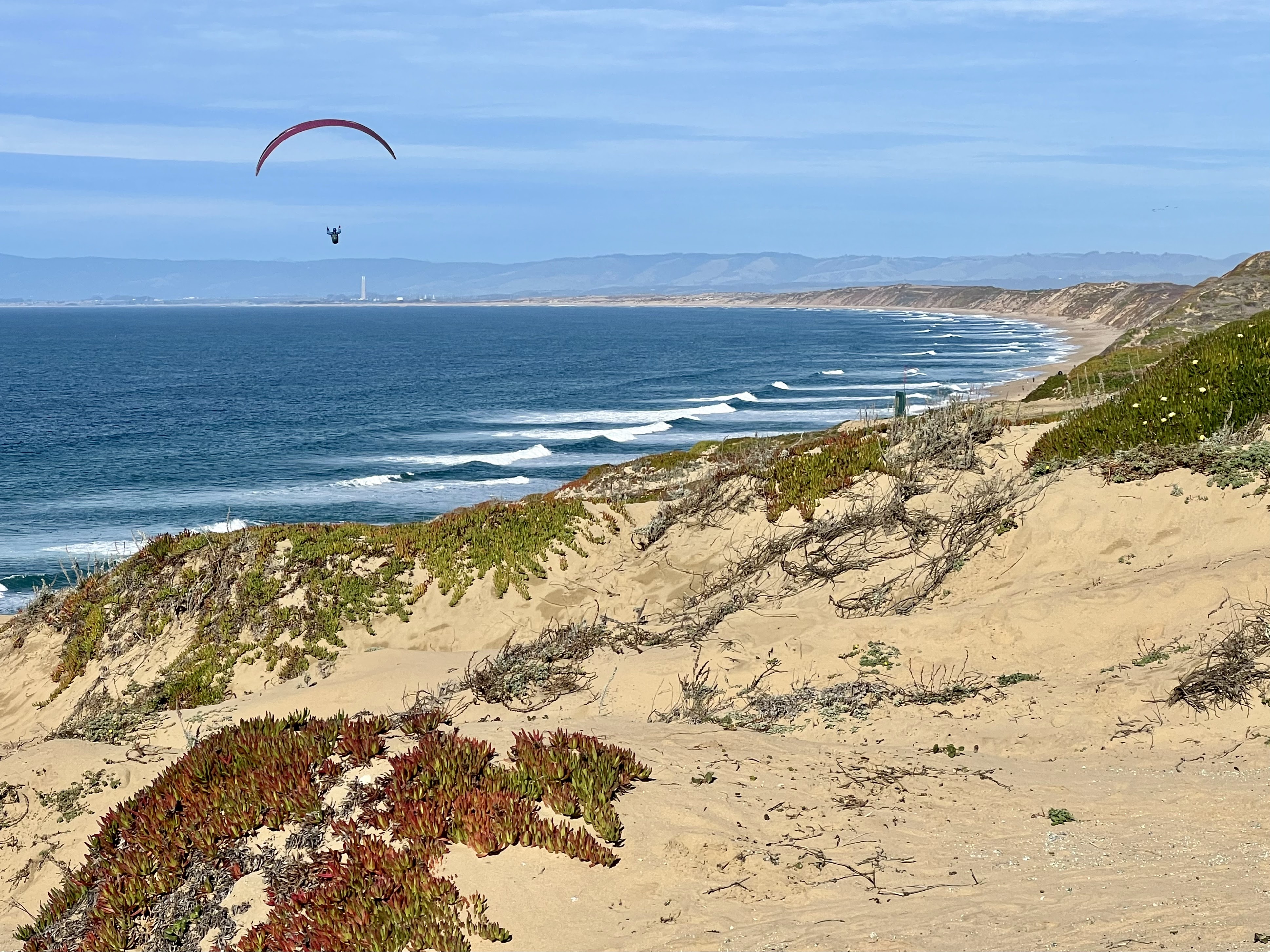
January 1, a walk along a short coastal bike path—our reason for being in the neighborhood being a geocache, but the views from the path of Monterey Bay are among the best.

Looking north toward Moss Landing


Natural sand sculpture along the path

Unnatural sand mover

The cache (the big duck)


On January 2 our walk took us behind a local business park, into a pine woods. We rarely encounter anyone there. But this day we encountered plenty of mushrooms, and we came home with a bounty that David transformed into dinner: blewits (Lepista nuda) on pork chops, with a side of braised chard. Yum!

Here he is with our catch. Note the
delicate lavender of the gills.

The lavender doesn't show up, but I love the
fragile gills.

There was also moss and lichen

The woods in question

Not only mushrooms: also toyon berries

Nascent honey mushrooms

Amanita muscaria without its spots

Suillus sp. (aka slippery jack)

And a couple of LBJs (little brown jobs)


 January 4 took us up to Jacks Peak County Park, via a back way that we enjoy; it's a climb, and it affords excellent views.

S-curve

Part of the path is through chaparral

Looking down on Monterey Harbor


It was a gorgeous sunset.


Continued on #87.


85 of 100: Afternoon walks

Just before New Year's, I started choosing our afternoon dogwalk spot for its variety of scene—because we have so many beautiful landscapes within a 15-minute drive, and I wanted to celebrate that diversity. And I documented our walks. So here, and perhaps extending for several posts (I'll get to 100 yet, ha ha), I'll post the photos that I originally posted on FB. I've had fun looking around.

December 27, Eucalyptus Road in Seaside: a road generally empty of cars because it doesn't go through to anywhere, on an edge of the former Fort Ord—chaparral, a dwarf oak woods. And currently, the water company is laying pipes. At the end of our walk we were treated to the conversations of several great horned owls. I took a video, but videos don't transfer here, sadly. It was a glorious sound. (The final image here is of two owls sitting side by side on a power pole. Mostly, though, they were in separate locations—in oak trees, on power poles—as they conversed.)

[I just realized that I already covered this first walk in #83. Oops! Well, I'll just leave it here too, because I like the contrasts between the three places covered here.]

I love the beat-up heavy machinery

A roadbed abstraction

There's plenty of concertina wire, this having been
a working army base for many years

The shrouded pipes awaiting burial


The two owls are at the bottom of the pole


December 28, Garzas Canyon: a favorite walk along a rushing creek

Turkey tail fungus

Garzas Creek


Ormsbee Lookout in the Santa Lucia Preserve


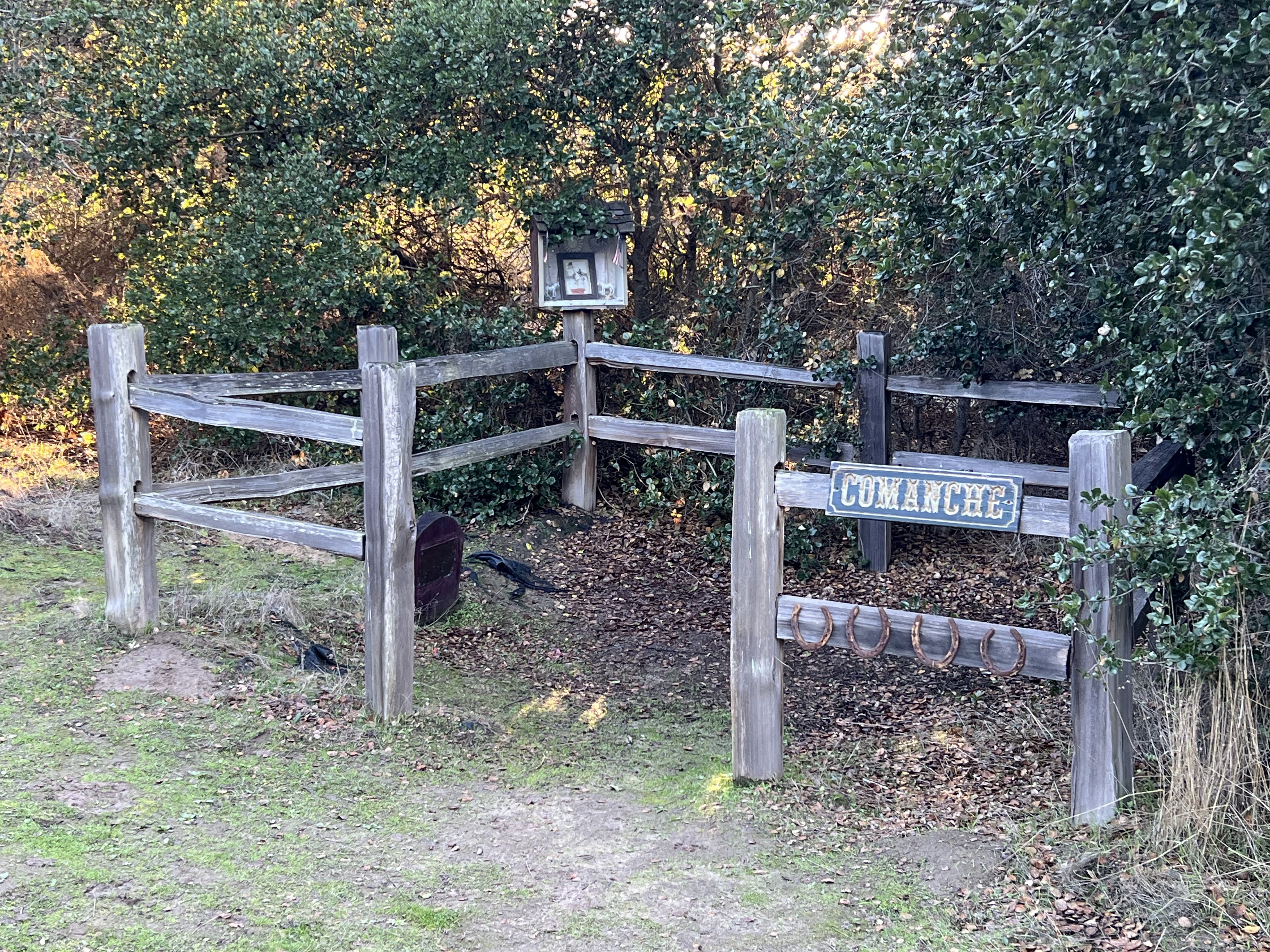
December 30, Fort Ord: a visit to Comanche, the old army base's last ceremonial war horse. The visit included a stampede of goats, here for the winter to digest some of the abundant vegetation, and I took a video, which I find amusing. You can see it on FB

A fuzzy screenshot, but I have to have the goats here!

Comanche's grave

We usually extend the walk through the oak woods

The mushrooms have started to pop

Continued on #86.

Wednesday, January 1, 2025

Book Report: Roman Stories

20. Jhumpa Lahiri, Roman Stories (2023) (12/31/24)

I finished this on New Year's Eve, the last of my books for 2024. I read it because it's assigned for a writing workshop I'll be participating in starting on Monday. It's a quiet book of short stories, originally written in Italian by Lahiri, who moved to Italy in 2012, and three years later stopped writing in English and devoted herself strictly to Italian. She translated many of these nine stories herself, though a couple were translated by her editor at Knopf, with fine-tuning by Lahiri. You may recognize her name from the Pulitzer Prize–winning Interpreter of Maladies (1999).

Each of the stories is, presumably, set in or around Rome (specific details would no doubt give a reader familiar with Rome a greater sense of this), and each explores the existence of someone who is somehow an outsider—whether to Rome or Italy proper, as Lahiri is, or to some aspect of the social life of the place. All together, the stories explore the challenge of straddling a boundary, and the meaning of home.

Most of the stories are understated, with a shallow plane of rising action, though the climax—the moment of self-discovery—is often profound enough to have stuck in my head. One story, "The Steps," gives us six different characters, all of whom live along or daily use a staircase linking two different neighborhoods in Rome. There's the mother, the widow, the expat wife, the girl, two brothers, and a screenwriter. Some of them grapple with a present-day difficulty, some remember back to earlier times. Near the end of the "Screenwriter" section, we find him thinking,

Tomorrow morning he'll take the train to join his second family [who've decamped to the seaside for August]. His wife will come pick him up at the station in their car and he'll be overjoyed to see her. At forty-two, she still looks like one of the girls worthy of sitting on the staircase in the evening. They'll take a walk along the shore, toward a tower on a promontory, and say hello to various friends (and maybe a few of his wife's ex-boyfriends) on the beach. And he'll think, with a certain melancholy, when he watches the water clamber up the shore, that every effort, and even every pleasure in life, every goal that's reached and achieved, every  recollection, lasts only for an instant, just like the water that throws itself onto the beach, leaving a spontaneous imprint whose wavering contours, like the line drawn by a heart monitor, are never quite the same.

This same quality of melancholy and of living more in memories or imaginings than in the moment shades many of the stories. They contain usually sobering epiphanies, where the characters shed some false hope or recognize some suppressed truth. The cover photo is appropriate, suggesting that although we all live together, we are at the same time separate from one another, that true connection may often be illusory, wishful. By the same token, however, we all somehow belong together in this sometimes confusing life, and connection can happen in the strangest and most satisfying ways. It's a lovely book.


Sunday, December 29, 2024

84 of 100: This year's books

As I mentioned the other day, this year I set a record for the smallest number of books read in a year, so this list will be short. Many of the titles are thriller/mysteries (*), because that's as much mental capacity as I've had lately, it seems. I've highlighted my favorites in red, but by far my most favorite book this year was Lonesome Dove.

1/6      Jo Nesbø, The Snowman*
1/11    Stanley Tucci, Taste (aborted)
1/20    Johann Hari, Stolen Focus: Why You Can't Pay Attention—and How to Think Deeply Again
2/4      Susan Orlean, The Library Book
2/17    Robert Galbraith, The Cuckoo's Calling*
3/3      Daniel Silve, The Kill Artist*
4/17    Percival Everett, Erasure
5/29    Mick Herron, The Secret Hours*
6/30    Robert Galbraith, The Silkworm*
7/7      S. A. Cosby, All the Sinners Bleed*
7/16    Oliver Hilmes, Berlin 1936: Fascism, Fear, and Triumph Set against Hilter's Olympic Games
7/24    Liz Moore, The God of the Woods*
8/3      Kaveh Akbar, Martyr!
8/19    Loren Long, The Yellow Bus (children)
9/8      David Heilbronner, Death Benefit: A Lawyer Uncovers a Twenty-Year Pattern of Seduction, Arson, and Murder*
10/6    Larry McMurtry, Lonesome Dove
10/27  Arnaldur Indriðason, Jar City*
12/27  Daniel Mason, North Woods
12/29  Claire Keegan, Foster
12/31  Jhumpa Lahiri, Roman Stories

Book Report: Foster

19. Claire Keegan, Foster (2010) (12/29/24)

Keegan has been variously recommended to me this year, in particular for this book and another, Small Things Like These, which has recently been made into a movie. She is also the author of a book of "stories of men and women," So Late in the Day, and—surprise! a book I already own (but, needless to say, haven't read yet), Antarctica. Her spare yet richly felt style has been widely praised: Hilary Mantel remarks in the back-of-the-jacket blurbs that "every line seems to be a lesson in the perfect deployment of both style and emotion," while the Irish Times comments that Foster "has beauty, harshness, menace, and the spine of steel worthy of high art."

At 92 loosely set pages, it's a quick read, though I found myself constantly slowing down to savor—a turn of phrase, a particular description, the subtlety with which Keegan suggests strong feeling. The story, told from the perspective of a young, nameless girl, is simple, beginning with her being dropped off by her father with some relatives, the Kinsellas, to spend the summer. But this is Ireland, sometime in the past, and there is an underlying current of disquiet: the girl's family has too many children to support well, the father is a drinker; the Kinsellas have suffered a tragic loss, which is clear to the reader from early on but comes as a world-changing revelation for the girl. Small-town tongues wag indiscriminately. It's a world both beautiful, as evoked through such homely chores as cow tending and rhubarb jam making, and hard. But in this temporary home the girl also discovers a different, more hopeful sort of love than she had ever experienced.

Here is a scene from early on, just after the girl has arrived:

     'Hands up,' she says, and takes my dress off.
     She tests the water and I step in, trusting her, but this water is too hot.
     'Get in,' she says.
     'It's too hot.'
     'You'll get used to it.'
     I put one foot through the steam and feel again the same, hot scald. I keep my foot in the water, and then, when I think I can't stand it any longer, my thinking changes, and I can. This water is deeper and hotter than any I have ever bathed in. Our mother bathes us in what little she can, and sometimes makes us share. After a while, I lie back and through the steam watch the woman as she scrubs my feet. The dirt under my nails she prises out with tweezers. She squeezes shampoo from a plastic bottle, lathers my hair and rinses the lather off. Then she makes me stand and soaps me all over with a cloth. Her hands are like my mother's hands but there is something else in them too, something I have never felt before and have no name for. I feel at such a loss for words but this is a new place, and new words are needed.

There are many other quiet moments of realization like this, other moments of strong feeling. The narrator has clear eyes, and we come to feel we're viewing the world through them too.

It's a lovely book. 


Friday, December 27, 2024

83 of 100: An afternoon walk

Just some photos I took this afternoon on a walk in a bit of the former Fort Ord, an army base active from 1917 to 1994. The highlight of the stroll was hearing great horned owls converse as the light started to fade. I took a video, but I don't believe it will transfer here. The last picture in this array shows two owls sitting together on a power pole. They're just dots, but I know they're there.

The image quality is poor: it's an iPhone. If I shot in RAW and fooled around with the images, they'd be better, but I don't want to fill my phone storage.  I know the iPhone camera has improved (I have a 13; the 16 is supposed to be very decent), but really, I would like to get back to using a real camera. I recently bought a small fixed-lens job that I have yet to start getting to know. So... that's one of my resolutions for the coming year: return to real photography. At least occasionally. Once a month, pack up my gear and head out to see what I see? It sounds possible. And, more important, enjoyable.

There's lots of construction going on hereabouts,
and I always enjoy checking out the heavy machinery.

A fencepost and barbed wire abstraction

A road pavement abstraction

An abstraction from that above piece of heavy machinery

Shrouded pipes waiting for burial

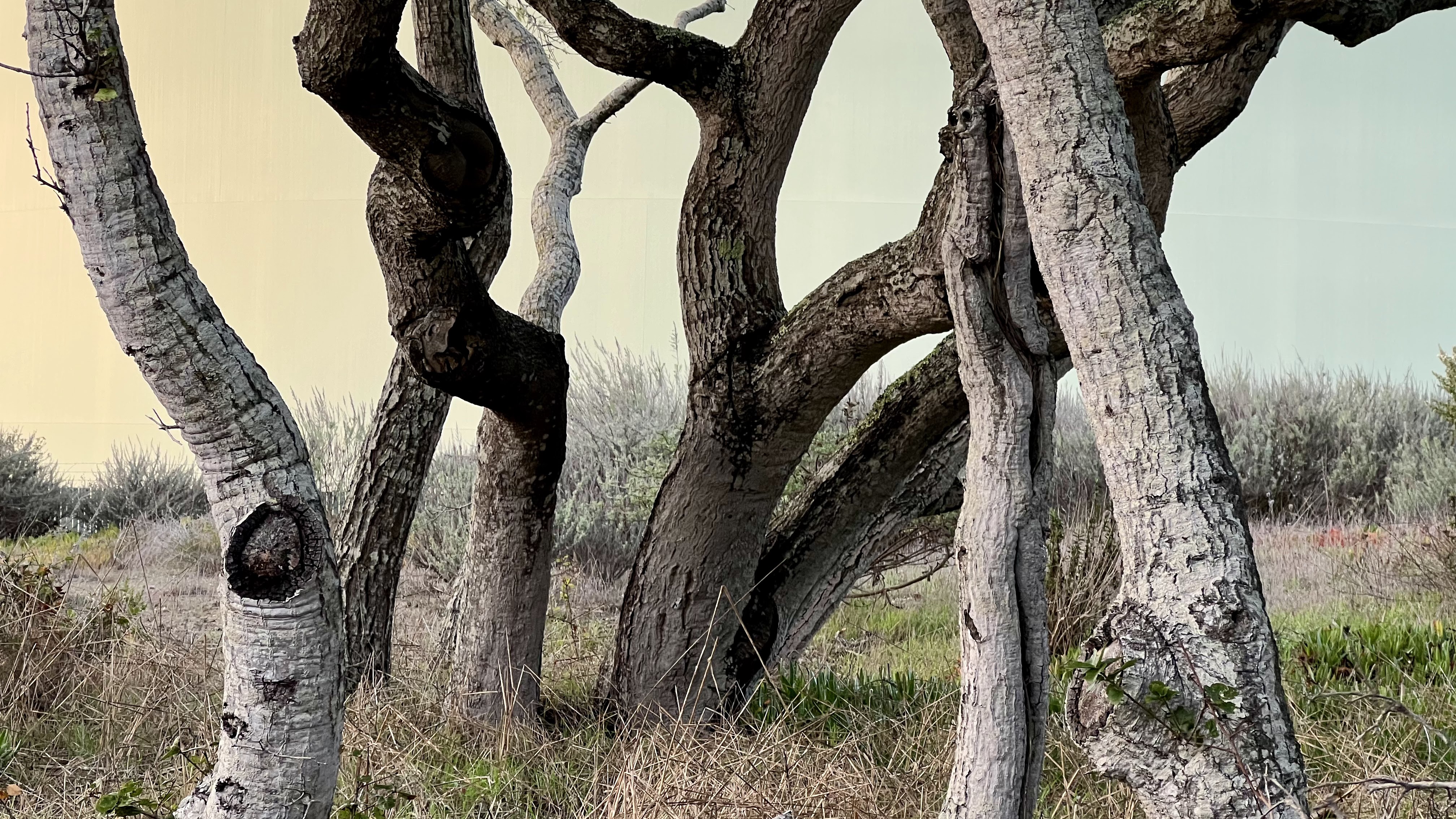
Oaks backed by a water tower

The water tower: beautiful pastels

The home stretch back to the car

See the owls at the bottom of the left-hand pole?


Book Report: North Woods

18. Daniel Mason, North Woods (2023) (12/27/2024)

I have barely been reading lately. Only eighteen books this year, and the last one finished, a schlocky mystery, was back in October! That must be a record. And not one I wish to break, so next year I'd like to get back to reading, make the time, even if that means stealing an hour from my evening TV-bingeing. 

This book did take me a little while, partly, perhaps, because it's a disparate hodgepodge of stories and styles, ranging in time from the Puritan days up to—and beyond—the present day, and encompassing, along with straight narrative, diary entries, a speech, ballads, clinical case notes, a True Crime! magazine article, even home movies. The one thing that stays constant is the place: a homestead in western Massachusetts. It's time alone that keeps things changing, and Mason uses the device with great skill. Even the language evolves as we progress through the centuries, and the plants and trees change, and the original yellow house itself grows in size, eventually crumbles, is reconstructed, finally burns down. It's a story of natural succession. Each part captivated me, and it was fascinating to see how earlier events reappear (often in the form of ghosts). But because it's not strictly plot-driven, it was easy for me to put it aside.

It's impossible to summarize this book. The New York Times has a review that does it more justice than I can, but I will echo its observation that what makes this book succeed so well is the way it toggles between the macro and the micro, in a way making all of it—all this life—at once glorious and trivial, celebrating the sometimes painful exhilaration of being alive while never losing sight of the cosmic indifference that underscores the natural (and human) condition.

Here's a paragraph from early on, sometime in the late 1700s, about a young woman living in what came to be known as the yellow house and a potter she takes a fancy to (though their romance is thwarted by a jealous twin sister):

She was carrying a shopping basket. Despite his crutches, he offered to hold it for her, and when she was done with her purchases, asked her if he might walk her to the edge of town. He’d been a drummer before the accident, and as they walked, he tapped out a string of paradiddles, ruffs, flams, and charge strokes. He spoke of the ways the cannonballs came hissing down the field of battle, the sergeant saved when a British cutlass was embedded in a turnip he had stolen and hidden in his hat, and how he’d seen Howe at Bunker Hill but missed his shot. He’d lost his foot when a gun belonging to a baker from Cambridge went off at half-cock during training exercises. He said that he was lucky, given his profession, that he hadn’t lost a hand. Then he told her about salt glazing. 

And by contrast, here's a paragraph describing a twenty-first-century show of works—forest landscapes—by a nineteenth-century painter (author of the diary mentioned above) who had also lived in the yellow house. The "she" here is Nora, a young botanist:

Eight rooms were mounted to show the works. Her role had been to identify the species when possible, and to provide commentary form an ecologist's perspective, alongside a discussion of Native plant use by two Mohican descendants who'd been brought there from their reservation in Wisconsin. And so she had described the way the level of lichen on the trees gave evidence of snowpack, the exactitude with which Teale had distinguished ferns that lost their leaves in winter and those that didn't, the different holes drilled by the different woodpeckers, the clustered sapling oaks that suggested a forgotten squirrel cache. But what struck her most was the vision of a forest she had previously only imagined. How extraordinary it was to look at a grove of massive beeches unblemished by beech scale, hemlock unmenaced by the adelgid, ash before the borer, elms before Dutch elm disease, chestnuts before the blight. At the end of the exhibit was a virtual-reality installation, produced in cooperation with a team from MIT, in which visitors could don headsets and step into a digital re-creation of Teale's Creek and Chestnuts. When she first placed the glasses on her head, she found herself within a world she'd known only in data tables. She'd seen many photographs of chestnut trees, but she had never stood beneath one and looked up.
     The headsets were so loud that she had to turn the volume down. But this is what it would have sounded like, the wall text told her. Between 1970 and 2019 alone, nearly a third of all birds had disappeared from North America. Once, the forest would have been deafening. In the recording they had layered the songs of hundreds of birds, not only those she knew, but others now displaced to distant forests—blackpoll warblers, Bicknell's thrushes—or lost forever, like the passenger pigeons whose melodies were re-created from musical notations that had been set down before they went extinct.
     And it was then, looking up at the canopy, feeling the birdsong in her spine, that it had all come crashing down.
     She felt as if she had fallen in love with someone only to learn that they were dying....

And to think, in his day job Mason is an assistant professor of psychiatry at Stanford. He's published four other books, which I may have to seek out.

But now, what's next? Let's see if I can finish one last book before 2025 rolls in. (Or, two? For an even 20?)