Every so often I search Flickr for a day in my life, to see photos I've posted on a particular day of the year. February 14 turns me up four photos, from 2008, 2009, 2010, and 2011 respectively. I feel a little chagrined that my participation in Flickr has fallen to almost zero. It's a great space for sharing, and archiving, photographs. Maybe I should make a point of showing up there more often?
Paris Bakery, downtown Monterey
An edit of a book on French wines
One of a mob of cedar waxwings that showed up on our pyrocanthus to feast away!
A lone sparrow on our soon-to-be-no-more ash tree
But seeing as how February 14 is St. Valentine's Day, here are a few pictures of my Valentine of going on 42 years. My co-adventurer. My partner in life. My rock. My love. David Ralph Canright.
Having just finished a mud run
Pondering life on the steps of the Lincoln Memorial
Testing some sort of scientific phenomenon at the Maryland Science Center, Bal'more
A sushi restaurant with interesting lighting
Best buds forever!
We like mushrooms
Making friends with trolls
In the high Sierra
Best buds FOREVER!
1983-ish? In El Cerrito, our first home. (Or should I say, Who is that dreamboat?)
Out geocaching
!
In Xinjiang Province, getting ready for a total eclipse
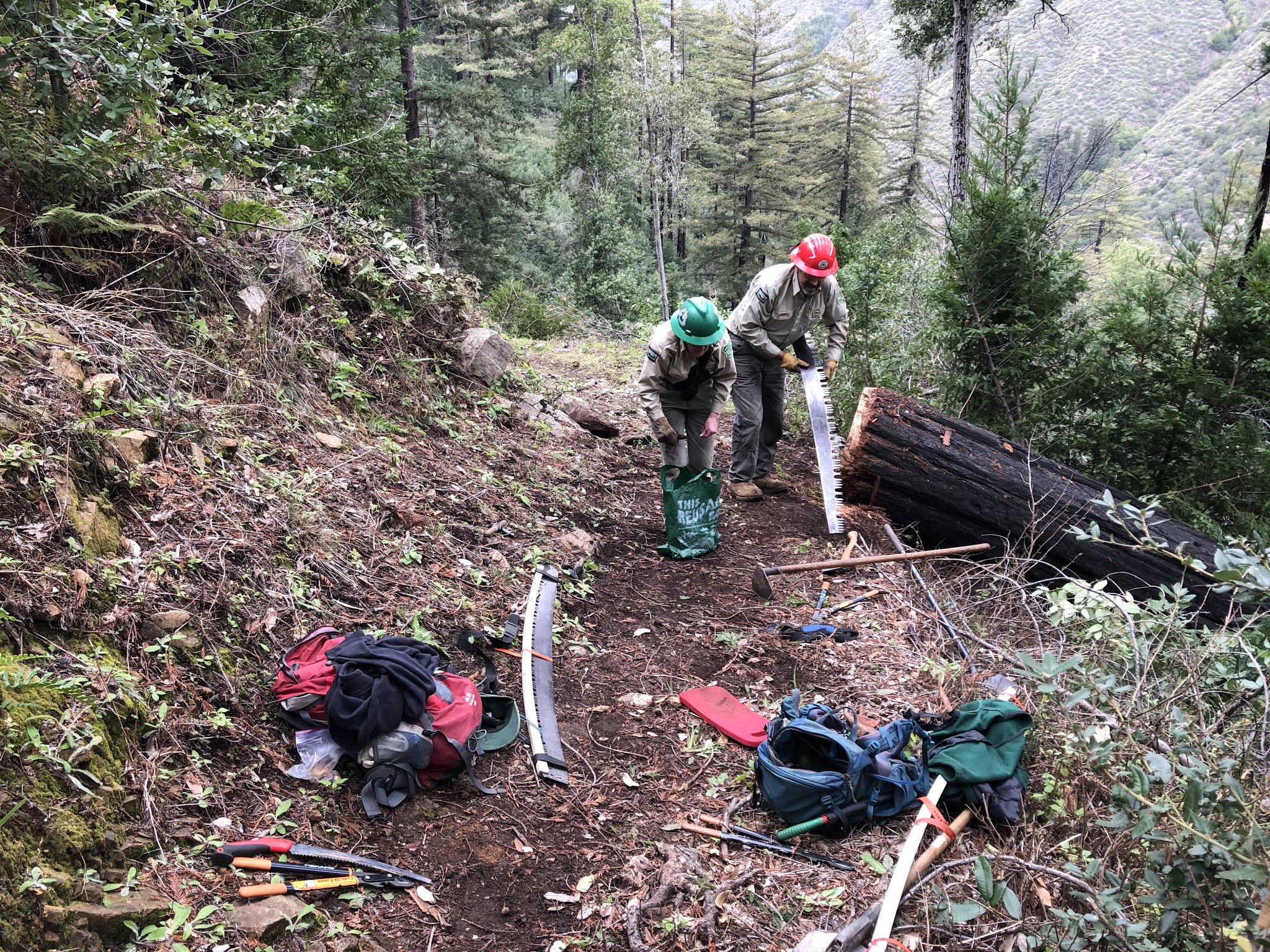
Yesterday I went out with three other wilderness rangers, Lynn, Steve, and Beth, to clear some trees from the first two miles of the Pine Ridge Trail, which heads east out of Pfeiffer–Big Sur State Park into the heart of the Ventana Wilderness. I knew we dealt with three trees, because we had to get out our big guns—or rather, saws: 6-foot Al and 5-foot Boss—and stop and strategize. But apparently we cleared the trail of seven trees in all while I wasn't paying attention. I'm glad somebody (Lynn) was.
Here are some pictures I took of the largest tree we wrestled out of the trail, a redwood burnt in the 2016 Soberanes Fire. I wasn't documenting our work per se, but the photos give an idea of what we do. It's fun!
The obstacle: 3 feet in diameter
First task: get rid of extraneous branches
Steve carving away bark on the lower (second) cut: bark is hard on the saw
Lynn and Steve and Al tackling the first cut, up the hill
The
second cut was a bear: difficult to get comfortably positioned,
especially on the near side. But finally, we were through, the cut piece
dropped—and the saw got pinned. But no worries: hammering on a wedge
in the cut should free it—and boy, did it! The log started rolling,
down the hill, onto the trail, and right on over the edge. Lynn, who was
standing down the trail, had to run out of its way (she was a ways
down, so there was no danger— but none of us were expecting the log to
move as quickly and decisively as it did). It was something to see— and
hear. Job well done!
And now just time for cleanup. What a satisfying log clearing operation!
8. Jess Walter, Over Tumbled Graves (2001) (2/9/21)
I don't even know what made me think of Jess Walter when I was searching for a new, preferably page-turner book the other day. I remember really enjoying his The Financial Lives of Poets (2009) and Beautiful Ruins (2012). I couldn't begin, now, to tell you what the first was about, but I remember the basic plot and mood (ebullient?) of the second. His range is broad and eclectic. And for some reason (maybe the fact that he has a brand-new book out?), Over Tumbled Graves wiggled into my mind the other day, and I happened to know on just which shelf it resided.
This, Walter's first novel (of seven), is a mystery-thriller, but it's also very much about the place it's set in—Spokane, Washington, Walter's hometown—and the relationships of people depicted in it. So it's not just about (a) murder, (b) police investigation, (c) murder solved. It's more than that. With a twist at the end that I expected but was not at all disappointed to see. It wasn't one of those out-of-left-field twists; it felt organic to the whole.
The basic plot involves the search for a killer, which quickly overlaps with the discovery of one, then two, and ultimately five murdered prostitutes, several of them laid out along a riverbank as if to gather attention—of the FBI variety. There are a couple of detectives, good at what they do, who have an unrequited thing for each other. There are a couple of FBI profilers who despise each other. The killer at the start is observed and followed, but although he remains elusive to the cops, we readers get to know him a little, and to sympathize with him. And through all of this, the neighborhoods and shady areas and river of Spokane draw us along.
I did not flag any passages, but I did make a mental note of page 303, and this is what's there. It's from the POV of Detective Alan Dupree, a worn-out homicide detective who's pushing 50 and being superseded by a young, unimaginative guy with up-to-date, high-tech training.
The tired houses and dead lawns at the base of the South Hill reminded him of an old theory. The theory of yard relativity. He believed you could tell a criminal by the amount of yardwork he did. He'd first come up with the theory in neighborhoods like this one, responding to a thousand fights and drug deals and domestics, and after a time it dawned on him that he was almost never called to houses with well-kept yards. This wasn't an economic or racial thing. It was a pure yardwork thing, the basic theory being that criminals don't have the patience for yardwork. That's what crime is, he believed—a lack of patience. Want to get rich quick? Get laid without all the work? Want to get rid of your business partner without the trouble of suing him or paying him off? That's the difference between criminals and real people. Patience.
Walter is a great observer—of detail, but also of character and desire and where a person stands on the sliding spectrum from earnestness to wiseassery, energy to exhaustion, engagement to desperation. The people in his books always seem very real to me. I admire that in any writer, and I admire Walter for pushing the envelope and trying out new situations, characters, and motivations.
The other evening I cooked a rather bizarre dish involving shredded chicken, green peppers, dill pickles, capers, green olives, tomatoes, golden raisins, a Scotch bonnet, ketchup, and tomato paste (some recipes include eggs and/or cashews)—which combination is interesting enough on its own, but what was really different was the fact that the entire mélange is baked within a shell of thinly sliced Edam cheese. It's called Keshi Yena, and it is known as the national dish of Aruba (formerly part of Netherlands Antilles). Traditionally, the meat mixture (which might be ground beef instead of or in addition to chicken) would be baked or steamed within the rind of an empty 2-kilo wheel of Edam cheese, topped with more grated or sliced cheese, but since wheels of used-up Edam are hard to come by, layered slices do the trick.
It may have been bizarre, but it sure was tasty.
Me, I like cooking from recipes, and the more involved or exotic, the better. So Keshi Yena was just the ticket. Nothing like anything I would ever just throw together. Despite the fact that it is, essentially, a little bit of everything, thrown together. I also like researching international recipes, dishes that use interesting spices or combinations of ingredients. I have had it in mind, for example, to do a "project" of savory pastries from around the world: empanadas, pirogi and piirakka, Cornish pasties and scones, hortopita and bučnica, huzzah!
So I'm thinking of adding a thread to this blog, of dishes from around the world that I grapple with myself. And if I end up going nowhere with this idea, at least I have now saluted Aruba, Curaçao, Bonaire, and Sint Willem for their endemic and delicious cheesy chicken dish.
7. Maria Konnikova, The Biggest Bluff: How I Learned to Pay Attention, Master Myself, and Win (2020) (2/5/21)
This is, in part, a book about poker—specifically, No Limit Texas Hold'em—not a game I play, but one that I find interesting for its blend of chance and skill. Which is exactly what Konnikova writes about, and about how, over the course of a year-plus, she set about becoming a tournament poker champion. Konnikova is trained as a psychologist, and she's a journalist (she is the author of two books, Mastermind: How to Think Like Sherlock Holmes and The Confidence Game, about the art of the con, and she used to write regularly for the New Yorker about these sorts of topics), with a journalist's nose for sources and stories.
In the second chapter of the book she introduces us to poker world master Erik Seidel, a delightful, understated man who becomes her mentor as she progresses from someone who doesn't know the difference between poker and blackjack to winning the 2018 PokerStars Caribbean Adventure (PCA) championship. Over the course of the book she speaks with many other people, players and academics alike, who offer insights into the game and into human psychology: how we learn, how we approach situations of chance and luck, how we monitor our feelings, how we read other people's behavior, how we adjust our beliefs and understandings of the world in the face of experience, or simply (or not so simply) how to strategize a poker hand.
In this TED Talk, Konnikova describes poker as a sort of metaphor for life, harking back to the founder of Game Theory, John von Neumann:
Last June she published an article about this yearlong experience, which, truth be told, probably would have satisfied me. Or listening to this Freakonomics podcast. But I had started the book before I learned about these other sources, and I wasn't about to quit, having already invested the time. The book was somewhat confusing in places—especially when poker jargon was invoked (there is a lot of it), but also when she'd mention some concept or person in passing that hadn't yet been covered. There was a tad too much sitting at tables with a motley array of characters—from "fish" to "whales" to "sharks"—as poker hands were played out (and described card by card). It was interesting enough to read about various psychological theories about how we approach uncertainty or apply skill, as well as about various fallacies, biases, and syndromes—the planning, sunk cost, and ludic fallacies, for example, or the beaten dog and impostor syndromes, or the status quo bias—but in the end they only sort of apply to the game of poker—or, for that matter, to life—depending on who you are and who you happen to be playing with, and how recently you had a good meal or how much sleep you got the night before.
In speaking of her experience traveling around the world playing tournaments, Konnikova writes (in this case about Las Vegas, fairly early in her apprenticeship):
Each venue offers a slightly different experience, and with each hand, I start seeing more and more of the patterns I've been learning about play out in real life. It's not all the aggressive shark tactics of the Nugget. There are the passive players, the conservative players, the active players, the loose players. There are the ones who like to drink. There are the ones who like to play and never fold. There are the ones who are vacationing and here to have fun, the ones who take it seriously and are here to win, the ones who are here to take advantage of others, and the ones who simply want to make a few friends at the table. There are the talkers, the stalkers, the bullies, the friendlies. With each game, each bust-out, each hand, I take it all in and write it all down. How do I adjust? How do I make myself known? How do I present myself so that I can finally go from losing to winning? I enter a sixty-dollar daily tournament at Bally's [ . . . ] It's small, only two tables' worth of players, but I feel a certain pride in watching the numbers dwindle to a single table, then eight, seven, six. . . . I'm in the final four. And it's hard for me to contain my excitement when I find myself with a flopped set of nines. There's a bet before me, and I joyously shove all my chips into the middle. This is it. All my learning is paying off. I will finally have my first tournament cash. I get called by a flush draw, the flush hits, and I'm out. I'm devastated.
I found myself pushing through to the end (taking breaks with a nifty little Texas Hold'em app for my phone). I'm not sorry I read it, not at all—but now I am ready for a page-turner.
Today's Facebook feed brought me this delightful photo, by Alex Shkolnik, of five
little egrets (Egretta garzetta), a black-crowned night heron
(Nycticorax nycticorax), and a purple heron (Ardea purpurea), at a fish
pond in northern Israel. Poised for a quick snack.
The comments included a debate over the Egretta species, one person insisting that "here" we call them snowy egrets. Turns out, the heron world is larger than that commenter knows, because: those are little egrets, not snowies. They look similar, but they are different species. (Snowy egrets are E. thula.)The identifying mark, besides size—littles are a little bigger than snowies—is their "lore": the patch of skin separating beak and eye. Snowies' are orange, red, or bright yellow, depending on the breeding season, while littles' are green, dull yellow, or gray. Easy!
But all that got me wondering how many types of herons there are overall. Turns out, 64—and these include herons, egrets, and bitterns. They are in the family Ardeidae, with three subfamilies.
According to Wikipedia, "Although herons resemble birds in some other families, such as the storks, ibises, spoonbills, and cranes, they differ from these in flying with their necks retracted, not outstretched. They are also one of the bird groups that have powder down. Some members of this group nest colonially in trees, while others, notably the bitterns, use reed beds. A group of them is called a 'siege.'"
One heron that formerly made up its own lonely monotypic family, but now has been rudely shoved into the large and diverse Ardeidae, like it or not, is the boat-billed heron (Cochlearius cochlearius), found in mangrove swamps of Mexico south to Peru and Brazil.
The two (out of 18) main genera within the Ardeidae family are Ardea and Egretta: the herons and egrets, making up a third or so of the total species. There are also whistling, capped, pond, green-backed, night, and tiger herons, not to mention the bitterns. Here are some exemplars. They are beautiful birds.
Green heron, Butorides virescens. Photo by Barbara Houston
The largest heron, Ardea goliath, lives in sub-Saharan Africa. It stands 4 to 5 feet tall, with a wingspan of 6 to 7.5 feet, and weighs 9 to 11 pounds. Photo by Guy Poisson.
One of the smallest herons is the least bittern (Ixobrychus exilis), 11 to 14 inches in length and weighing a mere 2 to 3 ounces. Photo by Jim McCormac.
Bare-throated tiger heron (Tigrisoma mexicanum), found from Mexico to northern Colombia. Photo by Linda Murdock.
Capped heron (Pilherodius pileatus), inhabiting rainforest from central Panama to southern Brazil. Photo by Andreas Trepte
Great egrets (Ardea alba). Photo by Fraida Gutovich
And finally, here is a black heron (Egretta ardesiaca) using its "wing umbrella" to hunt, at Rondebult Bird Sanctuary, Johannesburg, South Africa:
You may have noticed that the "black heron" is an Egretta, while the "great egret" is an Ardea. The common names are a bit like the difference between prawns and shrimps*: that is, common usage. "Egrets" are, basically, white herons, while "herons" are anything else. Unless they're a bittern. But let's not complicate matters.
Where I live, we have great egrets, great blue herons, green herons, snowy egrets, cattle egrets, black-crowned night herons, and American bitterns. And maybe others as well, though I haven't seen them. The great egrets and great blue herons nest in trees near Elkhorn Slough and Pt. Lobos. It's always fun to watch them squabble and carry on, up there on high.
*For the record, prawns are large, shrimps are small—in common usage.
But scientifically, shrimps brood eggs, whereas prawns release them into
the water--and then there are various anatomical differences. The Monterey Bay spot
prawns that I love to eat? Shrimps.
This morning on FB (that seems to be my usual refrain anymore for launching these posts) the poet Kim Stafford posted a beautiful photo of a feather, with the following comment: "I remember seeing the raptor's nest high in an old pine, and on a hunch walking downwind . . . and there was the feather at my feet."
Someone commented that the photo reminded her of Mary Randlett's (1924-2019) work, so of course I had to go check her out, because I find this feather exquisite.
She did indeed do lovely work. Here is a sampling of some of her Pacific Northwest landscapes, though she is also known for photographs of architecture, public art, and Northwest artists and writers, working eventually for the University of Washington Press. (Click to see them large.)
Above Paradise, Mt. Rainier, 1992
I find her work rather reminiscent of one of my favorite photographers, Michael Kenna. Beautiful images. I'm glad to have encountered her.