Saturday, February 19, 2022

Geocaching souvenirs

If you've followed me at all, you will know that I enjoy geocaching as a pastime. Well, today we were at it again: just the two of us, plus Milo the geodog, in Mt. Madonna Park, Santa Cruz County, on a nice loop trail that took us among redwoods, tan oaks, and eucalypts. We found 13 caches on our hike, plus 9 on our drive in and out of the park, for 22 in all (plus 3 DNFs...). Here are a few photos from the day:


An old pumphouse

I can't help it, I like graffiti

An astonishing number of cars were on
this dirt road, which we had to take back
to ours: we suspected that an event had
just let out—until we saw that huge line
of cars driving around in confusion up above
and finally turning down an adjacent road,
at which point we decided they were just lost
getting to wherever they were going...
But the dust they kicked up made for
a pretty sight.


But what I came here today to write about is geocaching "souvenirs." Because Geocaching HQ likes to dream up challenges—be it finding a cache at the end or start of a year; celebration of May 3, 2000, the day the "Blue Switch" was flipped and the first cache was planted; various nation days; geocaching milestones such as 3 million active hides; special dates like 10/10/10 or, coming right up, 2/22/22; International Geocaching or EarthCache Day; the annual GIFF (Geocaching International Film Festival); Pi Day. You get the picture: pretty much anything can serve as an excuse for a souvenir.

And the reason I bring this up is that today's outing finished off the latest series of souvenirs, called Reach the Peak: collecting points that equal or surpass the heights in meters of the world's highest mountains. Because today we climbed Mt. Everest! Yes, indeed. And it was a breeze! We started this quest in August with Puncak Jaya in Indonesia (representing Oceania), then successively, month by month, worked our way up Mt. Vinson (Antarctica), Mt. Elbrus (Europe), Kilimanjaro (Africa), Denali (North America), Aconcagua (South America), and finally, today, Everest (Asia). Huzzah! Here is the final bonus souvenir, for completing all seven, plus a base camp and a summit souvenir. So many—15 in all. And they are quite attractive, I must say. Kudos to the artist.


And no, don't worry, I don't put any stock in these "souvenirs." They are silly. And yet, they do often get us out caching. So those geniuses at HQ aren't earning their big fat paychecks for nothing. 

A few other series we've completed have, despite being pretty much totally arbitrary, been fun, simply because of the anticipation of collecting the souvenirs, which translates to a job well done. For example, the Natural, Ancient, Modern, and Solar System Wonders of the World, seven wonders each:

The final-final souvenirs being, WORLD and ULTIMATE EXPLORER! Yes! Of course we are!

Last year we had The Science of Discovery—rocket science, environmental science, futurology, and geology:

There may have other sciences celebrated, but those four souvenirs are all we got.

The "challenge" of these last ones was simply to find a cache of a particular designation, as randomly assigned by HQ. But I imagine HQ also hoped we would read the descriptions as we collected our milestones and ultimate prizes. Learn a little something?

Back in August 2013 they had a month-long series, 31 Days of Geocaching—as in 31 consecutive days. Of course we got them all. It was a challenge—not in the sense of being difficult, more in the sense of "be there or be square." Maybe we do take these silly souvenirs a little too seriously...


My favorite souvenirs to collect are, arguably, the geographic ones: the states of the US and the countries of the world. So far, I've got CA, AZ, NM, NY, NC, MN, WI, HI, WA, VT, MA, OR, AK, MD, DC, VA, PA, WV, and DE. Nineteen. I've got a few more to go. And as far as the world is concerned, I've got hundreds to go, but so far under my belt: USA, UK, Norway, New Zealand, Israel, Italy, Vietnam, France, Chile, and Antarctica. 

All together, I've amassed 181 souvenirs. I wonder what those wacky kids at HQ will dream up next?

Update 2/22: Make that 182!


Wednesday, February 16, 2022

Book Report: A Gentleman in Moscow

4. Amor Towles, A Gentleman in Moscow (2016) (2/15/22) (BB#3)

The other day I met my friend Barb for lunch and a walk, and we, as always, talked books. She mentioned this one, said she loved it. I knew I owned it. (Turns out, I owned it twice over: in paperback and in hardback.) When I got home, I sought it out. And dived in.

The pundits on the back cover call it transfixing, irresistible, delightful, beautiful, joyful. It is all those things. I totally enjoyed this book: gobbled it up in a few days. 

It's the story, tout court, of a Russian aristocrat hauled before a Soviet tribunal in 1922 at age thirty-three and sentenced to eternal house arrest: in the luxurious Metropol Hotel in downtown Moscow. He'd already been living there for four years, but now he is consigned to the garret—a hundred square feet (which he soon doubles, by accessing the next room over through his closet). 

Over the next thirty-plus years, he makes many friends—the hotel chef, the maitre d', the concierge, a nine-year-old girl who grows up to become a comrade, a seamstress, another small child whom he fathers, a Party monitor. We learn about his life before, about his homeland of Nizhny Novgorod, land of apple trees, and his sister and his old apartment mate. In the end, his life is as rich as any could be, regardless of the circumstances.

Towles is a wonderful writer, both technically (his language!) and in terms of imagination. 

I did feel a bit hermetically sealed into the hotel (our hero, Count Alexander Rostov, is not allowed, on pain of death, to set foot outside—though at one point, or maybe two, he does leave, to our great relief). We hear nothing about the atrocities committed by Stalin, or about WWII (though the story ends in 1954). But nevertheless, the joy of this book is seeing all the life that can happen without the possibility, or even necessity, of escape from a confined space. 

Towles himself says he wants to "gather together a pile of brightly colored shards of glass" and swirl them into a kaleidoscopic view. He does this well. The historical import of place and time may be somewhat elusive, but the life he conveys is lovely.

I flagged many passages, and may transcribe one or two later on. For now, I just want to count this big book (not quite 500 pages, but close enough) done. Huzzah!

Here is an interesting interview with the author.


Monday, February 7, 2022

Ōtagaki Rengetsu, potter and poet

In The Book of Form and Emptiness by Ruth Ozeki, there is occasionally a chapter of a fictitious book called Tidy Magic by a female Zen monk. At one point she tells about her master's favorite teacup, "an antique cup, very old and very beautiful, with a poem inscribed on it," which she accidentally drops. His only calm comment is, "Already broken"—though in fact, the cup is fine. When she asks why he said it was already broken, 

he held up his cup and admired it. "It's quite old, you know. Maybe two hundred years. It was made by Rengetsu. Do you know who Rengetsu was? She was a great beauty, but she had a very sad life. She was an illegitimate child and was given away for adoption when she was just an infant. Later, she married twice, but both husbands and all of her five children died, and so she shaved her head and became a Buddhist nun. She was poor but creative, and so she started making pottery and writing poems on her cups and bowls. They became very popular, and she made a lot of money, but she gave it all away to the poor."
     I listened to him impatiently. He often did this. Went off on some tangent and forgot about my question, but this time I was determined to get an answer. He was reading the nun's poem on the side of the cup.
     "The world's dust, swept aside here in my hermitage. I have all I need, the wind in the pines—"
     "But Hojo-san! The teacup isn't broken!"
     He looked up, surprised. "To me, it is," he said. "It is the nature of a teacup to be broken. That is why it is so beautiful now, and why I appreciate it when I can still drink from it." He looked at it fondly, took a last sip, and then placed the empty cup carefully back on the tray. "When it is gone, it is gone."
     That day, my teacher gave me a priceless lesson in the impermanence of form, and the empty nature of all things.

Years later, the cup does break: during the magnitude-9 earthquake that hits Japan on March 11, 2011, causing such destruction and loss. 

The earthquake shook us awake, and the tsunami washed away our delusions. It caused us to question our values and our attachment to material possessions. When everything I think of as mine—my belongings, my family, my life—can be swept away in an instant, I have to ask myself, What is real? The wave reminded us that impermanence is real. This is waking up to our true nature.
     Already broken.
     Knowing this, we can appreciate each thing as it is, and love each other as we are—completely, unconditionally, without expectation or disappointment. Life is even more beautiful this way, don't you think?
     Much later, I found a traditional craftsman who could repair that Rengetsu teacup with gold and lacquer to hold the pieces together. Now, in the cracks, there are delicate seams of gold, which honor the cup's brokenness. To my eyes, it is lovelier now than ever.

I wrote about this sort of repair, known as kintsugi, here. It's a beautiful practice.

And I was, of course, curious as to whether Rengetsu was a real person. Why, yes! Not only was she a waka poet and a potter, specializing in tea and sake vessels, but she was a master of martial arts (her adoptive family were well known as trainers of ninja), dance, sewing, and the tea ceremony. She lived from 1791 to 1875, in Kyoto.

Here are a few of her creations, and you can find more, some with translations of the poems written on them, here and here. (Click on the images to see them larger.)


Book Report: The Book of Form and Emptiness

3. Ruth Ozeki, The Book of Form and Emptiness (2021) (2/6/22) (BB#2)

Ruth Ozeki was ordained a Zen priest in 2010, and the two books she has written since then, A Tale for the Time Being (2013) and this one, certainly embody that philosophical tradition, in a most pleasing way: you come away feeling a bit wiser, more empathetic, looser and yet more grounded. 

The story here does involve a book, and a fourteen-year-old boy, Benny, who hears objects (like books, but also like shoes and windows and scissors) talk—though in this case, there is a special Book that is his story, which spins out as his life proceeds apace, and he converses with it. 

And his life is complicated. He recently lost his father, a Japanese jazz clarinettist, in a dumb accident. His mother, Annabelle, comfort-eats and has piled all manner of garbage all over their small duplex (ostensibly for work—she follows breaking news stories and must archive the materials, but still: she has a problem getting rid of stuff). When he starts hearing voices—everywhere—he is committed for a time to a Pediatric Psychology ward, where he meets eighteen-year-old Alice, aka the Aleph (a nod to Jorge Luis Borges's famous story). At Pedipsy (pe-DIP-sy), he learns some coping mechanisms, and is sent back home. But normal life eludes him. Instead of going to school, he goes to the main library (modeled on Vancouver's) and reads about medieval armor and fairy tales—when he's reading, the voices die back somewhat. He also starts discovering little slips of paper with instructions on them (à la Oulipo)—courtesy, it turns out, of the Aleph, who soon appears at the library with her pet ferret and takes Benny under her wing. She introduces him to a one-legged, wheelchair-bound Slovenian poet, Slavoj aka the Bottleman.

And events ensue. The elements of magical realism combine with real-world troubles: threats of eviction, rioting following a disastrous election, homelessness, and Annabelle's efforts at cleanup, aided by a self-help book very reminiscent of Marie Kondo's, but more practically by a new friend she meets while worrying about Benny. (For a little more on the self-help book, or at least the person who "wrote it," see my next post.)

Throughout, the Book tries to teach Benny lessons about acceptance, and about agency. What is real? becomes a guiding question. The problem of material consumption is another theme: "What makes a person want so much? What gives things the power to enchant, and is there any limit to the desire for more?"

The book's title is alluded to in various ways. For example, here is Slavoj:

"Let me tell you something about poetry, young schoolboy. Poetry is a problem of form and emptiness. Ze moment I put one word onto an empty page, I hef created a problem for myself. Ze poem that emerges is form, trying to find a solution to my problem." He sighed. "In ze end, of course, there are no solutions. Only more problems, but that is a good thing. Without problems, there would be no poems."

Later, Benny tells Slavoj about the voices and the stories they tell, which "are more like memories or dreams."

I told the B-man all this, and he said poetry was like that, too, like breezes or winds in the mind. At first you might not feel much, not whole words or sentences, but more like currents of air moving across an open wound. You have to keep your mind open and try to feel the voice of the poem as it blows by, even if it hurts a little. He said the trick is not to grab at the wind because as soon as you do, it won't be there.

Or as the Book puts it, "What is a story before it becomes words? Bare experience, a Buddhist monk might answer. Pure presence. The sensation, fleeting and ungraspable, of being a boy, of losing a father."

I enjoyed this book (though the Book did pontificate a bit too much), and pretty much sacrificed the last few days to simply sitting and reading. Now, I need to get a few things done. Like, clearing out a bit of the material detritus around here.


Monday, January 31, 2022

Book Report: The Warmth of Other Suns

2. Isabel Wilkerson, The Warmth of Other Suns: The Epic Story of America's Great Migration (2010) (1/31/22) (BB#1)

A friend of mine a number of years ago asked if I had read this book. He recommended it so highly that I, of course, bought it—but then balked at its length: 545 pages, not including the backmatter. But this year I've decided to read Big Books, so herewith, #1.*

This is an epic story, as the subtitle puts it; and beautifully told, weaving together many, many voices from over the course of the twentieth century, beginning around World War I and bringing us into the early 2000s. As Wilkerson explains, 

The book is essentially three projects in one. The first was a collection of oral histories from around the country. The second was the distillation of those oral histories into a narrative of three protagonists, each of whom led a sufficiently full life to merit a book in his or her own right and was thus researched and reported as such. [Wilkerson is herself a Pulitzer Prize–winning New York Times journalist, hence "researched and reported."] The third was an examination of newspaper accounts and scholarly and literary works of the era and more recent analyses of the Migration to recount the motivations, circumstances, and perceptions of the Migration as it was in progress and to put the subjects' actions into historical context.

The Great Migration embraces the many millions of African Americans who quit the Jim Crow South in search of a better, safe life with more opportunity. The three main stories that Wilkerson tells are those of Ida Mae Brandon Gladney, who left Chickasaw County, Mississippi, for Chicago in 1937 with her husband, George, and their two young children, after a cousin was almost killed by their "boss man" for allegedly stealing turkeys; George Swanson Starling, who left Eustis, Florida, in 1944 with his wife, Inez, for New York City, after he tried to enlist his fellow orange pickers in demanding decent pay; and Robert Pershing Joseph Foster, a medical doctor by training and a U.S. Army vet, who left Monroe, Louisiana, in 1953, alone (his wife, the daughter of a well-to-do university president, remained with their two children at her parents' home in Atlanta for virtually the first fourteen years of their marriage), to drive across the country to Los Angeles or Oakland, California. Each went on to settle permanently, each with considerable start-up difficulty because of the circumstances surrounding the Depression, World War II, or, simply, their race and background, but each, ultimately, succeeding—if not strictly materially, at least in terms of building a network of friends and family and being loved in their community. 

Speaking of the main conduit from the Deep South north to Chicago and Detroit, Wilkerson writes: 

It would not have occurred to them that they were riding history. They were leaving as a family, not as a movement, on the one thing going north. But as it happened the Illinois Central, along with the Atlantic Coast Line and Seaboard Air Line railroads, running between Florida and New York, and the Southern Pacific, connecting Texas and California, had become the historical means of escape, the Overground Railroad for slavery's grandchildren. It hurtled its passengers along the same route and under the same night sky as the Underground Railroad, the secret network of safe houses leading north that had spirited slaves to freedom the previous century.

Or here is George, who spent his entire career as a porter on the trains that plied the eastern seaboard, observing the passengers in 1947:

It seemed to George that the moment they stepped on the train going north, they became different people, started acting like what they imagined the people of the north to  be. Some started talking their version of a northern accent, sitting up straighter, eating their chicken wings with their pinkie out, becoming more like the place they were heading to. "A lot of them pretending to be always northerners," George said, knowing full well the difference.
     Heading south, it was a quiet and sober train, filled with the people of the North returning home, in their finest suits and hats, and southern visitors having just seen the big city for themselves.
    Heading north, the trains were more festive and anxious, filled with people migrating out with all their worldly goods and the people from the North returning to their adopted cities with all they could manage to take with them that they missed from back home in the South.
     George could tell the people form the North. The bags that were empty heading south were now heavy with ham and hog head cheese and turnip roots and sweet potatoes and any little thing they cherished from back home and had a hard time getting in the North or that, if they could get it in the North, just didn't taste the same.

The tension between the Old Country and the Promised Land, as the South and the North and West came to be called; between African American migrants and native-born northerners of any race or immigrants from Europe and beyond; between the older and younger generations; between hopes and lived reality—and much more—is explored in rich detail. 

It's a remarkable book. I learned so much.

*One lesson I learned, though: I'm going to have to pace myself. Five days ago, I wasn't even halfway through. So the last few days, I've been planted in my chair, reading. It made for a fascinating journey, but I think on the next one I'll try to read a minimum of 30 pages a day—and hopefully more. Or maybe I'll just get sucked in and keep going . . .


Sunday, January 30, 2022

El Anatsui, artist

I learned about El Anatsui from a silly photo game I play on Flickr. The source isn't important—except to note that we can learn about all sorts of fascinating things from the most random of places. Another lesson to keep our eyes open.

El Anatsui is a 77-year-old Ghanaian sculptor who has spent the bulk of his career in Nigeria. He has, as Wikipedia tells us, "drawn particular international attention for his 'bottle-top installations.' These installations consist of thousands of aluminum pieces sourced from alcohol recycling stations and sewn together with copper wire, which are then transformed into metallic cloth-like wall sculptures. Such materials, while seemingly stiff and sturdy, are actually free and flexible, which often helps with manipulation when installing his sculptures."

Here are some of his works:

Old Man's Cloth (2003): a modern interpretation
of Ghanaian kente cloth


Stressed World (2011)

Gravity and Grace (2010)

Logoligi Logarithm (2019)

Gbeze (1979): ceramic and manganese

There are plenty more examples of his work out there. I am very happy to have discovered this playful, innovative artist.


Monday, January 10, 2022

Book covers

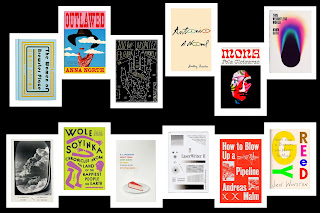
I was just looking at an old post of mine, about book covers. It was from 2016. Five years can make a big difference in aesthetic expectations. So I thought I'd see what 2021's choices for "best book covers" were. I actually don't know that they're that "different" from 2016, but they are cool to look at. Here's the New York Times's roundup (the art director's pick):

 Compare with the Washington Post selection:

Clearly, "best" is in the eye of the beholder.

And here's the American Institute of Graphic Artists list of eight.
And the Lithub list of 101.
Curiously, Parade's list of 25 doesn't actually include images, just verbal descriptions. Number 1 goes like this: "From the big bold type to the vibrant use of color, After the Sun by Jonas Eika evokes a lot of emotion and is sure to get the reader’s attention while sitting on the shelf." Seriously?

Anyway, all that subjectivity, of course, got me wondering about the best covers ever, of which I was sure there would be a list. And yes! The internet never disappoints! Here are a few:

The owner of Porter Square Books weighs in with two top-ten lists: one voted on by Pinterest folks, and his very own list. (They do not overlap, and they both are interesting.)

LitHub again weighs in with the 25 Most Iconic book covers (admittedly, not the same as "best"), all of them, I would say, quite dated. But yes, also familiar.

And here are the 50 Coolest Covers from Shortlist, many of which overlap with the Most Iconic.

Here are 20 from Glorify, which seems to be a graphic designers' site—with The Little Prince in number 1 place, which, yeah: I'll go along with that: great, iconic, classic, do-not-mess-with-ever cover.

And finally—because I could go on forever—here is a link to 19 famous book covers and (sort of) the stories behind them.