Friday, April 17, 2015

365 True Things: 20/Addiction

I do, I admit, have a fondness for mindless time-wasting—specifically, games: on my phone, on the computer, on the iPad. Word games aren't a problem: they stretch my mind for a few minutes, and I move on. But then there are those dangerous games where you manipulate shapes, say, or match similarly colored balls to make them disappear, and try not to let the shapes/balls accumulate—in which case you die an ignominious death. For some reason, those games suck me right in: it's an addiction. Because even after I "win" once, I can come up with all sorts of loftier goals, like a higher high score or no more than one life lost per level or (ha ha) a "perfect" game.

I.e., there's no such thing as winning. And so, paradoxically, you have to keep playing.

It's really rather embarrassing, and I'm only fessing up here because I know no one is reading this. Well, that and . . . unfortunately, it's a true thing about me. And that's what this blog is supposed to be about.

A few months ago I realized that I was wasting far too much time on those sorts of games. Zuma, Peggle, Sparkle: those were my three go-tos (all intended for ten-year-olds, I should point out). I'd sit down "just for a minute," and thirty or more minutes later I'd realize I'd been mesmerized, transported to the dark side. So I took action and deleted them all. Gone, in one fell swoop.

All but one, that is: I kept Two Dots. I'd learned about it in a New York Times article about time management apps—you know, the ones you can purchase to save you from yourself, or, more specifically, from your "device"? The reporter used the word addictive to describe the game, which should have sent me fleeing, but no: I decided to check it out. And somehow it ended up on my phone. Go figure.

The nice thing about Two Dots, and the reason I felt okay about keeping it, is that you only get five lives, and each takes twenty minutes to regenerate. Which guarantees, once you're dead, dead, dead, dead, and dead, that you have to take a good long break. (Well, you can sputter along, one game every twenty minutes, but what's the fun in that?) And losing five lives, especially as the game got progressively more complicated, took no more than ten minutes. Okay, fifteen. In any case, Two Dots takes care of you. It doesn't want to parasitize you.

It's also got very cool graphics, and the music is cheery silly fun—it makes you happy. And the act of swishing your finger around to make little squares or otherwise cause dots of a particular color to vanish is so satisfying.

However: I have now finished all 260 levels. I did go back and made sure all levels had been won at at least a two-star ranking (the one exception being level 123, which is simply impossible to get more than one star on, I'm convinced). And . . . I'm done! My compulsion to play Two Dots has vanished! I am free!

Until the promised next level, Emerald Rapids, is introduced, anyway. But maybe I'll forget to check to see if that happens. (One can dream.)

Since the great banishing act, I'll admit that I've added a couple of new games. One, Monument Valley, a gorgeous little journey through a series of Escher-esque landscapes, took me a few days to get to the end of. Yes, okay, I did proceed from one level to the next to the next etc., pretty much without stopping except to walk the dog or eat, but the goal was to finish. Right? And I did. Another new game, Three, involves adding 1s, 2s, and 3s, and multiples of 3, to get a high score. It's amusing in a limited capacity: not addicting. (Although I did just create my first 192-point tile. I wonder if there's one worth 384?)

The line between addicting and not is a very, very fine one—at least for me, at least when it comes to games. But it's good to know that, in a pinch, I can exercise the power of deletion. At the moment, thankfully, I think I have this particular addiction under control.


Thursday, April 16, 2015

365 True Things: 19/Work (VWA)

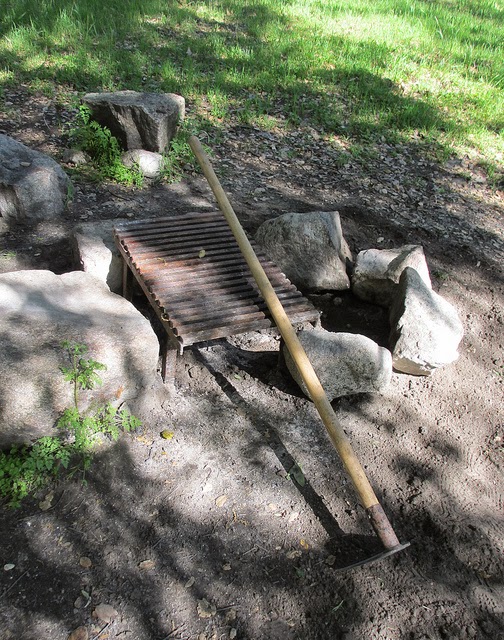
One of my greatest pleasures as a Volunteer Wilderness Ranger in the Ventana Wilderness (Big Sur) is making fire rings that look like this:


look more like this:


or even better, this (i.e., vanish them entirely):


Whereas picking up used toilet paper, along with assorted other trash, would have to rank as the least pleasurable part of the job.


Wednesday, April 15, 2015

365 True Things: 18/Coffee


I could have titled this Addictions, too. Not that I'm physically addicted to coffee: I don't get headaches if I don't have my daily dose. But I do love having not just one but several cups of coffee in a day. I make it half-decaf, so I don't get strung out. Sometimes—when we go out to breakfast, say, and I decide to "splurge" on full caf—I do feel jittery afterward. I don't like that feeling. So half-caf is perfect.

When I was younger, I drank coffee with cream and sugar, as my parents also did. One year, though, I was traveling and found myself in Finland—and when the coffee was served, I didn't know how to ask for cream and sugar! (Now I know that it's kerma ja sokeri.) I learned then and there to like it black. Now, I prefer it that way, though if coffee is too dark a roast (as at Peet's), I will add a little cream. Never sugar.

My other go-to coffee drink is a skinny latte. I'm not big on flavors, or whipped cream, or cinnamon sprinkled on top. I like things plain. That said, I do enjoy the pretty little designs that baristas so lovingly draw in the foam.


Another coffee memory: I'd been in Italy for a couple of weeks, with its wonderful espresso. But I was missing a nice big cup of joe. From Italy, I went to London, and was walking along when I saw a beggar sitting on the pavement, a venti Starbucks cup in his upraised hand. My mouth started to water, and wherever I was headed was deferred until I could find a Starbucks, which I figured would be close by. It was. And
. . . imagine my surprise when the grande cup of plain coffee proved to be too much! Now I know to order a tall. (I should have gone back and dropped a quid in the beggar's cup, but I did not.)

I tell myself sometimes that it would be good to go every so often without coffee, or caffeine more generally (tea actually gets me buzzier), and have herbal tea instead. It doesn't happen, though. I like that beautiful bitter taste of coffee too much.


Tuesday, April 14, 2015

365 True Things: 17/Doing

"Do All You Can" linocut
Anna Oneglia 2005


The last time I was at Tassajara Zen Center, tucked far back in a cool canyon among the chaparral-covered hills of Monterey County, I bought this postcard. I liked its message: Do all you can with what you have in the time you have in the place you are. So many facets for contemplation.

Now I move the card around the house with me, so I'll see it. Lately it's been propped under the TV-on-the-bedroom-wall. It reminds me of a few things: most vexingly, of the many interests I have and how there's not enough time for everything, or even most things; of the peaceful oasis of Tassajara with its zendo, and the practice of meditation that I am so very bad at. It also, sometimes, reminds me to water the garden.

The fact that the card is under the TV isn't significant. I just see it there. Lately I've been working at the kitchen counter, facing across the kitchen and out the window. As a little poem I wrote this morning (while avoiding work-work) describes:
From where I sit

Crumbs on the countertop
butter to be put away
dishes too.
Out the window, ruffling shadows.
A junco flits to the wire, pauses, flits up and away.
Spider floats, silver, on trembling thread of gossamer.
So putting the card in my office, say, wouldn't do me much good. And there's no convenient place to prop it on the kitchen counter. But the bookcase around and under the TV I see all the time. And when, one of these days, I migrate back into my office, the card will come with me. I find it soothing. Rooting.

I could detail everything I MIGHT be doing currently, but just thinking about it exhausts me. I've got a master list with all the possibilities, and from that I try to choose a few things every day. At the moment, my daily list basically comprises work (two jobs in), plus an on-line poetry class (hence the above poem: legitimate work!), this blog (commitment to self), doing a bit of research for my fiction project about the Japanese concentration camps, and walking the dog. Today, too, my little group of three "questers" is coming and we will discuss a reading ("Desiderata": that's right, "Go placidly amid the noise and haste," which now that I think about it is more or less the same message as Nkosi Johnson's).

When I sat down to do this just now, I thought I might write about Tassajara, or meditation—or, for that matter, about what I have, and the time I have, and the place I am—but I'll leave those for other days. (It's nice to know I have plenty to muse on in this project.) For now, I'd best get back to doing my work.

Monday, April 13, 2015

365 True Things: 16/Walking

I am in a lazy spell: about the most vigorous exercise I get these days is a daily hike. Or, just a walk. The dog keeps me at least somewhat honest on that front.

One of my favorite places to go walking is right nearby: the Del Rey Oaks Frog Pond Preserve. It's home to Pacific tree frogs (Pseudacris regilla), and David reported the other day that he saw a woodpecker (downy, we surmise) building a nest— carving it out of a willow tree. Next time we walk the dog there, I'll have him point it out.

The path is just a 3/4-mile loop (which I sometimes do twice or three times), but it's got tons of variety: willows, coast live oak grasslands, even a little redwood grove with a couple of benches for sitting and enjoying the stillness. And of course, the pond, which now is full—of water and dabbling ducks—but soon will evaporate and become a grassy green flat.

When the pond is full, the tree frogs let you know with their nightly celebratory chorus. It's fun to stand on the deck next to the pond, lean on the railing, and listen: they'll all be yelling full throat, then, as if a conductor has waved his baton, they all abruptly fall silent. The quiet lasts maybe ten, twenty, thirty seconds, then one by one by two by six they start in again, until they're all at it, trying to outdo each other. Then, that conductor waves his baton, and silence again. Over and over. It's an amazing performance, made even better by the darkness: nothing to look at, really; all you need do is listen.

Here is a series of photos I took on a walk last January: one circuit of the loop. Click on it to see it larger.


Sunday, April 12, 2015

365 True Things: 15/Taste

When I was a kid, my mother cooked many delicious dinners. She had an eclectic taste and enjoyed experimenting, with the help of lots of cookbooks. One year she went on an Asian kick, and discovered a recipe for "Cambodian chicken." It featured kumquats.

I learned with that dish that I do not care for cooked citrus. This dislike spreads to cranberry sauce that is ruined by oranges. Give me straight cranberry sauce any day.

Saturday, April 11, 2015

365 True Things: 14/Mastery

(Note: this post involves technical stuff. Don't worry; just keep reading.)

I woke up this morning in a sweat. Today was our monthly Search & Rescue training, and we were doing ropes competency check-offs. I had been tapped a couple of weeks before to run the rappel station. But . . . I wasn't entirely sure I knew how to do a conditional belay, which is a little cord you attach to a leg loop of your climbing harness; if, while on rappel, you should be so unlucky as to get hit by a rock and knocked out, you wouldn't simply slither off the rope: the conditional belay would lock and you'd stop.

I knew I could just ask—but I have a chip on my shoulder, I guess you could say, about knowing things. If I'm supposed to know, "I don't know" is not an option.

I had done some online research and more or less verified what I thought I knew. I also learned that there are several options for a conditional belay. There was my ticket: I could ask what the best option is! Then ask for a demo. Then go on my merry way and man that rap station. Perfect.

But then when I got to training, our commander, Steve, pointed at Ivan, one of the deputies, and asked him to man the station. Whew! Off the hook!

Then Steve looked at me and asked if I wanted to check people off on systems. Uh oh.

Rappelling involves a rope, a friction device, and that pesky conditional belay. Period. Systems—a.k.a. mainline (shown here) and belay, ropes that are used for lowering and then, later, raising a rescuer with a litter—involves (for each rope) an anchor, a "bearclaw," a cord, two prusik loops, a pulley, a friction device (ladder rack or "scarab" for the mainline), several carabiners, all of which are assembled in a specific way: the system. And when you switch from the lower to the raise, you throw another prusik and pulley into the mix. Systems also involves a bunch of knots and hitches: figure eight on a bight, munter hitch, double fisherman, radium release hitch, double interlocking long-tailed bowline, half and full hitches, etc.

And I'd been worried about the rap station?

But, okay, I was game. I'd practiced more complicated stuff not long before. And as proctor? I'd just be watching. Right? I can see if something's wrong, even if I'm not always necessarily sure just what is wrong. And then we'd work it out together.

The one thing I needed extra tutoring on was the double inter-locking long-tailed bowline. It's used to attach the rescuer and patient to a litter (as in the photo here: the yellow and blue loops at the top are the knots in question—they attach to a "god ring" that is at the center of the litter harness). And because I felt pretty confident about the rest of the systems, I found (thankfully) that it wasn't hard to ask about that one little thing. So I got a good lesson, and my confidence rose. I was good to go.

Long story short, working with my teammates, some of whom knew pretty well what they were doing, some of whom didn't, I am now solid on systems. We worked through stuff together. On one vexing problem, I asked for help. (I did! I asked for help!) I learned that most of us are sure about some things, not necessarily so sure about others, but there's always someone around to fill in the gaps. And together, we can get it right.

Photo courtesy of Alain Claudel.
The final check-off was the "up over and down" station, which involves ascending, traversing, and descending a rope. I stood and watched as people struggled to various degrees doing the circuit. Then Bob asked if I was up for it. Sure! I've always been able to do this one easily. And today, yet again: it was fun! Nothing to know. Nothing to remember. You just do the work.

Although I'm a pretty in-my-head kind of person, it's a pleasure to let your body take over. And if I keep practicing—and relax—maybe some of the other stuff that I overthink will become second nature. One can hope.