Friday, May 16, 2025

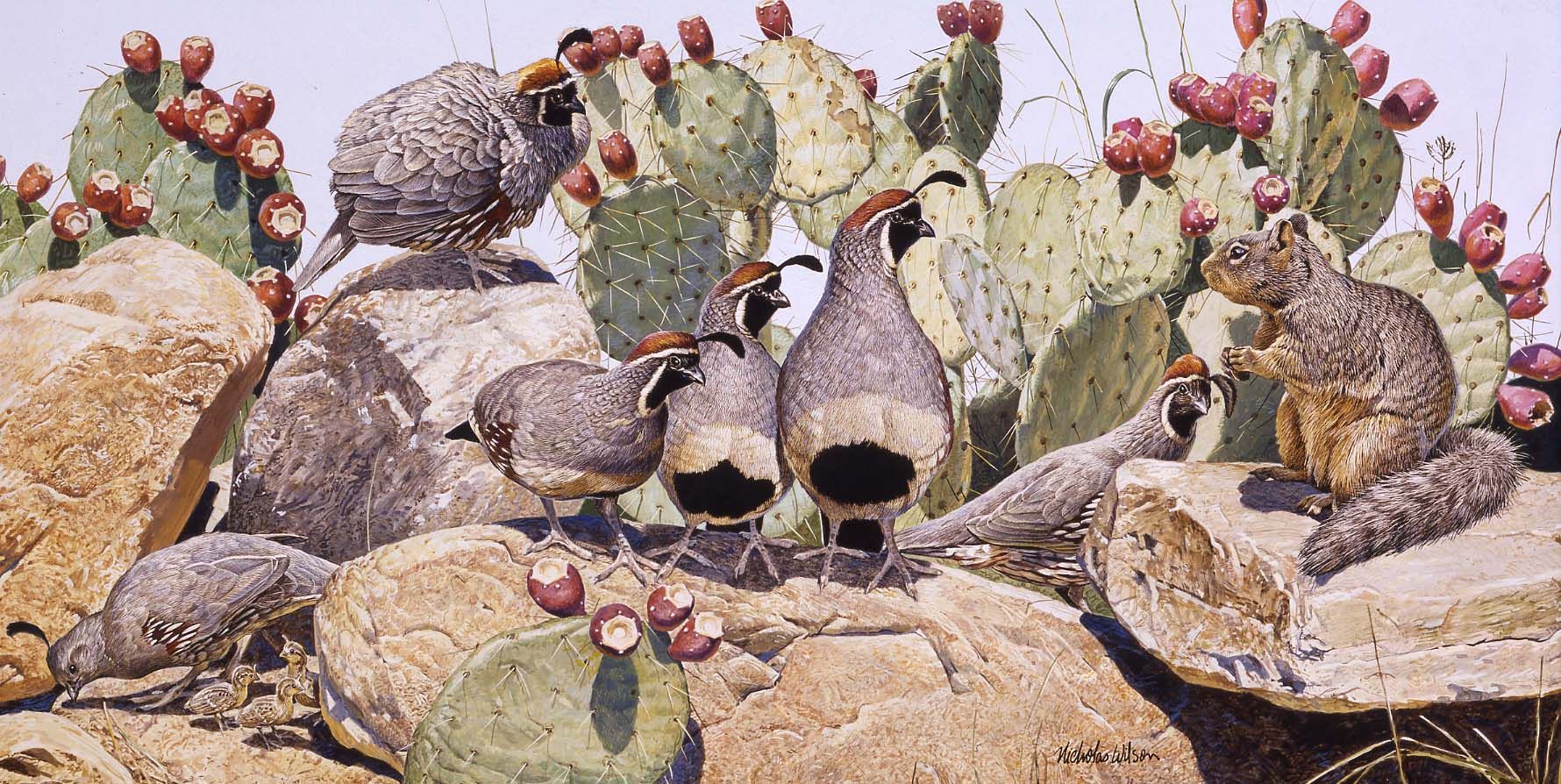
18. Nicholas Wilson, wildlife artist

As I've mentioned before, occasionally while scrolling Facebook I will stumble on something artistic—visual art, music—that intrigues me. Today it was an artist whose work captures the life of the US Southwest, both in oils and in woodblock prints. At the end I include a very short video where he talks a bit about his unusual technique for painting fur. (Click the images to view them large.)


Thursday, May 15, 2025

17. Some more IG six-packs

Back in January I posted a couple of what I call "IG six-packs"—a cluster of the last six shots I've shared on Instagram. I don't post there often, which makes these collections kind of pleasingly random for me. So here are some more—an easy out for me on a day when I don't really have anything to relate.

Geocaching encounter, cymbidium on my deck, 
photography challenge, Milo!, baby sunflower star

apple blossom, Jimi mural, a few of the 83 heads,
begonia blossoms, me and my brother (and a few others,
including kangaroo), Window on the Bay march

Mt. Shasta, Milo says "no more," Ashland OR trail,
oak, iris, Salinas valley

ladybugs, Carmel River, closed-off underpass,
Costa Rican artifact, planes, lamps


Wednesday, May 14, 2025

16. Geocaching adventures

We spent a very pleasant morning with our friend Alastair (aka Mimring) in the Santa Cruz Mountains, looking for—and finding, yay!—nineteen caches along the Fall Creek Trail up near Bonny Doon. Here are a few photos:

A Tribute to Hunger Games (GC43HZ0):
a thoroughly rusted shut ammo can with a dainty little bison tube
("the container") attached to the handle: excellent refurbishment!

The Bonny Doon Biggie (GCATVQV):
the biggest ammo can I've seen in quite some time,
and the satisfying reward of a puzzle cache

We originally thought the "biggie" referred to this big
burnt stump: here David and Alastair consult their oracles

A beautiful face in the redwoods

The trail

It's always excellent to catch up with Alastair, an economist who until Trump came along worked in international aid & development. Lately, he's been fixing up houses (his and his wife's, the house nextdoor, and his mother's house in the UK), getting at least one or two of them ready to rent—for a little necessary income. But come a week from Friday, he's going to hit the road for two-plus months, his goal: to find the oldest geocache in each of the lower 48 states (save California, which he found in January). 


Here is a list, with links to the cache pages, which go back to 2000 and 2001—25 years of geographically oriented fun. 

The oldest still-active cache in the US and in the world is GC30 Mingo, in Kansas, created on May 11, 2000—the seventh cache ever placed. (In those days, caches tended to be published rather haphazardly, and by region, so the first hundred or so aren't sequentially numbered.) 


The very first geocache was stashed a week earlier, on May 3, 2000, by Dave Ulmer near Beavercreek Oregon. Here's what AI and Atlas Obscura tell me about that event:
Ulmer, a computer consultant, hid a 5-gallon bucket containing various items, including Delorme Topo USA software, in a forest near Portland to test the accuracy of GPS. He shared the coordinates with an online group, and two people, Mike Teague and another individual, were among the first to find it. This act of hiding and then sharing the location of a container, along with the chance to take something and leave something else, marked the beginning of geocaching. 

Here's a more detailed look at the story:

Motivation:
Dave Ulmer, a computer consultant, wanted to test the accuracy of GPS technology, which had just become more precise after the removal of Selective Availability by the US government. 

The "Stash":
He placed two CD-ROMs, a book by Ross Perot, a VHS of the movie George of the Jungle, four dollars cash, a slingshot handle, a cassette tape recorder, some topographic software, and a can of black-eyed beans in a bucket, left it in the woods, and sent its coordinates (N 45° 17.460 W 122° 24.800) to sci.geo.satellite-nav. There was also a logbook with instructions: “The Rule Is: Take Something Leave Something.”
 
First Finds:
Within three days, two people, Mike Teague and another individual, successfully found the bucket using GPS. 

Spreading the Word:
The experience was shared online, and the idea of hiding and finding stashes quickly spread, leading to the creation of a mailing list called "GPS Stash Hunt" and the term "geocaching," coined by Matt Stum. 

Legacy:
The original geocache, no longer in place, is honored with a plaque in Beavercreek, and the can of beans that was part of the original stash is now a trackable item. 

You can read more about the history of geocaching here

Today there are 3.3 million active geocaches (I've found 5,554, since 2007—I've got a ways to go), in 191 countries. As a sport, it is most popular in Germany, then the US, the Netherlands, France, and Czechia. David and/or I have found caches on six continents (we lack Australia—it's on our list for next year—though if you count Oceania as a "continent," we've got all of them accounted for, yes, even Antarctica). We enjoy the pastime greatly.

Though I'm not sure we're quite as crazy as Alastair, with this mad adventure he's embarking on. That said, I'm very much looking forward to following him as he posts each state's find on Instagram—something I have commanded him to do, and will nag him about if I see him flagging. This is epic! Crazy, but definitely epic!  

I hope he has a wonderful time, and finds every last one. Some of them, he says, look really hard. But what's a hobby without a challenge?


Tuesday, May 13, 2025

15. Poems about the loss of a mother

My somewhat monthly poetry group met this morning. Among us six, two have recently lost a parent. Here are a few poems on the subject, specifically on the loss of a mother. The third one was read at Emily's mother's funeral by Emily's sister. And here is a photo of my mother as I never knew her, not really. She would be in her mid-forties here; I would have been about six. My father took this, developed and printed it himself. He never got around to spotting it. Maybe I should do so. Or, maybe it's poetic to leave it as is.


Mother

by Ted Kooser

Mid April already, and the wild plums
bloom at the roadside, a lacy white
against the exuberant, jubilant green
of new grass an the dusty, fading black
of burned-out ditches. No leaves, not yet,
only the delicate, star-petaled
blossoms, sweet with their timeless perfume.

You have been gone a month today
and have missed three rains and one nightlong
watch for tornadoes. I sat in the cellar
from six to eight while fat spring clouds
went somersaulting, rumbling east. Then it poured,
a storm that walked on legs of lightning,
dragging its shaggy belly over the fields.

The meadowlarks are back, and the finches
are turning from green to gold. Those same
two geese have come to the pond again this year,
honking in over the trees and splashing down.
They never nest, but stay a week or two
then leave. The peonies are up, the red sprouts
burning in circles like birthday candles,

for this is the month of my birth, as you know,
the best month to be born in, thanks to you,
everything ready to burst with living.
There will be no more new flannel nightshirts
sewn on your old black Singer, no birthday card
addressed in a shaky but businesslike hand.
You asked me if I would be sad when it happened

and I am sad. But the iris I moved from your house
now hold in the dusty dry fists of their roots
green knives and forks as if waiting for dinner,
as if spring were a feast. I thank you for that.
Were it not for the way you taught me to look
at the world, to see the life at play in everything,
I would have to be lonely forever. 


When I Am Asked

by Lisel Mueller

When I am asked   
how I began writing poems,   
I talk about the indifference of nature.   

It was soon after my mother died,   
a brilliant June day,   
everything blooming.   

I sat on a gray stone bench   
in a lovingly planted garden,   
but the day lilies were as deaf   
as the ears of drunken sleepers   
and the roses curved inward.   
Nothing was black or broken   
and not a leaf fell   
and the sun blared endless commercials   
for summer holidays.   

I sat on a gray stone bench   
ringed with the ingenue faces   
of pink and white impatiens   
and placed my grief   
in the mouth of language,   
the only thing that would grieve with me. 


Only as the Day Is Long

by Dorianne Laux

Soon she will be no more than a passing thought,
a pang, a timpani of wind in the chimes, bent spoons
hung from the eaves on a first night in a new house
on a street where no dog sings, no cat visits
a neighbor cat in the middle of the street, winding
and rubbing fur against fur, throwing sparks.

Her atoms are out there, circling the earth, minus
her happiness, minus her grief, only her body’s
water atoms, her hair and bone and teeth atoms,
her fleshy atoms, her boozy atoms, her saltines
and cheese and tea, but not her piano concerto
atoms, her atoms of laughter and cruelty, her atoms
of lies and lilies along the driveway and her slippers,
Lord her slippers, where are they now?


Saturday, May 10, 2025

14. Khadijah Queen, poet

My Howler co-conspirators and I have added a new mini-ritual to our routine: weekly poetry. As in, Sherilyn recently got a book of poems called You Are Here: Poetry in the Natural World, and she had questions. To begin with, her questions concerned a poem by Victoria Chang, "A Woman with a Bird." Turned out, discussing the poem, offering our own disparate interpretations and thoughts, really enriched... me, anyway, and I'm certain the others too. Different insights, different things we noticed and appreciated. Poetry really should be a shared experience, I'm learning.

Today we met again, for our second poem, by a fellow Antioch University classmate, Khadijah Queen. I find Khadijah's poetry challenging. Beautiful; austere. Elliptical, with a resonant depth, not at all narrative. (Me, my poetry? Way too narrative. Why don't I just stick to prose?)

Fortunately, this poem wasn't difficult. We definitely had questions, but the beauty of this one was that it had plenty to hold on to even if some subtleties may have been elusive. 

Tower

A black snake plays dead
on the path between 
dogwoods and a meadow of wild
Ageratum, pretends to be water-soaked,
a fallen branch. Others lie
strewn about, their bark-flaked corpses no
mirage. All is well, say the midges, dragonflies,
moths, ladybugs, even the wind
stirring the leaves says to trust
instinct's music. I walk to unravel
panic's thousand fingers braided through
my insides—false roots. When I see death
I think lose lose lose
automatically. The tarot says let go,
change. I haven't read Gospodinov's
The Physics of Sorrow, yet; can only take
Sharpe's In the Wake in small doses.
I don't want to drown in ocean math.
I narrow my eyes to the scam, don't
move too fast, switch directions
then pause—turn back to see
what choice the snake makes sans my alarm.
In the forest, grief lives a new life
as devotion. Early August leaves play at color
before surrendering to both
man-made ground and messy slopes
collecting undergrowth. I wonder what's past
resistance to change, on the other side
of fear. If I don't look down, or walk away. Step
over the snake instead, realize
both living and dying require giving up.

Thanks to Kim for understanding the title, a reference (we believe) to the Tarot deck: the Tower, the sixteenth Major Arcana (following right on the heels of the Devil). In A. E. Waite's 1910 book The Pictorial Guide to the Tarot, the Tower is associated with "misery, distress, indigence, adversity, calamity, disgrace, deception, ruin. It is a card in particular of unforeseen catastrophe." Curiously, the Tower is even worse than the Death card, which suggests transformation, change, new beginnings. The Tower is just catastrophic. And yet, once one has fallen from the tower, perhaps there can be an escape into freedom? Maybe the Tower represents an even greater transformation, a conscious reorganization of awareness?

I don't know why Khadijah settled on the Tower as the central metaphor here, but it's definitely interesting to think about. There are questions! 


Friday, May 9, 2025

13. John Singer Sargent, artist

There is a show on now at the Met of John Singer Sargent (1856–1925) in Paris. American by nationality, he spent virtually his whole life in Europe—born in Florence, trained in Paris, died in London. He painted hundreds (many hundreds) of works, in both oils and watercolor. He is no doubt best known for his portraits, which were commissioned in droves in the late 1800s, but in 1906 he closed up his studio, turning to landscapes, watercolor, and more personal work. His biography is very interesting, for being quite unusual. I won't go into it—you can read all about him on Wikipedia. I'll just post a few images that I like, starting with the one he's perhaps best know for, and ending with some architectural studies from early in his career that I find pleasing. (Well, I actually end with a poem, about a nude.)

Portrait of Madame X, 1884

The Daughters of Edward Darley Boit, 1882

Claude Monet Painting by the Edge of a Wood, 1885

Madame RamĂ³n Subercaseaux, 1880–81


Carnation, Lily, Lily, Rose, 1885–86

A few of his watercolors:

Gourds, 1906–10

The Chess Game, c. 1907

Sir Neville Wilkinson on the Steps of the
Palladian Bridge at Wilton House, 1904–5

And those architectural studies:

Fumée d'Ambre Gris, 1880

Staircase in Capri, 1878

The Steps of the Church of SS. Domenico e Siste in Rome, 1906

Staircase, 1878

And finally, from 1917–20, a nude study of an African American elevator operator and WWI vet named Thomas McKeller, whom he featured in various works toward the end of his life.


And wouldn't you know it, Yusuf Komunyakaa wrote a poem about it:

Nude Study

Someone lightly brushed the penis
  alive. Belief is almost
      flesh. Wings beat,

dust trying to breathe, as if the figure
  might rise from the oils
      & flee the dead

artist’s studio. For years
  this piece of work was there
      like a golden struggle

shadowing Thomas McKeller, a black
  elevator operator at the Boston
      Copley Plaza Hotel, a friend

of John Singer Sargent—hidden
  among sketches & drawings, a model
      for Apollo & a bas-relief

of Arion. So much taken
  for granted & denied, only
      grace & mutability

can complete this face belonging
  to Greek bodies castrated
      with a veil of dust.

A 21st-century Black man's interpretation of a hundred-year-old painting by a 19th-century star. One has to wonder what was going on in John Singer Sargent's head when he painted this study. Or more to the point, in Thomas McKeller's.

Thursday, May 8, 2025

12. Frank O'Hara, poet

Oh well, I had no time to research anything today (but I do have a nonpoetic idea for tomorrow, fingers crossed), so here's a poem, one of several that we read today in my generative group. The theme: music. I wrote a narrative poem about a pub in County Clare, Ireland, recommended to David and me, who were bicycling around the island, as being an excellent place to hear session music. The poem isn't especially good, but I sure did enjoy revisiting the memory. This poem by Frank O'Hara is narrative as well, and it's good.

The Day Lady Died

by Frank O’Hara

It is 12:20 in New York a Friday
three days after Bastille day, yes
it is 1959 and I go get a shoeshine
because I will get off the 4:19 in Easthampton   
at 7:15 and then go straight to dinner
and I don’t know the people who will feed me

I walk up the muggy street beginning to sun   
and have a hamburger and a malted and buy
an ugly NEW WORLD WRITING to see what the poets   
in Ghana are doing these days
                                                        I go on to the bank
and Miss Stillwagon (first name Linda I once heard)   
doesn’t even look up my balance for once in her life   
and in the GOLDEN GRIFFIN I get a little Verlaine   
for Patsy with drawings by Bonnard although I do   
think of Hesiod, trans. Richmond Lattimore or   
Brendan Behan’s new play or Le Balcon or Les Nègres
of Genet, but I don’t, I stick with Verlaine
after practically going to sleep with quandariness

and for Mike I just stroll into the PARK LANE
Liquor Store and ask for a bottle of Strega and   
then I go back where I came from to 6th Avenue   
and the tobacconist in the Ziegfeld Theatre and   
casually ask for a carton of Gauloises and a carton
of Picayunes, and a NEW YORK POST with her face on it

and I am sweating a lot by now and thinking of
leaning on the john door in the 5 SPOT
while she whispered a song along the keyboard
to Mal Waldron and everyone and I stopped breathing