Wednesday, February 8, 2017

Hodgepodge 101/365 - Let Sleeping Dogs Lie (2/7)

Tonight, because I'm already overdue here (I almost forgot, oy!), two photos. Short and sweet. When he's groomed, we call him Little Lord Fauntlereoy. He is soft as silk.


Oh, but I should mention that I was kicking butt on a proofreading job today, when I got an email from the in-house editor saying the author had delivered his changes early, so . . . could I please send what I had, NOW?

It was right about then that my back developed a muscle spasm. Which I suffered with for, oh, eight hours.

Milo seemed to know. He came and sat with me, cast his sweet brown gaze upon me. I twitched, I turned, I writhed, I stretched, I moaned. Milo was always there.

A dose of Edna Valley Chardonnay and Nurse Jackie (season 4, 4 episodes) seems to have cured my problem. But mostly: those sweet brown eyes. What will I ever do without them?

(Okay, a third photo.)

I love that dog.


Monday, February 6, 2017

Hodgepodge 100/365 - Protest

Today we attended our first protest rally, of what will no doubt be regular and frequent ones. The current administration is not slowing down when it comes to provocation.

We ran into various people we knew: a SAR teammate, a new friend from our little Indivisible group, some contra dancers and singers, a geocaching friend and her dog Clara. Today's theme was the First Amendment. A few people driving by yelled something negative (one even said Hillary should be thrown in jail—um, seriously?), but mostly we got lots of friendly honks and thumbs up.

I am heartened by much of what I'm seeing in the media about this new resistance—like an article from the Nation posted just this afternoon, "Your Guide to the Sprawling New Anti-Trump Resistance Movement." We are everywhere. And we are speaking out. They can not empty their voicemail boxes and so prevent constituents from getting through; they can say they don't hear us; they can pretend they are supported by "the majority"—but they'll be lying liars. And we'll keep letting them know that.

Sunday, February 5, 2017

Hodgepodge 99/365 - Coffeehouse Poet

My friend Nina called yesterday morning and suggested we get together in the afternoon at a Pacific Grove coffeehouse to write. My response was, Write???????? It felt impossible—like I've forgotten how to: the political situation has me too upset to even have thoughts, never mind collect them, plus my crazy workload lately has me completely blinkered—tunnel vision straight back to 1839 and the invention of photography. A proofreading job, with translations from French and German, for which I have the original documents to double-check against, and comparison reading of published English texts written in that quaint 19th-century style. Quirky punctuation,—anyone?

I definitely haven't been getting out enough. So I told Nina, Sure. I figured I could always sit and read a book—for pleasure—if words failed to flow from my fingers.

Once at the coffeehouse, it hit me that I must get out more. It was so stimulating to sit there with pleasant music playing (singer-songwriters), not too loud; the babble of voices—including a couple of women speaking Dutch, and later a trio speaking some Balkan language; the espresso machine squelching; the clunk of mugs on the wooden tables; the woman at the counter announcing drinks up—double macchiato! nonfat Masala chai! half-caf large capuccino! Even the screaming child that got carried through the room on her father's shoulder made me smile. Life!

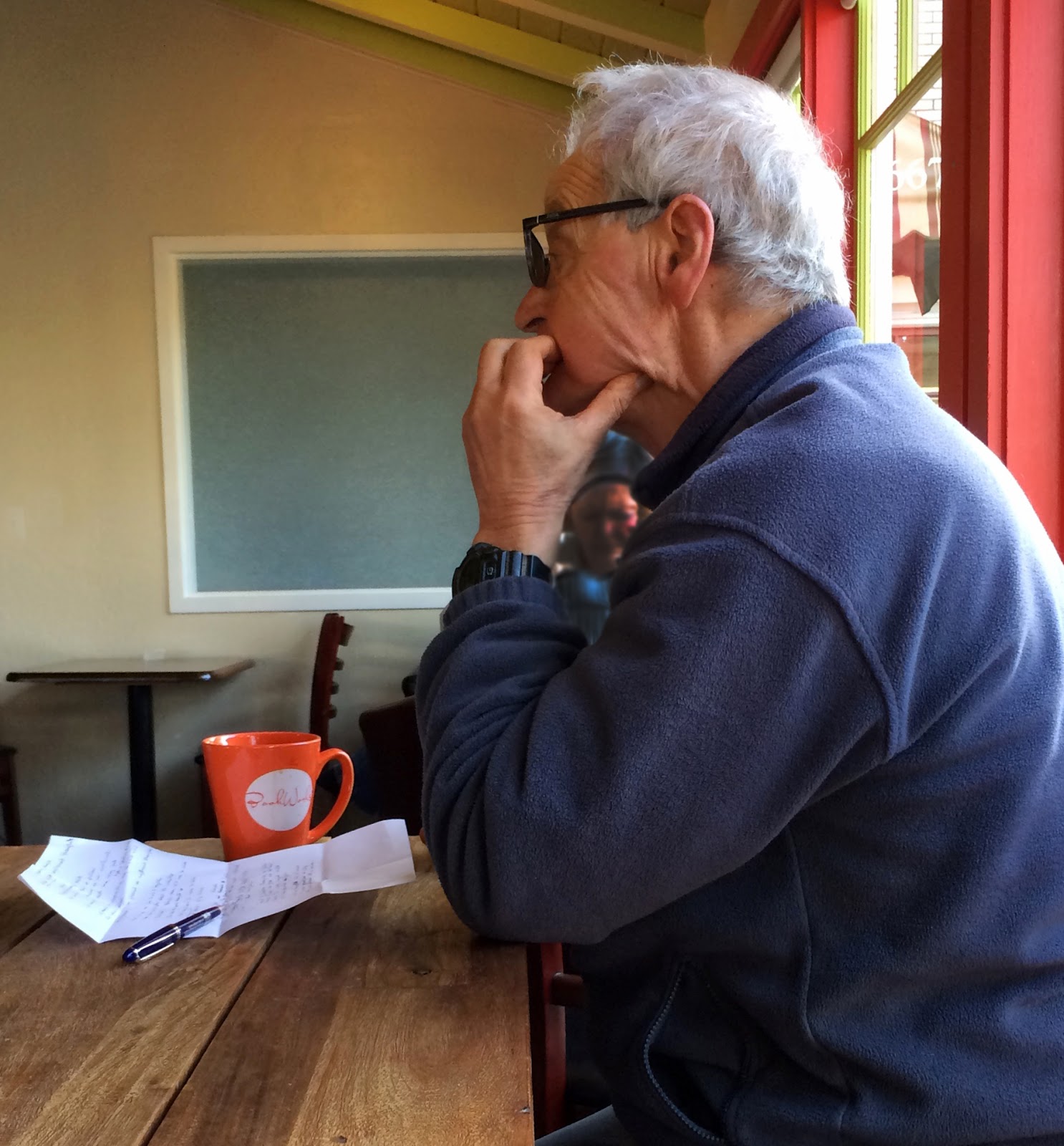
After we arrived and got our drinks, the only place big enough for all three of us (David came too) was a picnic table with benches at which an older man—short gray hair, thick dark-lensed glasses, blue fleece, blue jeans—sat staring at an unfolded piece of paper filled with small writing in blue ink. Nina, David and I settled in and caught up a bit: on the state of the country mostly (it's unavoidable), but also the movie Moonlight, which Nina went to see yesterday. (I have yet to see it. This week, I hope.)

As we were talking, the man in blue slid over on the bench and asked if we’d mind listening to a poem he'd been working on. He read it out loud in a strong Russian accent; it was difficult to hear it over the general hubbub, so afterward he slid the piece of paper (typewritten) over and David and Nina studied it, then shared their impressions. He offered the poem to us, since we’d expressed admiration. His name, Rudolph Tenenbaum, was penned at the top.

He later made his way around the room—in between bouts of staring at the handwritten page or just staring into space, chin resting on his hands, occasionally sipping his coffee drink—pulling a poem out of his pocket, sharing it. The same poem? A different one? I don't know. At one table, the one with the Dutch women, he was politely declined; at another, one of the auditors expressed praise and then mentioned a poet he admired, especially his later work (I did not hear the name). That fellow also asked what the poet intended to do with his poems, whether he was publishing them; I did not hear that answer either.

It was touching, his earnestness, his reaching out.

Here's his poem (which, curiously, I did not notice rhymed while he was reading it to us):

497

It is called a reduction disease.
What really happens to him?
Stage one: in horror he sees
Rot striking his every limb.

Stage two: his body is gone.
No face. Just a smooth place.
And yet he lives on and on
Out of time and space.

He feels truly bereft
His dear self left behind.
And what is left? What is left?
Just the mind. Just the naked mind.

Reduced to a thought he will try
To be strong, and proud, and free.
Even then he will call himself "I"
And refer to himself as me.

But now he seems to forget
The blue, the green and the red,
The beautiful woman he met,
The sweetness of milk and bread.

Indeed, he seems to forget
The trick of how to feel.
What is love and what is regret?
What is to ail and to heal?

He seems to forget all he knew:
The men, the streets and the trees.
It doesn't look like the flu.
It is the reduction disease.

But he still remembers the red.
To remember the red is fun!
"Half a loaf," somebody said,
"Is better than none."

The reality he will defy.
Defeated? He will disagree.
Even then he will call himself "I"
And refer to himself as "me."

Saturday, February 4, 2017

Hodgepodge 98/365 - Roadrunner Rules

Chuck Jones, in his 1999 memoir Chuck Amuck: The Life and Times of an Animated Cartoonist, laid out the nine rules that every episode of Looney Tunes' Road Runner/Wile E. Coyote cartoons had to abide by. They are not rules I would want to live by, but for cartoon characters? They made for some pretty funny situations.

Rule 1. The road runner cannot harm the coyote except by going "beep-beep!"
Rule 2. No outside force can harm the coyote—only his own ineptitude or the failure of the Acme products.
Rule 3. The coyote could stop anytime—if he were not a fanatic. (Repeat: "A fanatic is one who redoubles his effort when he has forgotten his aim." George Santayana)
Rule 4. No dialogue ever, except "beep-beep!"
Rule 5. The road runner must stay on the road—otherwise, logically, he would not be called road runner.
Rule 6. All action must be confined to the natural environment of the two characters—the Southwest American desert.
Rule 7. All materials, tools, weapons, or mechanical conveniences must be obtained from the Acme Corporation.
Rule 8. Whenever possible, make gravity the coyote's greatest enemy.
Rule 9. The coyote is always more humiliated than harmed by his failures.


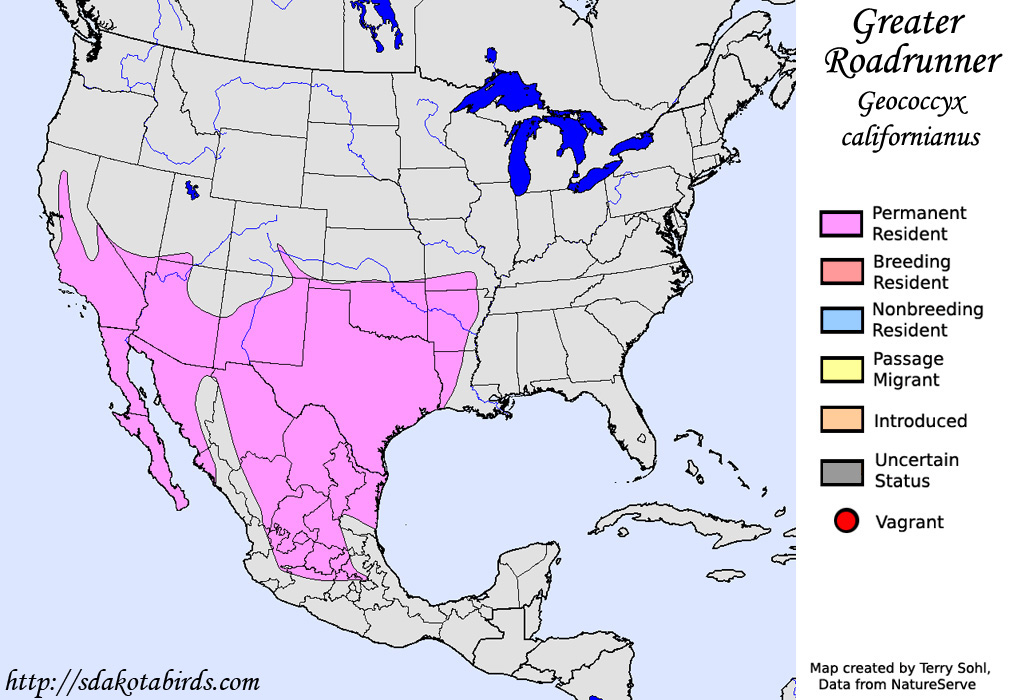
I have to say, whenever I see a real roadrunner (sometimes they actually are on roads!), I am beyond delighted. They are iconic and  beautiful, even, in a way, majestic. In California and the Southwest, we have Geococcyx californianus, the greater roadrunner (there's a lesser one in Mexico and Central America). They are "ground cuckoos" (the meaning of their generic name) in the subfamily Neomorphinae. (Something I did not know until now: the word coccyx, meaning tailbone, comes from the Greek word for, yes, cuckoo!, for its resemblance to the cuckoo's beak.)

Roadrunners are monogamous and mate for life. "During the courtship display," according to Wikipedia, "the male bows, alternately lifting and dropping his wings and spreading his tail. He parades in front of the female with his head high and his tail and wings drooped, and may bring an offering of food." The roadrunner's nest is usually composed of sticks, but may also contain leaves, feathers, snake skins, or dung. It is commonly placed up to nine feet off the ground, in a low tree, bush, or cactus. The eggs are generally white. Both sexes incubate the nest (with males taking the night shift) and feed the hatchlings. For the first couple of weeks after the young hatch, one parent remains at the nest. The young leave the nest at two to three weeks old, foraging with parents for a few days after.

I expect a real roadrunner would just laugh at the above rules (or maybe coo or bark: you can listen to roadrunners here—they do not say "beep beep").

Though they'd probably also be happy to know that the coyote generally gets its comeuppance—at least in the dreamworld of Looney Tunes.

Friday, February 3, 2017

Hodgepodge 97/365 - Dog Sledding in Alaska

I've been to Alaska four times: most recently, on the ferry through the Inside Passage (southeastern Alaska); before that, in the Ruth Gorge near Denali, where my climbing partner and I were hoping to do some ice climbing, but the temperatures were too mild, so we just skied up and down the glacier and snow-camped for a week; and before that, on Denali proper, where we were foiled by the weather gods (and food poisoning) in our attempt to summit, but nevertheless it was a pretty amazing few weeks—something I'd never aspired to before I met said climbing partner. We've since gone our separate ways (we email maybe once a year), but I will always be grateful to him for the many adventures we had. Denali no doubt being the biggest and best of them. (And I've never taken a shower for granted since.)

But this is about my first visit to Alaska, in March 2002. It was sparked in part by 9/11: one day, in the aftermath of that awful tragedy, I was sitting around wondering what I would regret not having done if my life were to be suddenly cut short. And what popped into my head was, Dog sledding.

Some years before, I'd worked on a book by Galen Rowell called Poles Apart, about the North and South Poles, and in it he had a spread narrating a dog sledding trip he'd taken. He happened to mention the company he went with: Sourdough Outfitters.

I googled, and found them: a small operation just 35 miles north of the Arctic Circle in Bettles, Alaska. They offered a five-day trip into Gates of the Arctic National Park. Sold! I booked a trip for the next March.

The details are fuzzy now. I believe I flew into Fairbanks, where I caught a small plane to Bettles with five or six others who would be my companions on the trip. We were outfitted with warm boots (military parachuter boots, white rubber) and parkas, high-calorie snacks and down sleeping bags, and assigned six-dog sled teams. I no longer remember my lead dog's name (she was white with blue eyes), but I do remember that I had a dog called Trouble, who unfortunately lived up to his name. He was eventually moved to the expedition leader's team—detention. We stayed in trapper cabins and tents with little wood stoves, ate vacuum-packed frozen salmon and curried veggies—positively gourmet. The days were gorgeous, every one of them, and the temperatures balmy, in the teens and twenties. We'd all spread out along the trail, and soon you'd just feel alone in all that white bigness.

The dogs were wily, though. They knew we were greenhorns, and they'd peer over their shoulders at you when you'd stop, waiting for you to step off the sled, then bam, they'd take off, leaving you stranded. Fortunately, as long as you were in the middle of the pack, someone would be along soon enough and give you a lift to your wickedly grinning team, who'd have gotten stopped by whoever was in front. Silly dogs.

At the end of the day we'd pull out big balls of lard that we'd been entrusted to carry and feed them to the dogs: it was the end of the season and their fat stores were depleted. The lard was the main thing keeping them going. The dogs would get tied up, and after eating they'd curl up tight, tucking nose into belly, and go to sleep.

Before we went I was worried about long nights, but of course this was around the equinox and above the Arctic Circle, so in fact we had long twilights—but enough dark night that we could look for the Aurora Borealis. I only saw it once, and it was not colorful: just white. But it was still magical: like the sky was blowing smoke rings. I lay outside under skins with a new friend, Paul, and we chatted while scanning the sky until he pointed and said, "Look!" Then we watched in silent awe. It didn't last long, but it was worth the trip right there.

Here are the very few photos I converted into digital format. I need to look for the rest (I assume there are more) and for my journal from the trip (I assume there is one). Fill in my hazy memory. It was an amazing trip. Now I guess I can die without regrets. (This trip also plays a small part in my first—and only—marathon, which I wrote about here.)


Thursday, February 2, 2017

Hodgepodge 96/365 - Garbage Can

Today while paying bills I actually took a look at the extra flyers stuffed in with the garbage collection bill. Two of them were sticky labels entitling us to ten extra pickups each of trash and greenwaste (yard clippings). We often do have to borrow a neighbor's yardwaste container, so now we have yet another avenue to get rid of, say, the bazillion bushels of pine needles that end up on the roof and need to be dispatched.

The inserts also discussed container size. It never really occurred to me until I was talking about it with a friend, but we never use more than one bag a week for our garbage (well, pretty much never)—and yet we have the maximally sized rolling bin. So today, with the phone number right there on one of those circulars, I called and asked if I could swap my supersized container for a small one, and whether that would save me money. Yes on both counts.

Sometimes the little things are enough.


Wednesday, February 1, 2017

Hodgepodge 95/365 - Grandparents' Grave

Eight years ago I drove to Minnesota to spend a couple of weeks in an artist residency on the St. Croix River. (I posted some pictures from that time, as well as a story I wrote for the host organization, here.) On my way there I stopped in the town of Owatonna, where my mother spent her childhood and where her parents are buried. We visited their grave in 1978, when my mother came to Wisconsin to visit me while I was studying at the UW–Madison.

On my drive to the hosting research station, I passed by Owatonna. Why not stop again to say hello? I thought. My grandmother, Annie Hooten Skinner, after all, was the only grandparent I had actually known. It would be good to pay my respecrs. But more so, I could stop for my mother, who herself had died just a few months earlier.

When I asked at a gas station for the town cemetery, the fellow asked, "Which one?" I said I didn't know, but I sort of remembered hills. He pointed me to the north of town, said it was probably (I'm guessing now, based on a Google maps search) Saint John's Cemetery, run by the Lutherans. My grandparents were Protestants. That could be right. 

I drove up a hill and found the graves laid out not in neat rows, but grouped and clustered, lots of different headstones and monuments, as if in conversation. Absolutely nothing looked familiar. I drove to various sections of the cemetery. Still nothing. About to give up, I decided to give it one last spin. At a bend in the road, something struck me. I parked and got out. And sure enough: there was the Skinner family stone, on the very edge of the plantable property, overlooking a forested glen. I thought it ironically fitting that even in death my family would be on the fringes. 

Here's a mosaic I made of my grandparents' graves. I was surprised to see the infants' headstones: I'm not sure I knew about lost children. (Well, I must have, since I'd visited the grave once before. But obviously I forgot.) It makes sense, though: my mother was adopted because her parents thought they couldn't have children of their own. I had just assumed they couldn't conceive. But it was sadder than that. 


I wonder if I'll be the last person to visit that gravesite deliberately. It's entirely possible . . .