Saturday, January 13, 2024

Curiosity 77: Fred again.. (and Tiny Desk Concerts)

As I've mentioned before, I like to listen to the New York Times commentator and podcaster Ezra Klein while I take my afternoon walk. The other day he was talking about developing our own tastes in this crazy world of internet optimization with New Yorker staffwriter Kyle Chayka, who has just published a book titled Filterworld: How Algorithms Flattened Culture. 

In the conversation, Ezra described wanting to learn more about classical music, and finally, through a lot of work—talking to people, reading books, getting Spotify recommendations, and just listening—discovering the music of Steve Reich and Philip Glass, and then Carolyn Shaw and Nico Muhly, which really spoke to him—caused, as he put it, "a reaction," "a very strong sense." One piece in particular struck him to his core, Peter Gregson's quartet "II. Warmth." 

Later, Ezra mentioned another musician, Fred again.., a British record producer, singer, songwriter, multi-instrumentalist, and DJ who in 2023 was nominated for a Best New Artist grammy—and his Tiny Desk Concert.

Well, I do enjoy the Tiny Desk Concerts, which NPR started producing in 2008. But I tend to listen to artists I already know. I thought, hmm, I should check out this Fred fellow, and maybe scan the list of recent Desk Concerts, give them a try—learn something new.

 So I started this evening with Fred again..—which I really, really like:


In the comments to this video, he writes: "I spent weeks practising this and learning instruments I hadn’t played for years to try n make this as special as I possibly could. EVVERRRYYYY thing you hear in this I play totally live. And there are some sounds I really couldn’t believe we were able to make like this. Its one of my favourite things ive ever been a part of 💜"

And now I need to find out more about Carolyn Shaw and Nico Muhly. And follow up on my intention to hear more Tiny Desk Concerts: of the most recent couple dozen, all but one of the artists are entirely unfamiliar to me. So much to explore! 

These will not redefine my own taste in music—but they might help expand it a bit. I'm all for that.


Friday, January 12, 2024

Curiosity 76: Mary Oliver, poet

The Fourth Sign of the Zodiac, part 3

I know, you never intended to be in this world.

But you’re in it all the same.

so why not get started immediately.

I mean, belonging to it.
There is so much to admire, to weep over.

And to write music or poems about.

Bless the feet that take you to and fro.
Bless the eyes and the listening ears.
Bless the tongue, the marvel of taste.
Bless touching.

You could live a hundred years, it’s happened.
Or not.
I am speaking from the fortunate platform
of many years,
none of which, I think, I ever wasted.
Do you need a prod?
Do you need a little darkness to get you going?
Let me be urgent as a knife, then,
and remind you of Keats,
so single of purpose and thinking, for a while,
he had a lifetime.

I have of course featured Mary Oliver (1935–2019) before, many times, but each time I happen on a poem of hers—this one today on FB—I appreciate the slowing down and invitation to reflect on my own experience of being on this planet. Oliver was diagnosed with lymphoma in 2015; she died in January 2019. This poem is from before all that, her book Blue Horses published in 2014, but still: she always had death in mind, from her close observation of the natural world, where death is merely an unavoidable fact, part of the cycle of life. She does not sentimentalize, either beauty or darkness. 

This section is part of a four-part poem titled "The Fourth Sign of the Zodiac." The reference to John Keats (1795–1821), I imagine, is to his brilliance—and to the fact that he was only 25 when he died of tuberculosis in Rome. He managed to be a practicing poet for only seven years (his first extant poem, "An Imitation of Spenser," dates from 1814), a published one for less than five (his first poem in print, "O Solitude," appeared in the Examiner in May 1816)—and yet what a legacy.

In 2015 Oliver participated in a rare interview with Krista Tippett of On Being. 

And finally, a long read from her book A Thousand Mornings in October 2012:


This will probably not be the last time I feature Mary Oliver, assuming I keep this confounded blog going. I can count on her for wisdom.


Thursday, January 11, 2024

Book Report: Taste

2. Stanley Tucci, Taste: My Life through Food (2021) (1/11/24)

Upfront disclaimer: I did not finish this book, which I picked up on the recommendation of a friend.

Granted, I only made it to the 1980s, when Tucci, just out of college, was a struggling actor in New York, so he had not yet found—or been able to afford—his adult tastes, or met many of the chefs and other food lovers he no doubt goes on to mention later in the book.

I don't know exactly what I was expecting, but it wasn't a small-town America look at home cooking, even if much of that home cooking had a Calabrian flavor, or a (tedious) tour of 1980s New York eateries (many now "sadly vanished"), or a meal-by-meal inventory of what Tucci ate as a high school student. (A lot of white bread was involved.)

So when, on page 85, I followed his instruction to "Please go on YouTube and find the brilliant comic stylings of Nick Kroll and John Mulaney performing their hilarious sketches in coffee shops revolving around 'too much tuna!' Your life will be changed for the better," and found Kroll and Mulaney neither brilliant nor hilarious, I decided I'd had enough. 

My friend did, however, in her recommendation, say that I should read through page 160 and then watch Tucci's 1996 movie Big Night. Well! I love that movie, so I flipped forward to chapter 9 (page 149), which describes some of its background, including the five-and-a-half-minute single tracking shot of the making of a frittata. Followed by a frittata recipe.

The book does indeed include various recipes. Most of them very, very simple—and hardly (in my view) worth inclusion. Assuming someone reading this book already loves cooking and eating. But maybe Tucci was assuming readers would just love him? I don't know. He certainly doesn't seem like a self-aggrandizing man. Maybe his editor steered him wrong.

One exception to the "simple" rule is the Timpano, which he includes in his Christmas chapter—and also in Big Night: 

I am grateful, however, for the nudge, and will rewatch Big Night. I also really enjoyed Tucci's recent TV series Searching for Italy, which I have now learned there's a second season of—adding to my list. 

The author of The Tucci Cookbook (2012) and The Tucci Table (2014), he frequently demonstrates recipes on TikTok, as here with a recipe for minestrone. As one commenter observes, "This feels like I asked my uncle for a recipe and it was too complicated to text so he just sent me this video." There's nothing fancy about his videos, but they're pleasant to watch. Better than the book. For me, anyway.

And to wrap up (though I could go on searching out video clips of Tucci—he's just charming in his drollness, which sadly doesn't come across in writing), here he is in a Q&A about the second season of Searching for Italy and about Italy and himself generally.

No wait, I will end with a video. Here, he's interviewed about Searching, Italian filmic characters, and his bout with tongue cancer (ironically)—which he cites as one reason he wrote Taste. Thankfully, he is now cancer free, his sense of taste and smell fully restored. I'm glad.

I think it's difficult to write about food in a sustained way, or to spin an entire memoir around a single subject, and I do not fault Tucci for trying. It just wasn't my cuppa. Though that said, this book  gets high marks on Goodreads, so maybe it's yours. Different tastes!


Wednesday, January 10, 2024

Curiosity 75: Dung beetles

With a title like that, you might think I'm veering away from poetry. Well, not exactly. But first, a few facts about dung beetles—which number in the thousands of species: up to 8,000-plus, depending on your source. Verily!

Dung beetles, like so many other successful species, are found on all the continents except Antarctica. They are the strongest insect in the world, some species rolling up to 50 times their weight in dung. This activity is ecologically important, removing parasites and waste from the surface and returning nutrients to the soil.

Why do they roll dung? It may serve as food, or as a place to lay eggs (a "brood ball"). Or, a male might present a ball of dung to a prospective mate. (The males do all the rolling; females may hitch a ride.)

When they have collected their pile of dung, they always roll it in a straight line, obstacles notwithstanding. The ancient Egyptians, seeing this, surmised that dung beetles drove the motion of the sun, which explains the religious importance of scarab beetles (Scarabaeus sacer), personified in the god Khepri. Though in fact, it's the sun that determines the beetle's path of travel (or, at night, the moon or even the Milky Way). 

There are three different kinds of dung beetle: the "tunnelers," which bury the dung right where it sits; the "dwellers," which simply move into the pile of dung; and the "rollers"—and you know what they do.

One subfamily of beetles, the Scarabaeinae, feeds exclusively on dung, but it is not an uncommon behavior in other groups.  They prefer the poop of omnivores, but will also feed on that of herbivores, as well as on mushrooms and decaying leaves and fruits. Dung is found via a keen sense of smell.

In case you were wondering, yes, there is an article, by the wonderful science writer Ed Yong, titled, "What a [Dung] Beetle's Genital Worms Reveal about the Concept of Individuality." I say again, verily! 

And because there's nothing like visuals:

Finally, yes, I did promise you a poem (didn't I?). It's one I heard the other day on Pádraig Ó Tuama's Poetry Unbound podcast, and it's what got me to wondering about dung beetles. Everything is connected to poetry in the end, isn't it? 

How the Dung Beetle Finds Its Way Home

The Milky Way’s glinting ribbon helps the dung beetle
roll his good ball of shit back to the ones he loves.
But blind him to the sky with as little as a hat,
and he will swerve like a drunk who, if he makes it home alive,

might find the family, soured with waiting,
gone. Drawers cleared, beds cold, even the watercolor ark
of giraffes and raptors pulled from the face of the fridge.
See? I want to tell my missing father, it’s a metaphor so simple

it’s almost not worth writing down: even beetles need the stars
to nudge them back to where they need to be
when they need to be there—toward their little ones’
gummy grins ever pardoning the grisliest parent.

I am thirty-four with a son the day my mother tells me
she enrolled in a four-day seminar about how to be a good mom.
A little late, I know.
Once, in a rage, I left my husband and our sleeping child.

Where did you go, friends ask when I tell the story.
I wish I’d had a grander plan. I wish I’d stood on the roof
of our building and, empowered by that single Brooklyn star,
I’d ripped up the book of my parents’ sins.

Or I wish I could tell someone the truth: that I fear
I am the kind of woman who could leave the one good family
God had the gall to give her. Really,
I sat on the stairwell leading up to the roof and wept

until a large bug threatened my life, at which point I recalled
the dung beetles, stopped blaming my parents, and—
thanking the metaphorical stars—I rolled up my pile of shit
and trudged back home.  

                                                                —Eugenia Leigh


Tuesday, January 9, 2024

Curiosity 74: Golden Shovel poems

My monthly poetry group met this morning—stimulating and illuminating as always—and one of our number offered up a "golden shovel" poem: a poem that pays tribute to a favorite line in someone else's poem (or if the original poem is short, the entire thing). The form was originated by Terrance Hayes:

The Golden Shovel

                    after Gwendolyn Brooks

I. 1981

When I am so small Da’s sock covers my arm, we
cruise at twilight until we find the place the real

men lean, bloodshot and translucent with cool.
His smile is a gold-plated incantation as we

drift by women on bar stools, with nothing left
in them but approachlessness. This is a school

I do not know yet. But the cue sticks mean we
are rubbed by light, smooth as wood, the lurk

of smoke thinned to song. We won’t be out late.
Standing in the middle of the street last night we

watched the moonlit lawns and a neighbor strike
his son in the face. A shadow knocked straight

Da promised to leave me everything: the shovel we
used to bury the dog, the words he loved to sing

his rusted pistol, his squeaky Bible, his sin.
The boy’s sneakers were light on the road. We

watched him run to us looking wounded and thin.
He’d been caught lying or drinking his father’s gin.

He’d been defending his ma, trying to be a man. We
stood in the road, and my father talked about jazz,

how sometimes a tune is born of outrage. By June
the boy would be locked upstate. That night we

got down on our knees in my room. If I should die
before I wake.
Da said to me, it will be too soon.

He wrote a second one, based on the same lines, in 1991. 

Here is the poem by Brooks that he is referencing:

We Real Cool

                The Pool Players.
         Seven at the Golden Shovel.

        We real cool. We
        Left school. We

        Lurk late. We
        Strike straight. We

        Sing sin. We
        Thin gin. We

        Jazz June. We
        Die soon.


In 2017, a collection titled The Golden Shovel Anthology: New Poems Honoring Gwendolyn Brooks was published, featuring work by Rita Dove, Billy Collins, Nikki Giovanni, Sharon Olds, Tracy K. Smith, Mark Doty, Sharon Draper, and Julia Glass, among many others. This morning, Jericho Brown was mentioned as a practitioner of this form (yes, he is one of the contributors to this anthology); I cannot find any examples of his golden shovels, but I did find this tweet by him from 2018:


Well, the form has continued to evolve, and now is described in the Poetry Foundation's glossary generally as a "poetic form... designed to allow poets to pay tribute to existing work by poets they admire." 

Quoting a poem, "1975," by Harlem Renaissance poet Anne Spencer (1882–1976), here is Nikki Grimes with "Kneel":

1975

Turn an earth clod
Peel a shaley rock
In fondness molest a curly worm
Whose familiar is everywhere
Kneel
And the curly worm sentient now
Will light the word that tells the poet what a poem is.

Kneel

In search of verse, enter a garden and kneel.
Feel the sun-kissed clay between thumb and
forefinger. If you're surprised by the
wriggling life-form in the midst, a curly
brown creature, thank her for doing her worm-
work, turning your soil into gold—her sentient
sacrifice of time unmeasured, until now.

Meditate on the gifts the earth will
furnish, assuming nourishment, light,
and life's clear elixir—the
water which satisfies, soothes, tickles—what wet word
pours itself into the vessel that
you call thought? Be still till your imagination tells
you which pictures it wants you to paint—this is the
lyrical word-journey of the poet.
Pace yourself. Watch the bee slowly gathering what
fragrant nectar he can find worth of a
hive and its queen. Now, slowly, gather words for a poem,
a honey-glazed treat. Isn't that what a poem is?

I trust by now you've figured out just how the golden shovel poet is paying tribute, but if not: Take the final word of each line and read down. Then look back at the poem being referenced. There. See it now? It's a cool (and, according to my friend, not so easy) way of acknowledging appreciation for another's words.


Monday, January 8, 2024

Curiosity 73: Kasen renku

This morning I suggested to my little group of "howlers"—by which I mean, Sherilyn and Kim—that we try creating a poem together. We've all been reading the book Writing Haiku: A Beginner's Guide to Composing Japanese Poetry by Bruce Ross, and Sherilyn and Kim have been writing daily haiku. 

(Me, I'm not at the "daily" point yet, but I've written a few since the first. Like this one, from yesterday:

the furnace whistles—
outside bright sun
47°

which if I were to title it would be called "Early Morning.")

One of the forms covered in the book is the renga or renku, identified especially with the master Matsuo Bashō (1644–1694). Basically, a renku is a poem written with other people. But that "basically" is belied by a couple of descriptions of the form that I found online, which indicate just how complicated such apparent simplicity can be. On the World Haiku Review archives page there are 16 entries for renku. One, "What's in a Name: Defining Renku," gives this list:

Renku is linked verse.
Renku is an art form.
Renku is a game.
Renku has rules.
Renku is not anarchic linking.
Renku has a flow, a pace, an overall effect.
Renku has no narrative.
Renku is a communal enterprise (some solo is done).
Renku is verse by individuals.
Renku is not serial haiku.
Renku begins with a haiku.
Renku makes good friends and companions.
Renku is fun.
Renku is habit forming.
Renku honors tradition.

All straightforward enough. But what about those rules? I gleaned these from the website "Haiku Spirit":

The renku consists of alternating 3-line and 2-line verses, with syllable counts (in Japanese, anyway) of 5-7-5 (i.e., a conventional haiku) and 7-7—though translated to English, the syllables become stresses: 6–7 in the 3-line verse (~14–16 syllables) and 5 in the 2-liner (~11–13). There are various types of renku, defined by different lengths; the type we are choosing to attempt, kasen renku, has 36 stanzas—so, for us, 12 each.

The first stanza, known as hokku, contains a reference to the season of composition—spring, summer, autumn, winter—via some appropriate imagery, like a nest for spring or golden leaves for autumn, or a cultural reference, like a 4th of July parade for summer.

The second stanza, wakiku, should evoke the same season, but include none of the hokku's specific imagery or vocabulary. It should stand on its own. The connection need not be logical or chronological. It could, for example, reflect a scent in the hokku, or the quality of light, or the sound of marching footsteps, but otherwise go in a completely different direction. (My mind flew just now from marching footsteps to a centipede walking over leaf litter—for example.)

That link (tsukeai) is one of the two compositional principles of a renku, and is employed in every stanza to come. 

The third stanza, daisan, could be considered the first real verse of the renku, for it will include both a link to the second verse and a shift (tenji), which means this stanza should bear no resemblance to the first one.  As the Haiku Society of America puts it, "any two consecutive stanzas form a connected poetical unit, but three in a row do not. Renku is not narrative verse."

The final stanza of the renku, known as ageku, typically ends on an upbeat image, almost always connected with spring. Usually, the most skilled poet in the group does the honors in wrapping up the communal effort.

All other verses are considered "ordinary" (hiraku) and can do pretty much what they want—as long as they employ tsukeai and tenji. Whew!

The entire kasen renku does, however, have an additional three-part structure, consisting of a preface (jo, the first 6 stanzas), development (ha, the middle 24 stanzas), and the "fast close" (kyū, the final 6 stanzas). Rather than alluding to content, these parts can be thought of as more about tempo or mood: a stately jo, a more upbeat, lively, anything-goes development, and the wrapping-up kyū. One site likens it to musical structure: larghetto, con brio, and rapid diminuendo.

Additionally, and traditionally, three themes are woven throughout the entire renku, at specific stanzas: the moon (stanzas 5, 13 or 14, and 29), a blossom or flower (17 and 35), and love, especially for one who is absent (twice or thrice in stanzas 9, 10, and 11, and again in 21, 22, and 23—or, more generally, in 7–18 and 19–30, but still clustered). 

There is—this will not surprise you—much (much) more subtlety in how, and how not, a renku should be constructed, if one is to do it right. (A whole 11-part series on the "School of Renga" can be found here.) But I suspect we howlers will be happy just to keep wending our way, through links and shifts, into something, anything, remotely resembling a 36-stanza creation, in stanzas of 3 and 2 lines, hopefully bearing a reasonably acceptable set of stresses, that gives us aesthetic pleasure and a sense of happy accomplishment. 

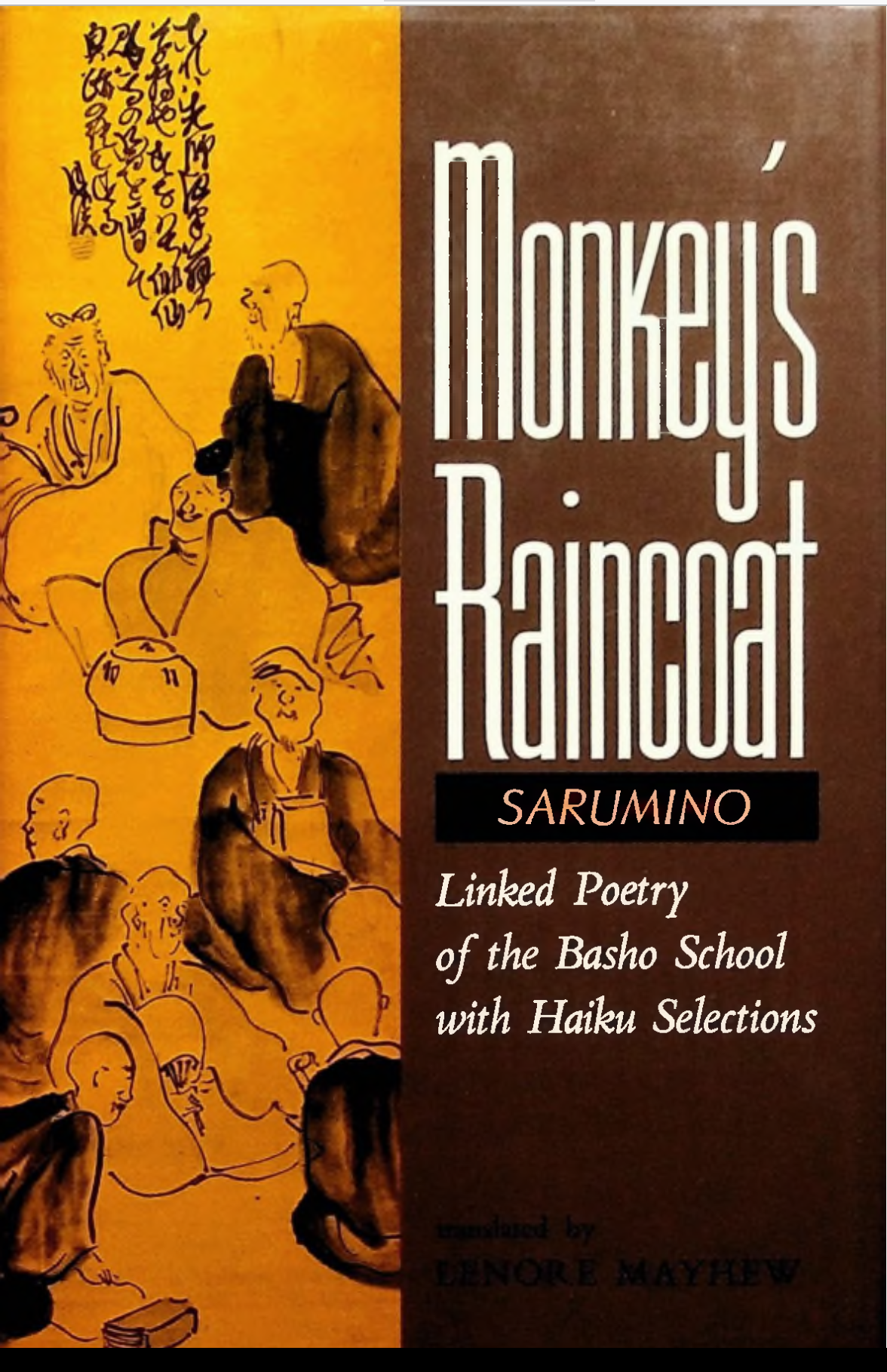
I found a set of four kasen renku by Bashō and his fellow poets, originally published in 1689/91 in an anthology known as The Monkey's Raincoat. (All four poems are included in the link, including the Japanese transliteration.) Here is the preface (jo) of the first one, "Winter Rain" (Hatsushigure), composed by Bashō, Mukai Kyorai, Nozawa Bonchō, and Nakamura Fumikuni, translated by Lenore Mayhew:

            First winter rain
the kite's rag-tag feathers
            sleeked down.

After the burst of wind
leaves rest.

            With morning undershorts
already soaked
            he fords the river.

Neighborhood badgers
afraid of set bows.

            Over the double doors
ivy crawling.
            Early moon.

Won't share
the local pears.

Or... here's the first ten lines of a contemporary American one, with ten authors (only nine of whom are represented in this extract—part of the "play" of a renku seems also to include trading off turns, mixing things up):

wet brown leaves
trampled on the boardwalk
Seattle morning

mallards on the autumn pond
so loud beyond the rushes

he turns down the radio
then carves a frown
into the pumpkin

a wedge of geese
slices the sunset

pizza shop
off the moonlit interstate
break from drifting snow

spare pillows piled up
on the bedside chair

sitting ovation
for our pilot's soft landing
zero visibility

falling into the cloud
Niagara Falls

spots on my glasses
the multiple haloes
of the well-lit park

cathedral windows
glittering with saints

(Note the moon's appearance in the fifth stanza of both exemplars.)

Anyway, we'll see what happens as we start our little experiment. Maybe I'll include the finished poem here in another month. Anything's possible! (Later: here it is!)


Sunday, January 7, 2024

Curiosity 72: Some photos

It's been a few weeks since I took the easy way out and posted some old photos from my Flickr archive. Well, today that's about all the energy I have. So, here's five, all from January 7ths past, with original captions:

Would you like a little girl? (2008)
The other day my cousin sent me this letter, from his mother,
my aunt's, files. It's from the Children's Home Society of Minnesota,
dated Feb. 19, 1917, and proposes that Mr. and Mrs. J. J. Skinner
"come to the Home and see the child and examine her history"—
the child in question being my mother, Loraine Skinner. I've had the
photograph of her forever (taken a year later, I believe, when she
was four?), but otherwise did not know that anything more existed
of her adoption history. The letter is formal, written in spidery
sepia script. I try to picture her waiting expectantly for her
new parents in the "receiving home" pictured in the upper left.

White Mountain (2009)
Went walking with Annie this morning. She convinced me that
I want a wirehaired fox terrier—if, that is, I want a divorce also.
Dog or husband, dog or husband, hmmm.... Along the way we met
a couple of rat terriers who looked SO happy to be out on such
a beautiful day. They further convinced me that I want a wirehaired
fox terrier (but not the divorce). The place we walk is part of the
equestrian area of Pebble Beach, and there are numbers everywhere
letting you know what equestrian trail you're on.
I thought 7 was an appropriate one to take a photo of today.
[2024: Milo came two years later. He is all doodle, zero terrier.]

Ouray (2010)
I'm starting to scan some old slides. I chose a box
randomly, and it took me to Ouray, Colorado, and an ice
climbing clinic with Chicks with Picks. Which in turn
prompted me to get in touch with the Head Chick, Kim
(who's also a friend). She wrote back and said there's room
in this year's clinic and won't I please come? It is a
huge temptation. I do enjoy ice climbing, and Colorado's
not THAT far. Should I do it?
[2024: I did go twice. Maybe I did?]

Dog toys (2011)
The scruffy thing on the right is the hands-down favorite
of all the various toys I'm trying out on Milo. It's a
stuffingless weasel or badger or something—long and slinky.
The squeakers at either end lasted maybe an hour. I figure
the "bone" and teething ring may be of more interest once
teething starts. Whenever that is.... In the meantime, it's been
suggested that I stock up on kongs. Okay. Any other
suggestions out there? I'm all ears!
[2024: Now Milo is 13, and he still loves his weasels.]

830 (2012)
We finally signed the loan on Thursday—over a year
since we started the process. We both moved out to our
new (separate) digs on New Year's Day. Seemed
appropriate. Since then we have, bit by bit, been emptying
out the house. Today David was taking down blinds, light fixtures,
and the like. I decided to walk through the house and take a few
last pictures. They're nothing in themselves—just a catchment for
memories, I suppose. We're not fond of the house: hence the remodel.
Well, I did rather like the front room. But that's about it.
So these pictures will remind me, six months from now,
why we embarked on what everyone assures me will be a
hellish journey. Me, I'm staying optimistic. I see this as an
opportunity, not a burden. We may feel clueless and indecisive
at many turns along the way, but we've got lots of help.
Am I naive in thinking it'll even be fun? Probably. But we'll see.
Anything's possible.
[2024: Hard to believe the "new" house is already 12 years old.
Lately, we've had a busted water system and a leaky roof to
deal with, the latter because we had to have the huge old
Monterey pine in the back corner of our lot taken out, and debris
fell. Time keeps marching on.... The house may be no
longer new, but we still love it.]