Saturday, December 21, 2019

Book Report: Missing, Presumed

27. Susie Steiner, Missing, Presumed (2016) (12/21/19)

A police procedural set in Cambridgeshire, this book is also more than that (or perhaps less, if you were expecting a page-turner): for in the end, it is a character study, or a study of a set of characters, told in chapters narrated from various points of view. Because once the initial disappearance of Cambridge University student Edith Hind occurs, with some telltale evidence that suggests possible foul play, very little actually happens. Manon Bradshaw, the 39-year-old (and painfully single) main detective, and her colleagues follow various clues and surmises, but these mostly seem to lead to dead ends. Meanwhile, we learn about the yearnings and vulnerabilities of, especially, Edith's mother, Miriam, and of DS Bradshaw herself—both of them unhappy in their personal lives, for quite different reasons. We experience the relative tedium of simply not knowing, of grasping at straws, of not giving up on hope. There are two further deaths, one definitely connected to Edith's disappearance, the other not so clearly so. People end up being not quite who they seem. Ultimately, the case is solved—and the main characters have changed, seemingly for the better. Or at least they seem better able to stumble in the direction of fulfillment.

The writing is excellent, with some smashing metaphors: "her heartbeat thudding like a bee against glass," for example. And speaking of a new, still-tentative relationship:
"Don't cry," he says, his hand on her cheek, and she wonders if he means it as solace or whether he is actually asking her not to emote in his presence. She is descending and he is floating up, like the birds beyond his window. The landing and the flying off.
I didn't flag any passages in particular. But I enjoyed the writing, the characterizations, the descriptions—and finally, the story—quite well.


Noticing lxvi - Stephen O'Donnell, artist

Stephen O'Donnell is a Facebook friend of mine. I believe I "met" him through Lidia Yuknavitch. He seems like a kind, joyous, and generous soul, and I enjoy seeing him on FB.

But more than that, he is an amazing and prolific artist with a vivid imagination, working in acrylic on panel. As Portland, Oregon's Froelick Gallery describes him, "Stephen O'Donnell paints gender-defying self-portraits in which he is adorned in the dress and hairstyle of past centuries. He also paints finely detailed images of animals and birds." If I had some extra cash, I would happily invest in one or two of his works (I am especially drawn to the birds and animals). He has an interesting blog too—Gods and Foolish Grandeur: Life and the Arts . . . from a Retrograde Perspective.

Here are a few of his pieces:

A Boy and His Dog (2017)
Imminent Encounter (2016)
Le Monocle (2012)
Les Deux (2009)
Les Perruches (2012)
Venus Cosmeticus (2015)
Pan (2015)
Berries (2016)
Plunder (2017)
Deceive (2019)
Savor (2017)
Lady (2017)
Twist (2017)
Found (2015)

Friday, December 20, 2019

Noticing lxv - Tamara Madison's "The Body of God"


Cassiopeia A (courtesy JPL)
Form is emptiness,
emptiness is form.

Heart Sutra

Cold tile beneath bare feet
They say you are made mostly
Of space
Cool mud beneath the blades of grass
You too, and your grass sticking up
Are mostly space
They say that space is everywhere
That we part it with our bodies
Yet still it fills us
That is why we are humming
With life, that even sitting still
Like this oaken table
We are not merely taking up space
But are infused with it
That no matter what we do
Or think or feel
There is no getting out of this
We are forever filled with this space
And this space is God
So God is all around and in us
And all of us forever dwell
In the body of God.
For some of us
That is all we need to know

Thursday, December 19, 2019

Noticing lxiv - counting

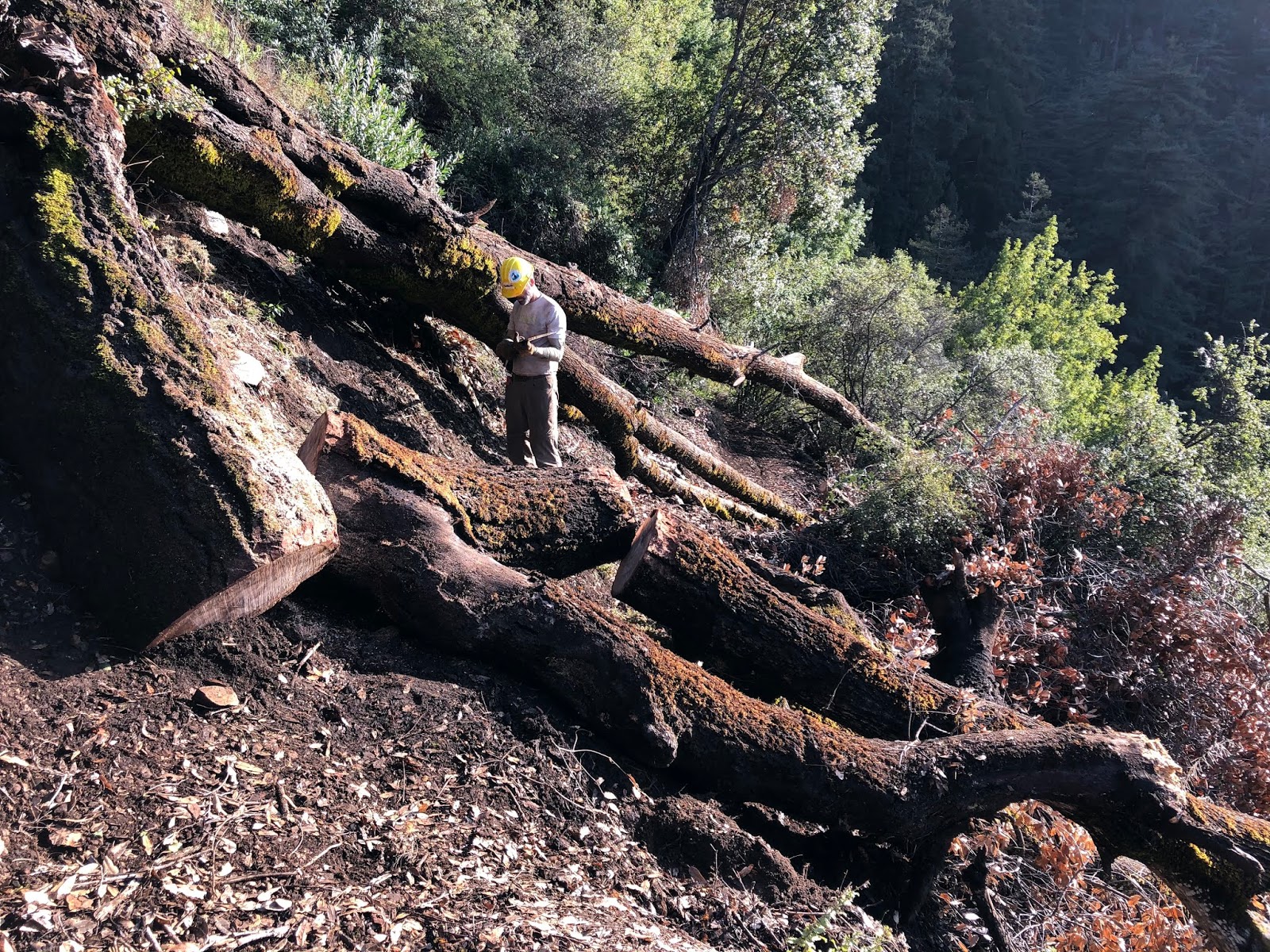
Today I spent the day with five other Ventana Wilderness Rangers at a place on Big Sur's Pine Ridge Trail called Bad Gulch. A huge oak tree had fallen in the trail, making it virtually impossible to navigate without a steep and dirty detour. Our mission was to "swamp" it—which basically means sawing and lopping off all the smaller branches, to reveal the skeleton of the "large bones": the trunks and the main branches. At which point crosscut sawing and removal could commence.

We did a pretty good job, though it's not complete; another day will be needed. But the trail is passable now, and . . . it looks pretty darn good! Unfortunately, it's impossible to convey in pictures just how gnarly this tree was (did I mention it was huge?), all cattywampus along a fifty-foot stretch of trail. But here are a few anyway, because I took 'em.

As we started working: there were a lot of dead smaller
branches to swamp out
Nearing the end of the day: no brush left,
just big stuff
Same tree, viewed from downhill side

There was some discussion at lunch about just how to count this tree, for bookkeeping purposes back at the office. It was just one tree, but it took us all day! It involved dozens of saw cuts, many with handsaws, some with a couple of more industrial-strength saws (including a Japanese "Katana Boy," Steve's Christmas present early), and the coups de grâce were accomplished with a five-plus-foot crosscut saw.

Do we count it as one tree? as seven to nine big branches that blocked the trail? by number of saw cuts? (which nobody was counting, so that was out from the git-go). I suggested counting "obstacles": anything that you'd have to step over, climb under, or that otherwise impeded your path.

It's not an exact science. Well, it's not a science at all. And in the end, today's leader will guesstimate something, and that'll be the count.

All this got me to thinking on the three-mile walk back to the car about counting—in particular, about Japanese counting. They have so many numbers! For starters, they have two basic cardinal number systems: one starts out hitotsu, futatsu, mittsu, yottsu, itsutsu, and goes only as far as ten (), the other starts ichi, ni, san, shi/yon, go, and goes forever. Not even remotely similar!

To make things more complicated, the ichi, ni, san system partners up with "counter" suffixes, which describe certain objects or shapes or sizes of things. For example, you can say "four apples" either as ringo yottsu or as ringo yonko, where yon means 4 and ko designates "an unspecified or generic object." (This according to Wikipedia, which I'm not convinced is authoritative. The wording below, yottsu no ringo, sounds more correct to me. But what do I know? I learned Japanese 55 years ago! I have forgotten a bit!)

Many, many things, however, are "specified objects"—even if only generally by shape. For example, flat objects (mai), like sheets of paper, photographs, or plates: so jugomai no shashin means 15 photographs; or long, slender objects (hon), which can refer to anything from bottles and pencils to railroad tracks and rivers to ties and guitars: so 15 pencils are jugohon no enpitsu. And very importantly, human beings get their own counter: nin—though of course, there's a catch, in that one person is referred to as hitori, two persons as futari, and only then do we get into the counting pattern: sannin, yonnin, gonin, etc. So 15 men, by this logic, would be jugonin no otoko, but Google translate tells me it's jugori no otoko. Is it -nin or -ri—or both? Oy!

Oni
And that's not all: there's an enormous list on Wikipedia of all the counters, including some items that get their own words (i.e., not based on shape or size), such as books (satsu), stories of a building (kai), swords (furi), courses of a meal (hin), votes (hyō), pieces of nigiri sushi (kan—though kan also denotes warships, only the kanji is different), shots of a drink (ko). You get the picture. Here's a counter I like: hatsu, which counts gunshots, bullets, aerial fireworks, orgasms, and sex acts. And in case you're wondering, ogres (oni) are counted in the same category as small animals, insects, amphibians, reptiles, and fish: hiki/piki. 

I'm actually surprised that apples are just generic things: why isn't there a counter for pieces of fruit? or round things? 

Of course, all this doesn't really mean anything, especially as related to the counting trees conundrum. But it was fun for me to think about. I hope it was fun for you too.

And by the way: the end count for our trees today? Seven. And there it rests.


Wednesday, December 18, 2019

Noticing lxiii - Peter Jackson's "They Shall Not Grow Old"

I was looking at the local movie listings this morning, thinking about going to see Ford v. Ferrari, when I noticed a special engagement of Peter Jackson's WWI homage, They Shall Not Grow Old—special as in, only three days, with the last day being today. I cajoled David into going.

So glad we did. It was an amazing accomplishment, involving four years poring over 100 hours of archival film footage and 600 hours of oral histories, constructing a story arc, modernizing the footage and colorizing much of it, to a painstakingly recreated color palette. Dialogue was identified by forensic lip readers, and supplied by actors, while the narration came from actual combatants via the oral histories. Even the sounds of artillery guns were realistic, having been recorded at a New Zealand Army military exercise. All the attention to detail, which Jackson discusses in a 30-minute feature following the film itself, was amazing.

That and, the harrowing experience of life in the trenches, on the battlefields, even in the hard work the soldiers were tasked with when they were not in the thick of the fighting, was eye-opening. Another vivid reminder of the insanity and horror of war.

Here is a trailer for the film:


Adam Gopnik described the technical feat of the making of the movie in a New Yorker article that is worth reading.

Tuesday, December 17, 2019

Noticing lxii - impeachment rally

We joined several hundred other patriots this afternoon to wave signs calling for impeachment at passing motorists, many, many of whom honked and thumbs-upped their approval. Our state senator, Bill Monning, spoke, exhorting us to get out and vote next November. He even exhorted those of us in a position to do so to temporarily move to swing states, establish residency—thirty days is all that's required—and vote there. He suggested that the Republican Party will be employing this tactic—which is pretty scary. He also commented that Trump has a $100 million war chest, and by November will have doubled that—whereas the Democratic candidate, whoever that ends up being, will be starting from scratch come March or April or whenever they clinch the candidacy. That, too, is scary.

But for now, it is looking certain that tomorrow, Trump will be impeached. And that is the good news in this bleak time.

Here are a few photos I took.

David and Nina


Indivisible leader Gary Karnes addressing the crowd

Monday, December 16, 2019

Noticing lxi - Piet Mondrian does trees

When I think of Piet Mondrian (1872–1944), I think of this:

#2 Composition with Red, Yellow, and Blue (1937–42)
or this:

Composition with Large Red Plane, Yellow, Black,
Gray, and Blue (1921)


These are examples of "neoplasticism," the style he exclusively explored in the latter half of his life, in which he simplified visual compositions to the most basic elements: straight line, the three primary colors, and the neutrals of black, white, and gray.

Yesterday, however, I encountered this:

Farm Near Duivendrecht, in the Evening (1916)

Totally different! And it turns out, he was really into trees. Here are some of those, for your viewing pleasure. I find them very beautiful. (As always, click on the image to view large and on black.)

Willow Grove: Impression of Light and Shadow (c. 1905)
Evening, Red Tree (c. 1909)
The Gray Tree (1911)
Horizontal Tree (1911)
Tree (1912)
Apple Tree, Blossoming (1912)
Tree II (1912)
Trees (1912)

In 1914, Mondrian wrote in a letter to painter, art critic, and collector H. P. Bremmer: "I construct lines and color combinations on a flat surface, in order to express general beauty with the utmost awareness. Nature (or, that which I see) inspires me, puts me, as with any painter, in an emotional state so that an urge comes about to make something, but I want to come as close as possible to the truth and abstract everything from that, until I reach the foundation (still just an external foundation!) of things . . .
 "I believe it is possible that, through horizontal and vertical lines constructed with awareness, but not with calculation, led by high intuition, and brought to harmony and rhythm, these basic forms of beauty, supplemented if necessary by other direct lines or curves, can become a work of art, as strong as it is true."

He was definitely headed in the direction of pure lines and fields of color with these trees, but there is also a strong feeling of the organic, the living, of beauty and shape and form. Here is a good article on Mondrian's shift to abstraction, which occurred in conjunction with a 1911 Amsterdam show, "Moderne Kunstkring" (Modern Art Circle), which brought cubism to Holland. His trees tell the beginning of the story of this part of his evolution as an artist.