Sunday, May 12, 2019

Book Report: Taking the Leap

12. Pema Chödrön, Taking the Leap: Freeing Ourselves from Old Habits and Fears (2009) (5/12/19)

I have a set of CDs by Pema Chödrön, Getting Unstuck: Breaking Your Habitual Patterns and Encountering Naked Reality, that I once listened to, on repeat, while driving. She is so friendly and soothing, and every statement, every idea, made perfect sense. And yet, once I was finished, I couldn't have begun to tell you what she'd said!

This book covers essentially the same territory (I'm pretty sure). I do remember that in the CDs she discussed shenpa, aka "attachment" or as she likes to call it, "getting hooked." Shenpa is at the root of all our unhappiness; it is the charge behind negative or uncomfortable emotions. It is the things that trigger us, the stories we tell ourselves about uncomfortable feelings, or about "who we are" (causing, respectively, deflection or rigidity); it's what keeps us from being simply present, what causes us to bolt. She characterizes it as a tightening, a pulling back, in response to a stimulus—or perhaps that sense of dread or discomfort that can sweep over us for no identifiable reason. She says the way to address shenpa is "simple": (1) acknowledge that you're hooked (with humor, if possible); (2) pause, take three conscious breaths, and lean into the energy (open, curious, intelligent); (3) relax and move on. Easy, right? Well, she does acknowledge that it becomes easier with practice . . . She suggests trying it out while driving: learning how to shake off our irritation at inconsiderate drivers is a way of confronting shenpa.

In this book, she also discusses the three qualities of being human, of our essential goodness: natural intelligence, natural warmth, and natural openness. Natural intelligence occurs when we aren't caught in the traps of hope and fear. If we're not obscuring our natural wisdom with anger, self-pity, or craving, we intuitively know what's the right thing to do, what will help and what will make things worse. Natural warmth is the whole gamut of what are often called heart qualities: our shared capacity to love, to have empathy, to have a sense of humor, and to feel gratitude and appreciation and tenderness. And natural openness she describes as "the spaciousness of our skylike minds," expansive, flexible, and curious.

The key to all this—of confronting shenpa, of reclaiming our inherent goodness—is learning how to stay. Just that. If you manage to notice moments of happiness and comfort, and cherish those moments as precious, they will continue to grow as you continue to practice. Contrarily, if you notice that you've fallen back into shenpa, pain and discomfort, it's okay: you've gotten the gift of having noticed, which is a form of attention and consciousness right there, part of our natural intelligence. Rather than beating yourself up, simply take note, and move on. Maybe next time (or the next, or the next) you'll be able to, as they say, avoid the hole.

And a way of practicing staying is to stop, frequently, as we go about our lives, take three deep breaths, being as fully present (and out of our thoughts) as possible, and then move on. She really believes in those three deep breaths. And moving on. The act, the process, gives us access to our natural openness, and hence to "the vastness and timelessness and magic of the place in which you find yourself," wherever you are.

The themes of the book are expressed in the chapter titles: the habit of escape, the natural movement of life, getting unstuck, the notion that we all have what we need, rejoicing in things as they are, the importance of pain (without which, there would be no joy, its opposite), and unlimited friendliness, or compassion, for ourselves and for others.

Here's something she says that I strongly believe, and that I believe is part of what is wrong with the world right now:
Usually when we're all caught up, we're so engrossed in our storyline that we lose our perspective. The painful situation at home, in our job, in prison, in war, wherever we might find ourselves—when we're caught in the difficulty, our perspective usually becomes very narrow, microscopic even. We have the habit of automatically going inward. Taking a moment to look at the sky or taking a few seconds to abide with the fluid energy of life, can give us a bigger perspective—that the universe is vast, that we are a tiny dot in space, that endless, beginningless space is always available to us. Then we might understand that our predicament is just a moment in time, and that we have a choice to strengthen old habitual responses or to be free.
I still have the CDs. Maybe I'll listen to them again, while driving.


Sunday, May 5, 2019

Book Report: Under the Egg

11. Laura Marx Fitzgerald, Under the Egg (2014) (5/5/19)

As an antidote to all the mysteries I've been reading, I picked up . . . a mystery, it turns out. But with no dead bodies. And written for middle schoolers. And in many of its basic premises, utterly ridiculous. (The cover blurb says it is "in the tradition of From the Mixed-up Files of Mrs. Basil E. Frankweiler," which it sort of is—suspension of disbelief is absolutely key. [My report on that book can be found here, #2.])

The story concerns poverty-stricken thirteen-year-old Theodora Tenpenny, whose mother spends all her time in her bathrobe in her bedroom drinking expensive tea and working on Fermat's Last Theorem. They live in half of a dilapidated old house on Spinney Lane in Greenwich Village, where Theo raises chickens and beets in the garden and spends a lot of time canning and pickling. (It's summer, so school's out.)

Not long before the action gets going, Theo's beloved grandfather, Jack, is killed by a car. She arrives on the scene in time to hear his dying words: "Look under the egg. There's . . . a letter. And a treasure. Before it's too late."

Through a series of accidents and coincidences (remember, suspension of disbelief) Theo—along with a host of new friends she acquires while solving the mysterious puzzle of these words—discovers that a painting above Jack's mantel, ostensibly of an egg, is, perhaps, in fact a priceless Raphael. She also learns, to her surprise, that her grandfather had served in WWII, as one of the "Monuments Men" (featured not too long ago in a George Clooney movie). The speculations start to mount, and in the process we learn about art treasures stolen by the Nazis, and about tracking down Holocaust survivors, and about scientific analysis of artworks, and about Raphael.

It's all a romp, and although I wasn't quite in the mood for something so outlandish, I finished it because it was short and the story kept moving along. It all wraps up quite tidily, with a huge serendipity in the person of the petulant nextdoor neighbor and a nice discovery "under the egg."

In one scene, Theo and her brand-new bestie Bodhi (the only child of some busy movie stars, which gives her plenty of freedom to do whatever the heck she wants) visit a man, Mo, who was captured with Jack during the war and sent first to a POW camp, then to a slave-labor camp called Berga. He tells them the awful story of their time there.
 "You sound angry," [said Theo]. And it was no surprise. Knowing what happened at Berga, I understood why Jack stole back a painting from his friend's killers and hid it away for years. "I think my grandfather felt the same way."
 "Angry? Nah. I don't believe in anger. Only revenge."
 "How did you get your revenge?" asked Bodhi, looking around the room for another painting, waiting to be discovered.
 Mo gestured with one shaky hand to the photos that covered his wall: a patchwork quilt of weddings, bar mitzvahs, and family reunions; generations of baby pictures mixed in with vacation photos and more than one snapshot of someone receiving a plaque or presenting a giant check. "Genesis Fifteen. 'Look up at the heavens and count the stars. So shall be your descendants.' " Mo smiled. "That's enough revenge for me."

Friday, May 3, 2019

Book Report: The Black Echo

10. Michael Connelly, The Black Echo (1991) (5/3/19)

I decided a while back to read all the Harry Bosch books, starting at the beginning—so that I could see how homicide detective Bosch's character grows and changes. Some of the books, including this one, I've read already, but not in a long while. And now I'm off: one down, twenty-one to go.

As I read, there was one, rather central character that I kept thinking was hinky—just a vague memory, but at a few spots in the narrative, this character's actions or words were definitely "off," if you happened to be paying attention. Turned out, I was right, but there was another hinky character that I'd completely forgotten about—and that one really was a bad guy. The first character's motives were basically good. And no one was supposed to get hurt.

The title of the book refers to Vietnam, and "tunnel rats": soldiers whose job it was to go into the VC tunnels and clear them of the enemy. As the story gets going, some fifteen years later, one of those tunnel rats is found dead in a concrete pipe—ostensibly from an overdose, but Bosch is suspicious. His suspicions take him to the FBI and an unsolved bank heist from the year before, which was accomplished by, yes, tunneling.

It was interesting to watch Bosch as he worked things through, carefully fitting clues both new and old into a framework, sometimes stepping back to second-guess or self-correct. Connelly also does a good job of obfuscating, which allows the conclusion to draw out in a series of surprises.

And of course, one thing I especially enjoy about Connelly's books is the "character" of Los Angeles. This one features the Federal Building on Wilshire and the VA cemetery across the street—which back in the day I used to ride my bike through, to get from my house in Santa Monica to UCLA, a five-mile trip. It features the Mulholland Dam as well, Bosch's spectacular view over L.A. from his house on stilts in the Hollywood Hills, Wilshire Blvd. through Beverly Hills, and "Little Vietnam." It's a world I'm quite familiar with, which only adds to the pleasure.

I flagged two sections for the telling writing. In the first, Bosch and FBI agent Eleanor Wish are interviewing a witness, a young graffiti artist who got things rolling when he witnessed the vet's body being dumped and called it in as an anonymous tip.
The boy reached for his cigarettes on the table and Bosch pulled back and got out one of his own. The leaning in and out of his face was a technique Bosch had learned while spending what seemed like ten thousand hours in these little rooms. Lean in, invade that foot and a half that is all theirs, their own space. Lean back when you get what you want. It's subliminal. Most of what goes on in a police interrogation has nothing to do with what is said. It is interpretation, nuance. And sometimes what isn't said. He lit Sharkey's cigarette first. Wish leaned back in her chair as they exhaled the blue smoke.
 "You wanna smoke, Agent Wish?" Bosch asked.
 She shook her head no.
 Bosch looked at Sharkey and a knowing look passed between them. It said, You and me, sport. The boy smiled. Bosch nodded for him to start his story and he did. And it was a story.
The following explains the book title, when Wish asks him,
"Harry, tell me about the black echo. What you said the other day. What did you mean?" . . .
 "There isn't anything really to tell. It's just what we called one of the intangibles."
 "Intangibles?"
 "There was no name for it, so we made up a name. It was the darkness, the damp emptiness you'd feel when you were down there alone in those tunnels. It was like you were in a place where you felt dead and buried in the dark. But you were alive. And you were scared. Your own breath kind of echoed in the darkness, loud enough to give you away. Or so you thought. I don't know. It's hard to explain. Just . . . the black echo."
The next books in the series, in order, are: The Black Ice, The Concrete Blonde, The Last Coyote, Trunk Music, Angels Flight, A Darkness More Than Night, City of Bones, Lost Light, The Narrows, The Closers, Echo Park, The Overlook, 9 Dragons, The Drop, The Black Box, Switchblade, The Burning Room, The Crossing, The Wrong Side of Goodbye, Two Kinds of Truth, Dark Sacred Night, and coming out in October, The Night Fire. A few of these feature Bosch's half-brother, Mickey Haller, and the two most recent feature a fellow night-shift detective, Renée Ballard.

I will take my time polishing them all off. This will be a years-long project. But one that I look forward to pursuing.


Sunday, April 28, 2019

Book Report: Pippi går om bord

9. Astrid Lindgren, Pippi går om bord (1957) (4/24/19)

For the fourth installment in my friend Thelma's and my "Norwegian torture" series, we chose a classic, originally Swedish, kids' book, Pippi Goes on Board. Pippi is a larger-than-life redhead (her two braids are braided so tight they stick straight out) who lives all alone in Villa Villekulla (I love to say that out loud) with her horse and her monkey, Mr. Nilsson. No parents. Though there is a father somewhere, who was apparently washed out to sea and has become king of the cannibals. So she says.

There are also a pair of neighbor kids who love to hang with Pippi. Tommy and Annika. Together they have adventures: going shopping (for candy: seventy-two pounds' worth), going to a school picnic in the Monsters' Forest, going to the fair, getting shipwrecked for a couple of days. Havoc reigns, generally and gleefully.

Pippi is a life force, so no wonder Tommy and Annika—and pretty much everyone—love her so. She is constantly lifting that poor horse up over her head (she is the world's strongest girl). And coming up with wild, fun ideas, that she proceeds to carry out. Would that life were so loose and free in actuality.

At the end, her cannibal king father appears—he actually exists! he's not a figment of Pippi's boisterous imagination!—and it seems she'll be leaving Villa Villekulla for good.

Oh, but . . . maybe not.

Here's the Norwegian description of the book, all of which I actually understand (it's a miracle):
I Villa Villekulla bor verdens sterkeste jente. Hun heter Pippi Langstrømpe og bor der alene sammen med hesten sin og Herr Nilsson, Pippis apekatt.
 I huset ved siden av bor Tommy og Annika, og jammen har det blitt mye morsommere etter at de ble kjent med Pippi!
 I denne boka kan du blant annet lese om Pippi som kjøper hele atten kilo karameller, eller når hun tar med Tommy og Annika til en øde øy og er skipbrudden i to dager.
I liked this book. Next up, we'll be trying to navigate Jo Nesbø's first Harry Hole mystery, set in Australia. It's long, so give us a year.


Sunday, April 7, 2019

Book Report: The Cruelest Month

8. Louise Penny, The Cruelest Month (2007) (4/7/19)

This is the third of Louise Penny's thirteen books featuring Chief Inspector Armand Gamache (my reports on the first two can be found here and here).  By now we've come to know some of the regulars, both in Gamache's small group of homicide investigators and among the populace of the idyllic village of Three Pines, Québec. We'd also been introduced, as I recall somewhat in passing, to a scandal that rocked the Sûreté, the police force of the province,  some time before in which Gamache was a key player. That scandal comes back to haunt the Chief Inspector in this volume (and apparently is not put completely to bed by the end, though it is soothed).

The main story involves a murder in a "haunted" house (that also plays a role in the earlier books), of a woman fairly new to the community but well loved (perhaps too well). The woman seems to have died of fright—and of poisoning by ephedra, a diet drug. Complicating factors arise. As do people from her past.

The plot itself isn't why I enjoy reading Louise Penny. It's more the characters, and the setting, and the relationships. And especially Gamache himself. The village of Three Pines seems to shelter or attract an outsized amount of jealousy, loneliness, and perfidy, in addition to heaps of bonhomie, creativity, and good humor. It's completely unbelievable, really—but who cares? It's enjoyable, and I always end up learning something, usually of an emotional or psychological nature, often dished up by the bookstore owner Myrna.

Like the notion of the "near enemy": "It's a psychological concept," Myrna explains. "Two emotions that look the same but are actually opposites. The one parades as the other, is mistaken for the other, but one is healthy and the other's sick, twisted." Gamache asks for an example.
"There are three couplings," said Myrna. . . . "Attachment masquerading as Love, Pity as Compassion, and Indifference as Equanimity. . . . Pity and compassion are the easiest to understand. Compassion involves empathy. You see the stricken person as an equal. Pity doesn't. If you pity someone you feel superior."
 "But it's hard to tell one from the other," Gamache nodded.
 "Exactly. Even for the person feeling it. Almost everyone would claim to be full of compassion. It's one of the noble emotions. But really, it's pity they feel."
 "So pity is the near enemy of compassion," said Gamache slowly, mulling it over.
 "That's right. It looks like compassion, acts like compassion, but it is actually the opposite of it. And as long as it's in place there's not room for compassion. It destroys, squeezes out, the nobler emotion."
 "Because we fool ourselves into believing we're feeling one, when we're actually feeling the other."
 "Fool ourselves, and fool others," said Myrna.
 "And love and attachment?" asked Gamache.
 "Mothers and children are classic examples. Some mothers see their job as preparing their kids to live in the big old world. To be independent, to marry and have children of their own. To live wherever they choose and do what makes them happy. That's love. Others, and we all see them, cling to their children. Move to the same city, the same neighborhood. Live through them. Stifle them. Manipulate, use guilt-trips, cripple them."
 "Cripple them? How?"
 "By not teaching them to be independent."
 "But it's not just mothers and children," said Gamache.
 "No. It's friendships, marriages. Any intimate relationship. Love wants the best for others. Attachment takes hostages." . . .
 "And the last?" He leaned forward again. "What was it?"
 "Equanimity and indifference. I think that's the worst of the near enemies, the most corrosive. Equanimity is balance. When something overwhelming happens in our lives we feel it strongly but we also have an ability to overcome it. You must have seen it. People who somehow survive the loss of a child or a spouse. As a psychologist I saw it all the time. Unbelievable grief and sorrow. But deep down inside people find a core. That's called equanimity. An ability to accept things and move on."
 Gamache nodded. He'd been deeply affected by families who'd risen above the murder of a loved one. Some had even been able to forgive.
 "How's that like indifference?" he asked, not seeing the connection.
 "Think about it. All those stoic people. Stiff upper life. Calm in the face of tragedy. And some really are that brave. But some," she lowered her voice even more, "are psychotic. They just don't feel pain. And you know why?"
 Gamache was silent. Beside him the storm threw itself against the leaded glass as though desperate to interrupt their conversation. Hail hammered the glass and snow plastered itself there, blotting out the village beyond until it felt as though he and Myrna were in a world all their own.
 "They don't care about others. They don't feel like the rest of us. They're like the Invisible Man, wrapped in the trappings of humanity, but beneath there's emptiness."
 Gamache felt his own skin grow cold and he knew goose bumps had sprung up on his arms under his jacket.
 "The problem is telling one from another," Myrna whispered.
. . . "People with equanimity are unbelievably brave. They absorb the pain, feel it fully, and let it go. And you know what?"
 "What?" Gamache whispered.
 "They look exactly like people who don't care at all, who are indifferent. Cool, calm, and collected. We revere it. But who's brave, and who's the near enemy?"

Wednesday, March 27, 2019

Book Report: Death in a Strange Country

7. Donna Leon, Death in a Strange Country (1993) (3/27/19)

If all Commissario Guido Brunetti did was wander around his native Venice for the entire duration of one of Leon's books, I'd be perfectly content. You learn so much about the history of both Venice and Italy, about social relations and government corruption, about food and drink. You meet Brunetti's family, the lovely Paola and teenagers Raffi and Chiara, and fellow police officers—including the somewhat ridiculous Vice-Questore Patta. The mystery to be solved is almost incidental.

Which is probably just as well, because the mystery in this book, involving, immediately, the death of an American serviceman from the nearby army post of Vicenza, and later the seemingly unrelated theft of several Impressionist paintings, ends up being not especially satisfying in its wrap-up.

Oh well! I still got a thoroughly enjoyable tour of Venice and met a few interesting characters. All good!

This is the second of twenty-eight Brunetti novels, written by an ex-pat American, now 76, who lived in Venice for twenty-five years. Apparently his character becomes more sharply delineated (and droller) as the series goes on, so I'm looking forward to continuing to get to know him.

The following paragraph encapsulates the reasonableness of Brunetti, who comes across as a sort of Everyman—likable, with few major faults; dedicated to his work and his family; compassionate yet a tad cynical. You'd enjoy bumping into him at a random bar in Venice and sharing a glass of wine and a bit of conversation with him.
The secret of police success lay, Brunetti knew, not in brilliant deductions or the psychological manipulation of suspects but in the simple fact that human beings tended to assume that their own level of intelligence was the norm, the standard, and to work on that assumption. Hence the stupid were quickly caught, for their idea of what was cunning was so lamentably impoverished as to make them obvious prey. This same rule, unfortunately, made his job all the more difficult when he had to deal with criminals possessed of intelligence or courage.

Saturday, March 23, 2019

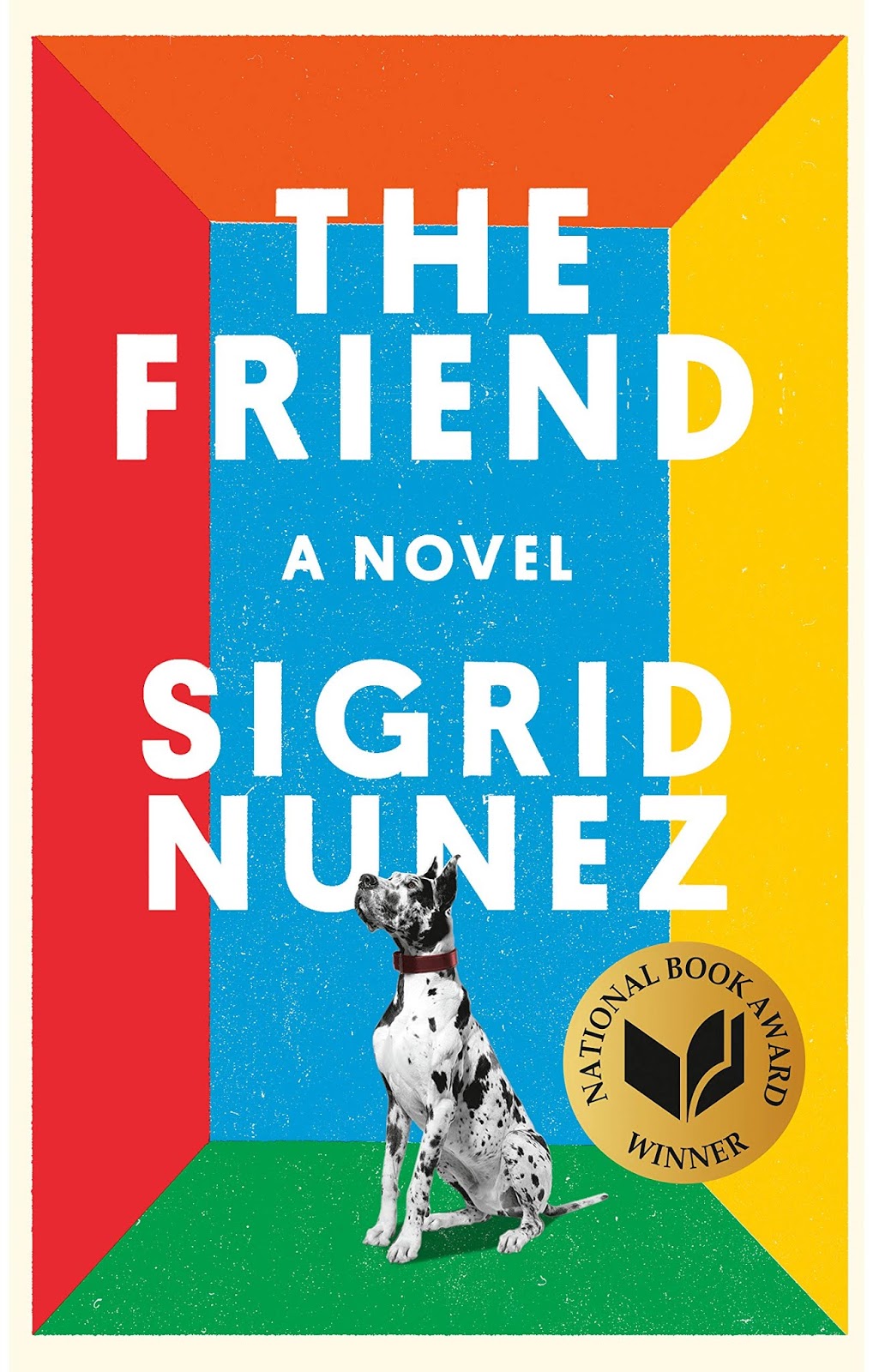
Book Report: The Friend

6. Sigrid Nuñez, The Friend (2018) (3/23/19)

The National Book Award–winning The Friend is an oddly moving book, exploring love, loss, and pain as well as literature, aesthetics, cultural expectations, and the gap—or rather bridge—between humanity and animals. Framed as a sort of journal-slash-letter to a close friend who has committed suicide, the book explores, sometimes in brief one-thought paragraphs, other times in longer accounts of specific memories or events, the nameless female author's relationship to the nameless male friend and mentor, both of them fifty-ish writers and teachers. There is also a dog, a 180-pound harlequin Great Dane named Apollo, whom the writer has inherited and must share her 500-square-foot apartment with, illicitly (she lives in rent-controlled Manhattan).

There's no real plot to speak of: it's largely a novel of ideas and impressions. The dialogue is not novelistic, but rather chunks of prose within quotation marks. There is relatively little descriptive detail. The book is divided into twelve "parts." The first begins with the last conversation the author and dead friend ever had, moves into his memorial service and a general, unflattering description of the friend—he was an unrepentant womanizer, one might say lacking in maturity—and ends with the conversation with Wife Three in which the author learns that she will be giving Apollo a new home. The next nine chapters range through, among other things, examinations of literature (J. M. Coetzee's Disgrace and J. R. Ackersley's My Dog Tulip, for example, both of them featuring dogs in a sorry fashion—but many, many writers, from Proust to Flannery O'Connor, Virginia Woolf to Heinrich von Kleist appear, even if only briefly); the act of writing as confession or catharsis; the nature of attachment, in part through the lens of human sex trafficking (the object of the author's research); political correctness and the notion that the world can be made "safe"
. . . and quite a bit about the nature of dogs: their opinions, their yearnings, their anxieties, their regrets, their sweet, sweet—or bittersweet—memories. Which, of course, reflect immediately back on the author—or, humanity writ large.

Not to give anything away, but the final two chapters bring the book onto a new plane and relieve some of the angst of the previous musings. They leave the reader feeling lighter and, dare I say, both glad to be alive and feeling a little more careful to enjoy this life as fully as possible.

Here is a brief discourse on the life (and expectations) of a writer (the "you" in the following is the dead friend):
I remember the interviewer asked the usual question about audience, whether you wrote with a particular reader in mind. Which set you off about the relationship between writer and reader and how much that relationship had changed. As a young writer you'd been told, Never assume your reader isn't as intelligent as you are. Advice you'd taken to heart. You wrote with that reader in mind, you said, someone as smart as—or why not even smarter than!—yourself. Someone intellectually curious, who had the habit of reading, who loved books as much as you did. Who loved fiction. And then, with the internet, had come the possibility of reading the responses of actual readers, among whom you were pleased to find some who did indeed match, more or less, the reader in your head. But there were others—not just one or two but quite a number when you added them up—who had misread, or misunderstood, in some cases quite seriously, what you'd said. Troubling enough when the reader was someone who'd hated the book, but that was far from always the case. Like other writers you now found yourself regularly damned or praised for things that had never occurred to you, things you had never expressed and never would express, things that represented pretty much the opposite of what you actually believed.
 . . . You got customer reviews full of umbrage, suggesting that if a book didn't affirm what the reader already felt—what they could identify with, what they could relate to—the author had no business writing the book at all. Those hilarious stories that people loved, and loved to share—the book clubber who said, When I read a novel I want someone to die in it; the complaint against Anne Frank's diary, in which nothing much happens and then the story just breaks off—did not make you laugh. Oh, you knew that a lot of people, including other writers, would accuse you of being precious. Some would say that, after all, the one sure way for an artist to know his work had failed was if everyone "got" it. But the truth was, you had become so dismayed by the ubiquity of careless reading that something had happened that you had thought never could happen: you had started not to care whether people read you or not. And though you knew your publisher would spit in your eye for saying so, you were inclined to agree with whoever it was who said that no truly good book would find more than three thousand readers.
And what dog owner (and perhaps cat guardian as well) can't identify with this close to chapter 8?
Watching Apollo sleep. The peaceful rise and fall of his flank. His belly is full, he is warm and dry, he has had a four-mile walk today. As usual when he hunched in the street to do his business I guarded him from passing cars. And, in the park, when a texting jogger bore down on us, Apollo barked and blocked his path before he could run into me. I have played several rounds of tug-of-war with him today, I have talked to him, and sung to him, and read him some poetry. I have trimmed his nails and brushed every inch of his coat. Now, watching him sleep, I feel a surge of contentment. There follows another, deeper feeling, singular and mysterious, yet at the same time perfectly familiar. I don't know why it takes a full minute for me to name it.
 What are we, Apollo and I, if not two solitudes that protect and border and greet each other?
 It is good to have things settled. Miracle or no miracle, whatever happens, nothing is going to separate us.