Saturday, November 12, 2022

National Book Award: Fiction (7)

The National Book Award nominees were announced today. I haven't even heard of any of the fiction books, shortlist or long. I am resisting the (strong) temptation to jump on the internet and order like crazy. I will, perhaps, act like an adult and check the library first? And so, it will help to have a list (the descriptions are excerpted from the publisher-provided blurbs). The selection committee comprised Ben Fountain, Brandon Hobson, Pam Houston, Dana Johnson, and Michelle Malonzo. I don't think anyone can complain about a lack of diversity in these choices. (11/17 The awards were announced yesterday, and the first entry here was the fiction winner. I must say, it looks intriguing.)

The Rabbit Hutch, by Tess Gunty. An online obituary writer. A young mother with a dark secret. A woman waging a solo campaign against rodents — neighbors, separated only by the thin walls of a low-cost housing complex in the once bustling industrial center of Vacca Vale, Indiana. . . . A bitingly funny snapshot of contemporary America, a gorgeous and provocative tale of loneliness and longing, entrapment and, ultimately, freedom.

The Birdcatcher, by Gayl Jones. Set primarily on the island of Ibiza, the story is narrated by the writer Amanda Wordlaw, whose closest friend, a gifted sculptor named Catherine Shuger, is repeatedly institutionalized for trying to kill a husband who never leaves her. The three form a quirky triangle on the white-washed island.
. . . A study in Black women's creative expression and the intensity of their relationships.

The Haunting of Hajji Hotak and Other Stories, by Jamil Jan Kochai. Kochai ​breathes life into his contemporary Afghan characters, moving between modern-day Afghanistan and the Afghan diaspora in America. In these stories verging on both comedy and tragedy, the bravado of the often young characters is matched by their tenderness.

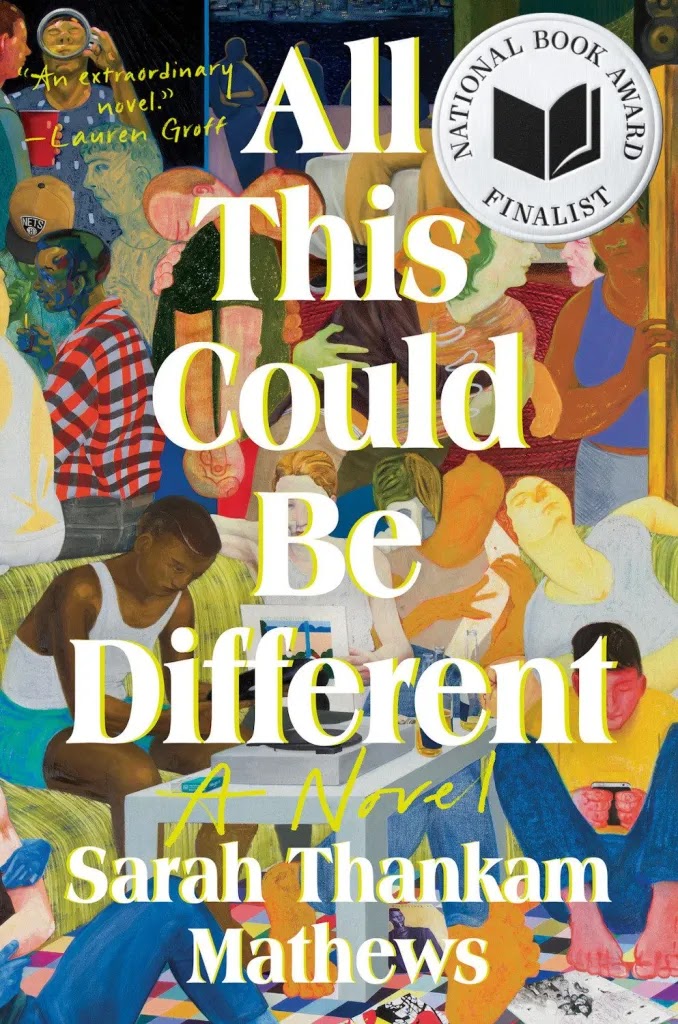
All This Could Be Different, by Sarah Thankam Mathews. Graduating into the long maw of an American recession, Sneha is one of the fortunate ones. She’s moved to Milwaukee for an entry-level corporate job that, grueling as it may be, is the key that unlocks every door: she can pick up the tab at dinner with her new friend Tig, get her college buddy Thom hired alongside her, and send money to her parents back in India. She begins dating women—soon developing a burning crush on Marina, a beguiling and beautiful dancer who always seems just out of reach.

The Town of Babylon, by Alejandro Varela. In this contemporary debut novel—an intimate portrait of queer, racial, and class identity—Andrés, a gay Latinx professor, returns to his suburban hometown in the wake of his husband’s infidelity. There he finds himself with no excuse not to attend his twenty-year high school reunion, and hesitantly begins to reconnect with people he used to call friends. . . . Captivating and poignant; a modern coming-of-age story about the essential nature of community, The Town of Babylon is a page-turning novel about young love and a close examination of our social systems and the toll they take when they fail us.

Longlist (here, for the most part, I am paraphrasing the publisher blurb)

When We Were Sisters, by Fatimah Asghar.  Three Muslim American sisters must raise one another when their parents die.

Shutter, by Ramona Emerson. A Navajo forensic photographer sees the ghosts of crime victims, who point her toward clues the police overlook.

If I Survive You, by Jonathan Escoffery. Linked stories about a Jamaican immigrant family, especially a younger son, searching for a foothold in Miami.

Nobody Gets Out Alive, by Leigh Newman. Stories set in Alaska about women "struggling to survive not just grizzly bears and charging moose, but the raw legacy of their marriages and families." 

Maria, Maria, and Other Stories, by Marytza K. Rubio. "Set against the tropics and megacities of the Americas, Maria, Maria takes inspiration from wild creatures, tarot, and the porous borders between life and death. Motivated by love and its inverse, grief, the characters who inhabit these stories negotiate boldly with nature to cast their desired ends."

Maybe tomorrow I'll present the nonfiction nominees. I have heard of a few of those. They all look interesting. (And I know, I know, all this information is on the NBA website. But will I remember to look there in a month's time? Plus, not every day here has to be about me, does it?)


Friday, November 11, 2022

Vision (6)

I grew up with poor vision, and wore glasses, and then contacts, for much of my life. Then about twenty years ago I had Lasik surgery, and corrected my vision: to 20/30 or so in the left eye, for distance, and 20/something in the right, for reading. I remember waking up the next day and, instead of having to grope for my glasses, being able to see. It was a miracle! My brain figured out the differential, and for years I've been fine relying on one eye or the other to do the bulk of any job.

Until earlier this year I noticed that I really had to get up close to see clearly what I was reading. That was weird. And so I went to the eye doctor, and sure enough, my right eye has been getting progressively worse. I believe the culprit is a cataract. The doctor says we should just let it be until I can't stand it anymore. In the meantime, glasses will help.

And so I went to Lenscrafters and ordered two pair of glasses, one for distance (blue frames), one for reading (red). It's kind of a pain, but I am getting better and better about keeping my glasses in designated places where I can find them: in front of the TV for the distance ones, on my desk or by my reading chair for the others. And I can still drive without glasses (until my next DMV visit, at least): my left eye hasn't changed. 

We are fragile creatures. If you stop to think about it, it's astonishing that we work at all, never mind as well as we do. Even when we're not working exactly perfectly.


Thursday, November 10, 2022

Toilet (5)

For a number of years now I have been a volunteer wilderness ranger in the Los Padres National Forest, as part of a partnership between the US Forest Service and our local Ventana Wilderness Alliance (VWA). Last Saturday we had our annual summit, where I once again got invigorated about going out on at least eight outings for the next year in our Wilderness areas: the Ventana and the Silver Peak.

VWRs (Ventana Wilderness Rangers), VWA staff,
USFS representatives: one big happy family

Today was my first such outing, with my friend and fellow ranger Lynn and our new trainee Lynne. Our goal: to move a wilderness toilet at one of the several very popular camps along Big Sur's Pine Ridge Trail. "Move" means: dig a new hole, then relocate the heavy wooden box from the old hole to the new one. Hoping the shit in the old hole hasn't piled up too high—which in this case, thankfully, it hadn't (quite). And then covering up the old shit with the dirt we dug up from the new hole. We used a shovel, a heavy digging bar, and a tomato can in this endeavor. Here are a few photos:

Lynn starts the new hole

We've made some progress!

Done!

And reconfigured!

You can see where the old toilet was;
we "naturalized" and hope everything remains stable

After completing this project, and having lunch, we checked out the second toilet at Barlow Flat. Oy! It is overfull: shit well up into the box. I am really glad that I was in on this first venture. The next one will be good experience for another one of our five trainees ;-)

We have a number of wilderness toilets under our purview: 1 at Ventana Camp, 2 at Terrace Creek Camp, 2 at Barlow Flat Camp, 3 at Sykes Camp, 1 at Pine Ridge Camp, and 1 at Willow Camp (all in the Ventana Wilderness), plus two in the Silver Peak Wilderness, at Estrella and Spruce Camps. I have a feeling that, given the increased use of these beautiful backcountry venues, we'll be seeing more toilet maintenance coming our way. It's okay. Better than picking up stray toilet paper behind random trees along the trail.

Moving toilets is just one part of our job. We also clean up and remove fire rings, pick up trash, do "brushing," repair trail tread, saw trees out of the trail, and best of all, talk to visitors. Today we met up with 15 backpackers (and two dogs). They all seemed really happy to be out on a beautiful day. 

As were we.


Wednesday, November 9, 2022

Book Report: The Island of Missing Trees (4)

25. Elif Shafak, The Island of Missing Trees (2021) (11/7/22)

A friend recommended this book the other week, saying it was one she'd already read twice and could see reading yet again. She absolutely loved it. That's high praise. And while I don't expect to be rereading this, I did enjoy it—mostly. 

It's a story of a divided land: Cyprus. And of people, Turks and Greeks, divided by war. And of young lovers, Kostas and Dafne, similarly divided by circumstance, by history. The story plays out in several time frames: the late 2010s in England, 1974 in Cyprus, and the early 2000s in Cyprus. 

In the present-day story, we have Kostas and his teenage daughter, Ada, who have grown increasingly apart since Dafne's death the year before. (Yes, we learn right off that the two lovers do marry.) Then Ada has a disturbing experience at school, which makes her feel ostracized and odd. At the same time, her aunt Meryem, Dafne's sister, comes to visit, and Ada isn't entirely welcoming. Why did none of her mother's family come to help grieve when Dafne died? 

The older stories tell of young Kostas and Dafne's illicit courtship, aided by two tavern owners, also Turkish and Greek, and then of their reunion twenty-five years later, long after Kostas, at his mother's insistence when the bloodshed in Cyprus became unbearable, had moved to England to live with his uncle. In the meantime, he has become a respected botanist, and Dafne has become an anthropologist. When they meet again, she is part of a team that is looking for the bones of the dead on the island. 

It's a good enough story, though there were no surprises. (Kind of like real life, I suppose.) Even the sad fate of the two tavern owners, who happen in addition to be gay—sin heaped upon sin, for those days and that culture—is essentially laid out at the very start, in a prologue. But Shafak does an excellent job of telling the history of Cyprus, all the divisions and animosities, through these characters' stories. I remember reading about the partition and the violence back in the 70s; Shafak makes all that come alive and underscores the sadness, pain, and confusion of the time. Also the echoing silences.

What I did not like was the use of a gimmick: a narrating fig tree. Although I appreciated most of what the tree had to say—it proved a useful stratagem for relaying all sorts of random stuff, about natural history especially, the bees and butterflies and songbirds and, of course, trees of all sorts, but also about Cyprus and humanity—it felt like an annoying contrivance. It found a sort of redemption at the very end, I suppose (the only real "surprise" in the book), but still...

There was also something about the writing itself, just the way the words were put on the paper, that I found irritating. I can't put my finger on it. Maybe a sort of preachiness?

But all that said, yes, I am glad I read this book. I learned a lot. 

I didn't flag any passages, but I did stick page 141 in my mind. It's the darn fig tree talking:

They call it the Green Line, the partition that cuts through Cyprus, aiming to separate Greeks from Turks, Christians from Muslims. It acquired its name not because it was marked with mile after mile of primeval forest, but simply because a British major general, setting out to draw the border on a map spread out before him, happened to use a green chinagraph pencil.
     The colour was not a random choice. Blue would have been too Greek and red too Turkish. Yellow represented idealism and hope, but it could also be interpreted as cowardice or deceit. Pink, associated with youth and playfulness as well as femininity, would simply not work. Nor would purple, symbolizing ambition, luxury and power, have produced the desired result. Neither white nor black would do, they were too decisive. Whereas green, used in mapping to mark pathways, seemed less contentious, a more unifying and neutral alternative.
     Green, the colour of trees.

Tuesday, November 8, 2022

Alexander Malofeev, pianist (3)

I am feeling lazy today, so just a couple of videos, of a young pianist whom a friend referenced on FB and whom I'd like to keep track of. The first piece is Sergei Rachmaninoff's Rhapsody on a Theme of Paganini, ор. 43; conductor Myung-Whun Chung with the Orchestra Sinfonica Nazionale della RAI di Torino (2018). Malofeev was sixteen. (He is now twenty.)


The second one is Saint-Saens's Piano Concerto No. 2 in G Minor, op. 22. Here Malofeev is twelve. This performance won him a gold medal in the 8th Tchaikovsky Competition for Young Musicians (2014). The State Symphony Orchestra "New Russia" is conducted by Yuri Tkachenko.


And finally, Mozart's Piano Concerto No. 20 in D Minor, K. 466, from 2019. En Shao conducting the Orchestra Academia China.


I took piano lessons when I was a kid, with Mrs. Josephine Siple. I was never any good at it, and the lessons didn't last all that long—though I enjoyed going to Mrs. Siple's big river-rock house up Mandeville Canyon in LA. As I recall, there were cookies. However, the piano is one of my favorite instruments to listen to. And this kid is amazing! As one of the YouTube commenters says, quite rightly, of the third piece here: "This is the first Mozart I have heard Alexander play. He does with Mozart what he does with every other composer he plays: he raises him from the dead. His flawless technique and deep understanding of the melodic line allows his listener to forget him and encounter the author. He is a truly humble virtuoso. He doesn’t have to prove himself, he lets himself go. And in this case, Mozart soars."


Monday, November 7, 2022

My day (2)

It is raining! The sound of pouring, pounding, even just pattering rain is so delightful to these drought-stricken ears! And I know the little fig tree and persimmon, the lavender and rosemary, the rhododendrons and cyclamen-in-a-pot, the Lady Banks roses and wisteria (if it's still alive...), are rejoicing even more. I hope it will be a good rainy season. Though too often, we get rain early, then nothing. So we shall see.

But the plants aside, for me this day had various acts.

Alfred Boulton, Untitled, c. 1940
I. Finished a proofread for the Getty Research Institute, about a Venezuelan photographer and art historian, Alfredo Boulton. I will send it back tomorrow. (I like proofreading. It involves minimal fuss. And I usually learn something.)

II. Finished my latest book-for-pleasure, The Island of Missing Trees by Elif Shafar. No spoilers now: the report will be tomorrow or the next day's post.

III. Walked our ballots over to city hall to VOTE. I am dreading tomorrow's results. I wish I felt more optimistic, but I just don't. We are in dark days...

IV. Helped (rather minimally, save standing in a very long line, for a very long time, at our local Xfinity store) David solve an issue with our TV. Last night when we tried to watch streamed features, it wouldn't work! Today, too: wouldn't work! David checked the Xfinity website and saw a large spike in people reporting issues with their TV streaming last night, so we figured we were part of that. But when it didn't resolve, David stepped up to the plate—or rather, picked up the phone. Many hours later, speaking to both Xfinity and LG (our TV's people), we (he) finally got things working. But our ethernet seems to be shot. So we're using wifi. I don't know what this all means, really. It's as foreign as baseball to me. 

Turned out, standing in that long line wasn't even necessary: we don't need the (free) gadget they gave us (because yeah, wifi does the trick). But we did run into an old friend, the Singing Sheriff Pat Duval (who turns 80 next week, and has just successfully fought off aggressive prostate cancer), and it was nice to chat it up.

V. Had leftovers for dinner: smoked gouda and pumpkin mac and cheese, with a bit of chicken tossed in, and salad on the side. Comfort food, for sure. I will be making that recipe again.

VI. Finished up with our usual evening of TV: Handmaid's Tale, third episode of season 5; Barry, first two episodes; and M*A*S*H, S3E21. And by then David was falling asleep. As he does by the time we get to M*A*S*H. Because the cats wake him up at an ungodly hour. Plus, today: all those phone calls. He was bushed!

All in all, a good day. And the dog even got walked! (He helped us vote.)

NB: I have a couple of friends (FB friends: friends I've never in fact met) who every day post about what they've been up to, what they see out their window, what their dog is doing, what music they're listening to, what friends they've gotten together with, etc., etc., etc. Just beautiful mundane stuff. I find it strangely compelling, even though I don't actually know these people. But I empathize, or maybe I'm sympathizing, I don't know. I just feel an affinity. Don't worry: I'm not going to do a daily accounting of my doings. But today: well, it was memorable, in its own way. I'm glad I have a record.


Sunday, November 6, 2022

Eating out (1)

I have done a few Project 365 blogs. I am considering another one. Hence the (1) in the title, which I realize is bold.

It's not that I have anything in particular to say, but I crave the discipline—of paying attention to my time, to what I encounter or learn or feel in a day; and of writing, which I don't do enough of. Though it is, arguably, what I'm good at. 

I used to share "15s" (basically, journaling) with my sister-in-law, but that stopped. I've missed the interaction. I know very few people look at this blog, but those of you who do: you're my friends, and I enjoy sharing my experience of life with you.

So, I'm considering another 365.*

For right now, I just want to share this evening's experience of going out for dinner at a restaurant, which is something we do more and more rarely. It's expensive! (Used to be much less expensive.) The food is good, but if it's more or less something I'd cook in my own kitchen, what's the point?

David, though, has been sighing for a while now about wanting to go out to eat. I keep pointing out that we have lots of tasty leftovers! For some reason, that doesn't appease him. So this afternoon I asked, "Do you want to go out to dinner?" The look on his face! Like our cat just after he's captured a white-crowned sparrow!**

So: I chose Zab Zab, a Thai restaurant in New Monterey that we like. There was a table free, in front, yay! Unfortunately, to my left was a family of three, the small child of which was very vocal. Little kids have high-pitched voices that can be loud. Dad kept admonishing, "Shhhhh" (bless his heart), but there was only so much he could do. I maybe need to start carrying earplugs when we go out to dinner. So I can concentrate on the menu at least.

But the darling little tyke ended up being no problem at all. The problem was the table to my right, four adults. Who were discussing a legal case. The plot of which I didn't entirely discern (I was trying not to listen), but an older gentleman was grilling one of the women, 50-ish, about her relationship with (a) marijuana and (b) a marijuana-smoking younger relative. Grilling! He kept mentioning "the jury." I had an impression that the younger relative... died? The older gentleman (I employ the word advisedly) kept using the word "shit," which every time made me cringe. So much judgment. Maybe he was a lawyer, the 50-something's lawyer, I don't know. He certainly seemed to be prepping her for questions.

I tried to enjoy our spring rolls, our sweet and sour chicken and cellophane noodles with shrimp, my Chardonnay. But I couldn't not hear the oppressive conversation going on next door.

Eventually (they were long done with their meal), I couldn't help it: I had to speak up. "Excuse me, do you think you could take this conversation elsewhere? It's not conducive to dining. It's heavy and it's combative. Maybe go talk over drinks or something?" 

I'm not confrontational, so it wasn't easy for me to say. But honestly: what I was witnessing was an interrogation, in an otherwise pleasant setting! 

They very quickly rounded up the check, paid, and took off. The two women apologized as they left. I wished the one who'd be before the jury luck, and she thanked me. 

It all just struck me as so inappropriate. Like we're all in each other's business anymore anyway, but at the same time all in our own little bubbles—so anything goes? No situational awareness, no respect for others. It's not good.

I have been feeling increasingly anxious as the Tuesday election nears. I am not at all optimistic that civility, our social good, will prevail. This is happening all over the world, not just here, which I guess is a bit of a comfort. It's not only this (my) country that's getting torn to pieces. But it doesn't make me feel very hopeful about humanity...

Since I always include a photo with my posts, here's something beautiful and completely random,*** a work of environmental art by Andy Goldsworthy, by way of antidote:


*I know, I know: I aborted one a couple of years ago, at #100, when travel, and then the pandemic, interrupted. And I sort of started one earlier this year, but it didn't get far at all. Still, it's a new day! Maybe this time I'll persevere! Or maybe I'll take it to 100 again and leave it at that. Or to 30 or 50 or 75. Or (gasp) skip a day now and then! There are no rules. Or rather, I make the rules. And nobody else cares.

**Yeah, our cat catches birds. We have switched to a schedule where he's indoors during the day, and gets to go out at night, when the birds are asleep. Sometimes, though, he sneaks out in daylight. Yesterday he brought us a song sparrow—which was alive and flew away—and a scrub jay—which was not. We need to train ourselves to keep him indoors. We're getting better at it.

***The Goldsworthy image was not actually completely random. I saw it on FB today, in a thread by a photographer friend who posted it accidentally (I think he intended to post one of his own photos). It made me happy to see Goldsworthy, though. Serendipity! And beauty! Never a bad combination.