Friday, December 24, 2021

Wigs

Last month our family convened here in California for a week: Geoff and Heidi all the way from Norway, and Patty from Seattle. It was so good to get together with them, and also with Geoff's son and his family, Aaron, Ruby, and Felix, up in Bonny Doon in the Santa Cruz Mountains. 

Patty flew into the Monterey airport, and we went to pick her up. We waited at the gate, but no Patty. Then a text came: "I'm at baggage." We went over there. No Patty. We kept looking around, and then a woman in pink hair sidled our way. A woman in pink hair, a sly gleam in her eye—with Patty's face! Ha ha ha ha ha! She wore a pink wig for her entire trip! Oh, the audacity!

When Patty described her gutsy experiment, she mentioned the show Schitt's Creek and the character Moira Rose (played so delightfully by Catherine O'Hara) and her oh-so-many "girls" (i.e., wigs). That comment got us to watch Schitt's Creek again. Oh! What a wonderful show! (We finished the sixth and last season this evening.) I had forgotten about the central role that Moira's girls, and her ostentatious wardrobe, play. Not in the story so much, but certainly in her self-creation. Something (self-creation, that is) that I have zero understanding of. But I do admire people who do understand and manifest—in a positive, creative way.

So here, for my own viewing pleasure, I'm posting a few videos of certain themes in the show. First up, Cabaret: 


Next, David and Stevie's friendship:

The Crowening:


And here are a couple of cast roundtables that I am putting here for future viewing. And yes: I will most likely be queuing up Schitt's Creek again before too long. Because it's that good.


And here's the cast talking about the final season:


I just love this show. I think it's important: it teaches love, acceptance, and the importance of family and community above all.

And no, sorry, I guess I didn't say much about wigs. Except it's a wig that got me here.


Wednesday, December 22, 2021

Book Report: All About Love

65. bell hooks, All About Love: New Visions (2000) (12/22/21)

When I learned last week that feminist cultural critic bell hooks had died, I felt it only right that I finally read this book, which I've had on my shelves for years. Finding it proved surprisingly easy, considering the spine had faded such that only "New Visions" was legible. Clearly, it, too, was ready to be read.

Comprising thirteen chapters titled in abstractions—clarity, justice, honesty, commitment, spirituality, values, greed, community, mutuality, romance, loss, healing, and destiny—the book explores the ways in which we both seek love and run from it. Occasionally, we even find it. In this effort, hooks invokes many, many other writers—psychologists, spiritualists, religious folk, philosophers, etc.—such as Jack Kornfeld, Thich Nhat Hanh, Alice Miller, Harriet Lerner, Sharon Salzberg, Thomas Merton, Marianne Williamson, and many more. (She was reportedly a voracious reader.) She also, and perhaps more rewardingly, speaks freely of her own life—her own experiences with difficult or fulfilling relationships, of being a child in a dysfunctional family, of seeking spiritual solace, of thinking about society and our place in it. 

hooks asserts from the start that love is not simply a feeling: it is an action, a way of being in the world, a process that involves active soulful connection, the will to nurture our own and others' spiritual growth. "To truly love," she writes, "we must learn to mix various ingredients—care, affection, recognition, respect, commitment, and trust, as well as honest and open communication." These must all be present and in balance. It is not easy to love; it requires work. 

Then too, we must be aware of tendencies that work against love, such as violence, materialism, manipulation by others, fear (of pain, of death, of discomfort). She points up capitalism and patriarchal structures and norms as especially damaging, promoting false dichotomies of what is possible or desirable in our search for wholeness.

Here is a paragraph from "Values: Living by a Love Ethic" that I found telling, given today's climate:

Cultures of domination rely on the cultivation of fear as a way to ensure obedience. In our society we make much of love and say little about fear. Yet we are all terribly afraid most of the time. As a culture we are obsessed with the notion of safety. Yet we do not question why we live in states of extreme anxiety and dread. Fear is the primary force upholding structures of domination. It promotes the desire for separation, the desire not to be known. When we are taught that safety lies always with sameness, then difference, of any kind, will appear as a threat. When we choose to love we choose to move against fear—against alienation and separation. The choice to love is a choice to connect—to find ourselves in the other.

I found much of what she had to say worth pondering, but I also began to find the book a bit tedious by about half-way through—something about the preacherly voice, and the way she'd circle back and around to points already made. I am glad I read it—in a certain way it is affirming of the very possibility of more love in our lives. I'm also glad I can now mark it as complete.


Saturday, December 18, 2021

Salmon Creek workday

This morning I met four other wilderness rangers at 6:30 (though it felt like the middle of the night), whereupon we drove 75 miles down the coast to Salmon Creek Trail—to do some work.

The day really got going while watching the full moon set over the Pacific, laying its beam of light on the water. We were pretty much alone on Highway 1, and the world felt large and beautiful as we snaked down that twisting road in the growing dawn.

At Salmon Creek Station we met up with two other rangers. And then we seven set off, with two crosscut saws, various long-handled tools (shovel, hoe, combi-tool), hardhats, and a general plan: a number of logs across the trail to be dealt with, some tread to be repaired, and always brushing.

I took some photos, of course. (Click to see large.)

Narcissus at Salmon Creek Station

Lynn crossing Spruce Creek,
running nicely after the recent rains

This was our first tree to cut

The next few photos show some of the life
inhabiting said tree


And the ladybugs! Not on that tree, but on some
deadfall nearby—and then, all over the trail...
we tried to move them, but I fear many hundreds
will not survive. And they probably thought they'd
picked the perfect spot to congregate...

Another tree, with a little saw action

The ferns are so green right now!

Treadwork

Spruce Creek on our crossing back out

On the way back north, we watched the sun set on our left (Lynn was sure she saw the green flash—the horizon was so crisp) and the moon rise on our right. 

After a quick Boboli pizza dinner, David and I headed to the Sandbox, a new creative space in Sand City, to watch/listen to an open rehearsal of a string quintet—Dvořák's op. 18/77. Sawing of a different kind. All in all, a delightful day.


Wednesday, December 15, 2021

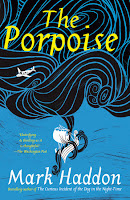
Book Report: The Porpoise

64. Mark Haddon, The Porpoise (2019) (12/15/21)

This is a strange but riveting book, a portmanteau of not just two, but three stories: one present-day, set mostly in southern England; one set in the mythic past of ancient Greece; and the third taking place in Jacobean London. The framing story sees very wealthy Philippe lose his beloved, pregnant wife in a plane crash, but the baby, Angelica, survives and winds up hidden away at his estate, where he takes sexual advantage of her, as if it's perfectly normal—though as she grows into a teenager, she comes to realize it is not. She retreats into her imagination, which brings us the retelling of the story of Pericles (aka Appolonius), a Greek prince—who is morphed from a young man, Darius, who arrives at Philippe's estate and, momentarily, seems poised to rescue Angelica. Pericles's adventures, too, include the (seeming) death of his wife, Chloë, aka Emilia, and in his case the abandonment of a baby daughter, Marina. These three characters' stories make up the bulk of the book. Midway, interspersed, are a few chapters that feature (dead) Will Shakespeare and a fellow (dying, then dead) playwright (and "pimp, minor criminal, abuser of women") George Wilkins—authors of a retelling of the story of Appolonius, Pericles, Prince of Tyre. 

Though it sounds confusing, it isn't so long as you trust yourself to Haddon's skill with words. He is a master of description, of vocabulary, of rhythm, of suspense—and whereas the original (Wilkins/ Shakespeare) story is focused only on Pericles, in this retelling the women are given considerable agency. The Pericles/Emilia/Marina story ends on a note of hope. The Philippe/Angelica one does not—or does it? It depends on your perspective, I guess. 

I flagged three passages, though I could have flagged many more for the virtuosic writing. Here's one of them:

Angelica hears the soft rip of gravel when Darius arrives and goes to the window to look, visitors being a rare entertainment. The young man who gets out of the sports car and removes a portfolio from the boot is more entertaining than she could have hoped for. He is clearly not someone employed by her father—a lawyer, a banker. He is utterly uncowed by the house and garden and looks, for all the world, as if he might own the place. Is it possible that he is a friend of the family?
     His looks are unimportant. He is young and wealthy, he comes from the Great Elsewhere and there is a dash about him which suggests that in his company anything might happen. But on top of these things he happens to be almost comically handsome—slim hips, a wave of thick hair the colour of black coffee, a feline ease in his own body. She has read about Lydia Bennet's elopement with George Wickham, about Marie Melmotte falling for the rakish idiot Sir Felix Carbury but she knows little of the world and it is often hard to recognise stories when you find yourself inside them, so that by the time she has found Darius and her father sitting in the slatted sunshine of the roof terrace she is already in thrall to an imagined future in which he takes her away from all this, and the knowledge that the fantasy is ridiculous does nothing to sour its addictive sweetness.
     Philippe's hackles rise as soon as she appears. If he had known a little more about Darius in advance he would have explicitly excluded her from the meeting. He says, without thinking, 'You shouldn't be here,' taking her subservience for granted. This, he will realise later, is the mistake that changes everything, goading her in front of Bobby's son.

Haddon frequently refers to such "realizations," as well as to events (usually involving death) that are about to happen, reminding the reader that the narrator is in control. And here is an example (picked at random) of Haddon's descriptive prowess:

Above him sails ripple and sway—top-gallant, topsails, courses
. . . Men spider through the rigging. He knows every inch of this ship from the stern lantern to the wooden mermaid with long tangerine hair, painted lips and full but slightly chipped wooden breasts. Three hundred and seventeen tonnes laden, nineteen carriage guns, a hold packed with bisket, Holland cheese, neats' tongues, mutton, lemons, good wine . . . and secreted under these, the Barbary gold which they have earned trading Venetian glass.


Thursday, December 9, 2021

Book Report: Don't Let the Pigeon Drive the Bus!

63. Mo Willems, Don't Let the Pigeon Drive the Bus! (2003) (12/9/21)

Sneaking a super-quick read in here, to give me a balance of three books left for the year. But this one, oh! Hilarious!

The premise is simple: a bus driver has to leave for a little while . . . "So can you watch things for me until I get back?" he asks of the reader—or, more to the point, the child being read out loud to. "Thanks. Oh, and remember: Don't Let the Pigeon Drive the Bus!"

That pigeon is clearly up to no good. He wants what he wants, even if he doesn't know why he wants it. "I tell you what: I'll just steer," he says. "Hey, I've got an idea. Let's play 'Drive the Bus'! I'll go first!" as he runs off the page in the direction of the bus. 

The illustrations, though simple, are what make the book.

As one Goodreads reviewer comments,
"This, friends, is the face of the great manipulator."

He has given up trying to be subtle...

Fortunately, through some unseen force, the pigeon keeps getting thwarted—until finally, the bus driver returns.Whew. That was close. Because seriously: we do not want the pigeon to drive the bus.

Short, quick, very fun read. Not much to it except that—and the fact that it won the Caldecott Medal. Apparently there are other books about this determined pigeon, but apparently too, this one is the best.


Wednesday, December 8, 2021

Book Report: The Art of Description

62. Mark Doty, The Art of Description: World into Word (2010) (12/8/21)

Part of the delightful "The Art of . . ." series from Graywolf Press on various aspects of the craft of writing, The Art of Description explores, through the examples of poems, sensory experience as it is translated, transformed, into words and language. Doty opens the book by saying, 

It sounds like a simple thing, to say what you see. But try to find words for the shades of a mottled sassafras leaf, or the reflectivity of a bay on an August morning, or the very beginnings of desire stirring in the gaze of someone looking right into your eyes, and it immediately becomes clear that all we see is slippery, nuanced, elusive. As Susan Mitchell says, "The world is wily, and doesn't want to be caught."

It's a short book, comprising four essays and an abecedarian, an A-to-Z lexicon of sorts of the tools of the word artist—concepts like color, economy, hunger, morality, qualifiers, and uncertainty. My favorite piece was "The Tremendous Fish," an analysis of Elizabeth Bishop's poem "The Fish," as well as a celebration of everything language can do when it gets it just right: a sense of time and space, of reverence and sorrow, of grace. In "Remembered Stars" (in which he examines poems by George Herbert, Gerard Manley Hopkins, and Hart Crane) and in "Instruction and Resistance" (Ezra Pound's "In the Station of the Metro") he looks at poetry as a means of self-examination, or as an active process of thinking, of being "in the position of interpreter of something that is perpetually open." And in "Four Sunflowers" he looks at four examples of, yes, sunflower poems—four very different poems in mood and style—by William Blake, Alan Shapiro, Alan Ginsburg, and Tracy Jo Barnwell that, yes, evoke sunflowers but also manage to express some aspect of the speaker's psyche: flower and observer become one.

Here's a long section from the first essay, "World into Word," that I enjoyed in part because I have been in a similar situation as to what Doty describes vis-à-vis a fireworks display, and I thoroughly appreciate how he keeps going deeper and deeper into the effort to capture it:

On a warm August evening on a pier in Cherry Grove, New York, I watched a display of fireworks. The wooden dock was crowded, everyone excited for the show to start. Police boats and fire boats whizzed around on the water. When the first flare went up, it became clear that the barge from which the rockets flared was anchored a mere hundred yards off the end of the pier. We could see, in a way I never really did before, the rough industrial-looking process of firework-shooting. When a group of streaks all went up at once, the metal barge itself was lit, and you could smell the gunpowder, and see the fire fountains sputtering into action.
     Proximity to the source meant that the shells were exploding right over our heads. A few children had to be comforted, a few shocked pets hurried away, but everyone else loved it, craning their heads back and taking in the gold and green and fuchsia sparks exploding over us in the form of starbursts or fantastic down-raining flowers.
     Here I sigh. That last sentence just doesn't come anywhere close to evoking the actual visual or auditory experience. Not to mention the smell of burnt powder and drifting smoke picking up a little salt and seaweed tang, mingling with the annoying cigarette of the man next to me. Or my awareness that the colors overhead were complicated by a peripheral sense that the intense light of the launching rockets had lit up the water a peculiar army-surplus green, while a cheerful little blue and yellow inflatable skiff to our right rocked on the wavelets beneath all that celestial action.
     But what struck me most was this: as the bits of fire came arcing down, they streaked across the night at the same time that I became aware of the spider-smoke behind them, strange contrails and patterns left where the flares had been; these were already shifted and lengthened by the wind—so that, beneath the descending display of lights, a kind of ghost display moved at a right angle to the first, strangely, like a visible history of fire written on the night.
     That is a lot to try to fit into words, and it has taken me a paragraph to note, somewhat awkwardly, what the eye took in in a fraction of a second. I tried to put it into a single sentence in order to suggest, as Proust did, the simultaneity of perception. He wanted to dilate the sentence toward its outer limit, so that one would feel the blur of space and time that the unit of syntax held all at once, as it were—like seeing a whole landscape reflected back to you in a single drop of water. Because I'm not him, the attempt to render visual intricacy makes words feel unwieldy, like sacks of meaning that must be lugged into place, dragged here and there, then still don't feel quite accurate.
     Which raises the question, why bother? Is it necessary to render this bit of perception into words? Why do I feel compelled to get this right?

His answer, in a nutshell: because it's what he does. Though it's not that simple, of course. In Doty's case, his excursions through language and meaning and interpretation and representation seem closely linked with desire—desire and yearning (to understand this life, to taste it fully, for deep connection, to experience a sense of the sublime). Perhaps that's true of all of us, but Doty seems to wear that desire on his sleeve. It's something I admire and appreciate about him, very much.

Saturday, December 4, 2021

Book Report: Blue Desert

61. Charles Bowden, Blue Desert (1986) (12/4/21)

I bought this book in Tucson in 1994 but had not read it until just now. Consisting of twelve short essays and fourteen mini-profiles distributed among three parts—"Beasts," "Players," and "Deserts"—it provides a deeply intelligent, unsentimental and yet invested view of the "Sunbelt" and its environs, specifically Bowden's home territory of Arizona, where he worked for years as a journalist. Throughout the book, Bowden comes back to the land, in all its harsh beauty, though he is also fascinated by the kaleidoscope that is humanity. 

The section on beasts focuses on several endangered animals: Mexican bats, pronghorn antelopes, desert tortoises, and a native fish, the Yaqui topminnow. In his discussion of these creatures, he weaves in history and science, underscoring the ways in which the life of the planet—or of this patch of the planet—falls victim to the capriciousness and greed of humankind, even as many seek to protect and preserve.

In "Players," Bowden profiles four individuals: a man of Mexican background whose people came to the area around Tucson when that city was just a scrape in the sand; a Papago Indian whose ancestral land near Phoenix is being scrutinized by developers; Dave Foreman, founder of EarthFirst!, who shows up at Glen Canyon Dam to protest a visit by then–interior secretary James Watt; and a "company man" living in the dying copper town of Ajo. 

Finally, "Deserts" describes life and death as it can play out in the Sonora Desert. Human life and death, that is. In two of those pieces, Bowden walks across the land, reconstructing the journeys of ancient inhabitants, the Monhollan, and of modern-day mojados, or "wetbacks." The last essay reminded me of Luis Alberto Urrea's The Devil's Highway, and it didn't surprise me to learn (in an NPR tribute to Bowden upon his death in 2014) that the two men were friends. Bowden was also part of Ed Abbey's circle. He went on to become known for his scrutiny of drug cartels and the thorny issue of cross-border immigration.

In the chapter on antelopes, Bowden describes accompanying researchers who are trying to learn more about a very small herd that lives on Air Force lands. The essay ends thus, when they have succeeded in netting one of the animals via helicopter:

Huge spikes drink the beast's blood, a thermometer is rammed up its ass and a white radio collar snapped on the neck. The antelope is blindfolded to calm it and this spares us the wild look in its eyes. The animal writhes and the body temperature, normally 98 or 99, jumps to 104. We all jockey in and touch. We cannot resist.
     There are four or five billion of us, a couple of dozen of them. Everyone must touch.
     For years there has been speculation that the pronghorn are mute. They are not.
     A deep rattling moan escapes the animal and the warm desert air suddenly chills. No one can mistake the message of the sound, the grieving powering it.
     A kind of collision between cultures has taken place. Huge machines that fly at eighty miles per hour and drink more than seventy gallons an hour have snared an organism that has raced at fifty miles per hour for millions of years.
     The sound keeps coming and coming. We have violated some deep important thing and we cannot doubt this fact.

There is a sad and clear-eyed perspective to these essays. Here is another extract, this from one of the "Deserts" pieces:

The past, the wilderness, the sting of thirst, the grip of hunger have become an exotic in my world and in my life. I think back to Secretary James Watt at Glen Canyon Dam so easily celebrating the big cement block choking the river. And Dave Foreman of EarthFirst! trying by language to conjure up a world that has dropped below our horizons.
     "We have the vision." I hear Foreman roaring. "We have the daring. . . . We will see Glen Canyon alive and free, flowing and green in our lifetimes because we can do what we will to do.
     "The other thing is we've got the ethic, we've got the courage
. . . to put our bodies between what we love and the agents of destruction."
     No we don't.
     We are beginning to realize what we have lost with our wonderful inventions and our monstrous new powers. We are becoming more and more aware that our civilization destroys the foundations that support it by devouring the earth and the things of the earth.
     But we don't have the courage to back away, to stop, to restrain ourselves. I know I don't.
     It is just that finally I know, I truly know, that my world cannot last and this dry, hard ground around my camp can and will. So I visit the past to taste the deeper present and prospect the inevitable future.

I don't know if I will seek out more of Bowden's books—I already have too many waiting for me!—but I am glad (if that's the right word for such a sober book) I read this one.