Tuesday, March 16, 2021

Danica Phelps, artist

Danica Phelps with
The Cost of Love (2012) (see below)
Another artist I learned about from Eula Biss's Having and Being Had: Danica Phelps. It is in the section "Accounting," in a chapter titled "Accounting," about worth, value, in art, in life. I quote from Biss:

Income's Outcome is a project that began when . . . Phelps made drawings of everything she did with the money in her bank account until that balance was spent down to zero. She drew her son putting a coin into a parking meter, her hands opening bills, boots on her feet, a scooter, her son pushing a grocery cart. When she sold each one of those drawings, she recorded the income and drew everything she did with that money. The drawings are full of bodies, rendered in long liquid lines, overlapping in embrace, and hands holding things, cookies and eggs and apples. . . .

Her art is an accounting. When a drawing sells, she records the income by painting a green stripe, a tally mark, for every dollar. Money spent is painted in red stripes. Credit is gray, as it occupies the gray area between earnings and expenses. . . .

Not all the drawings she made for Income's Outcome were good, in her opinion, but she had to keep them all because they were part of the financial record, which was also the body of work. And so she priced them according to how much she valued them as works of art. "When I started showing my work, I put the price right on the drawing," she said. "In my first exhibition, there were pieces ranging from $7 to $1,600, based on how much I liked the drawing." The determination of the price, as one gallery noted, was her "final aesthetic decision." . . .

The value of Phelps's art, as she sees it, is inscribed on the art itself, art that illustrates what is done with money paid for art. Her work is both a rebuke of the art market and an acquiescence to that market. Because, as one dealer puts it, "There would be no drawing without the collector act of buying."

That final statement itself is a question definitely open to interrogation, but we are talking about capitalism in this book—a topic that Biss neatly segues into in the next chapter, titled, yes, "Capitalism."

Here are some photos from a gallery installation of Income's Outcome: 


Phelps has done visually similar, but arguably intentionally dissimilar, projects, including The Gratitude Project (2016), the proceeds of which, $20,000, went as donations to 41 philanthropic organizations helping Syrian refugees.

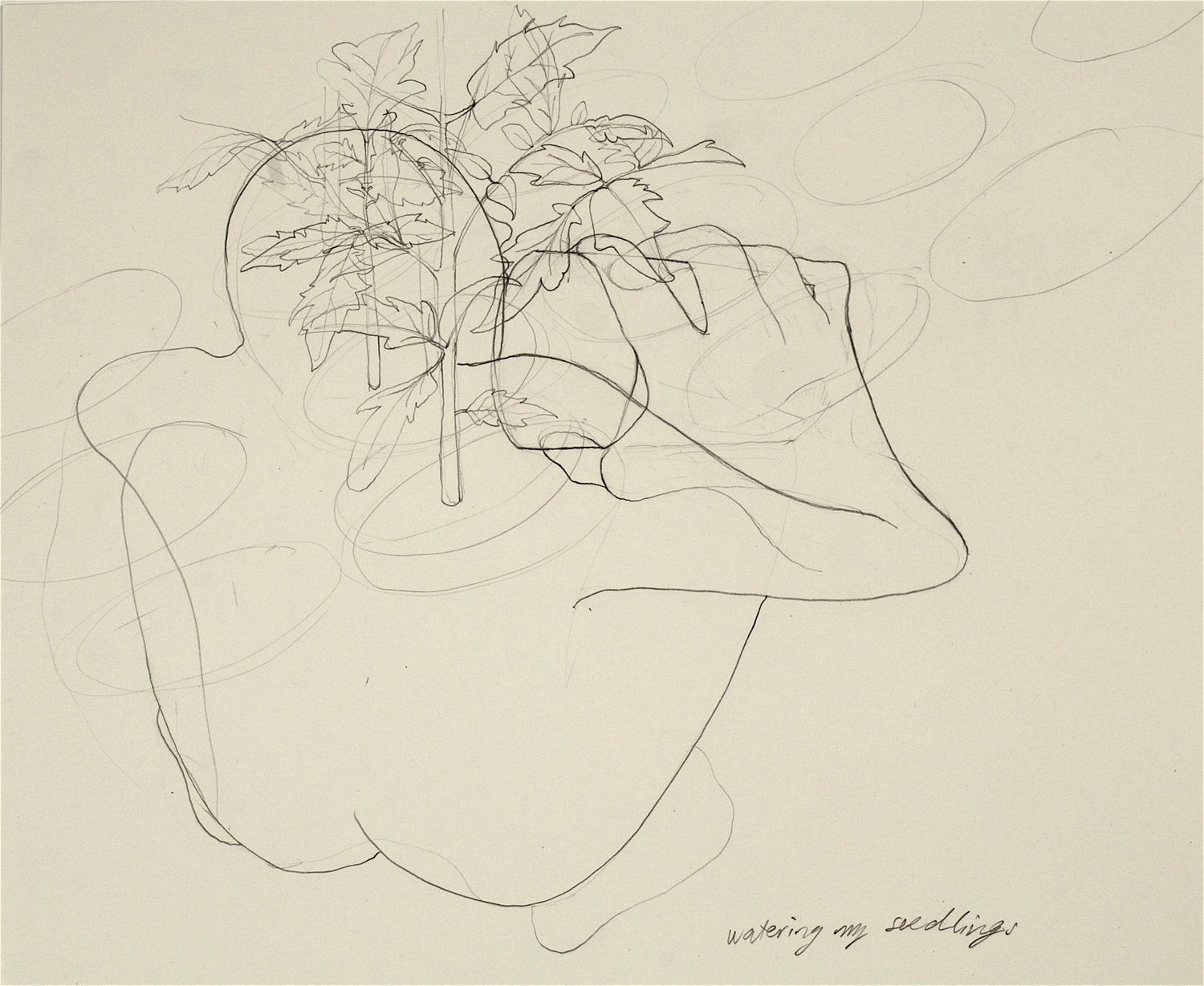
Here's Biss again, describing another project, The Cost of Love (see above, portrait of artist):

In 2012, [Phelps] exhibited a series of twenty-five plywood panels covered in 350,000 red gouache stripes for the $350,000 she lost in the foreclosure of the home she had shared with another woman, her former lover. The Cost of Love . . .  included words drawn from a housing court ruling: "animosity," "eviction," "mortgage." When she bought the home, she hired assistants to help her paint the 627,000 gray stripes that represented the loan of $627,000. But when it foreclosed, she painted every red stripe herself, which took five months. "It's like letting go of the house, every single penny of it," she told a reporter. "And once I've painted it, it's gone."

Here is a detail from "paragraph 2" of The Cost of Love. I am so glad there are obsessive artists like Danica Phelps out there: they help to give visible meaning to life.


Monday, March 15, 2021

Heather Christle, poet

I have a love-hate relationship with Facebook. Currently it's trending toward hate, but then I take a quick look and stumble on something lovely. Like this poem, which actually appeared on Twitter ☛, which I rarely look at, or at least I don't get into such a scrolling mood with it, because I follow so many people--well, 520, which isn't all that many people, but it's still harder to parse, because of retweets and comments and threads and I don't even know what-all. But I am now following two new poets there. 

Anyway, here is a poem by Heather Christle (who comments in that Twitter thread, "Being married to me is Fun probably"):

Suggested Donation

In the morning I drink
coffee until I can see
a way to love life
again. It's okay, there's
no difference between
flying and thinking
you're flying until
you land. Somehow
I own like six nail clippers
and I honestly can't
remember ever buying
even one. My sister
came to visit and
saw them in a small
wooden bowl. I
heard her laughing in
the bathroom. I hope
she never dies. There's
no harm in hoping
until you land.
The deer are awake.
Is one pregnant?
If they kept diaries
the first entry would
read: Was born
Was licked
Tried walking
Then they'd walk
away and no second
entry would ever exist.
I run the deer's
archive. It's very
light work. Visitors
must surrender
their belongings.
Surrender to me
your beautiful shirt.


Saturday, March 13, 2021

Amanda Williams, artist

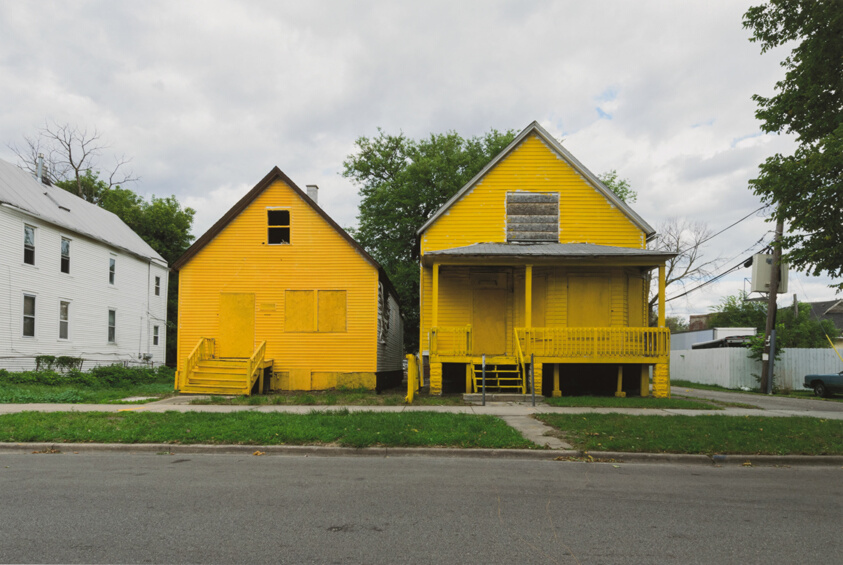
I learned about Amanda Williams, a Chicago-born visual artist trained as an architect, while reading Eula Biss's Having and Begin Had, about consumer culture (book report will follow in a few days). She mentions Williams's Color(ed) Theory Series, an urban art project from 2016, in a chapter about paint chips. Here is a prĂ©cis of Williams's project from the Art Institute of Chicago:

For her series Color(ed) Theory, Amanda Williams repainted and photographed eight vacated and condemned houses in the Englewood neighborhood of Chicago, drawing attention to the issue of underinvestment in African American communities around the city. The artist painted the buildings in a palette of colors found in products and services marketed primarily toward Black people that she felt represented Black consumer culture: Harold’s Chicken Shack, Newport 100s, Crown Royal Bag, Flamin’ Red Hot Cheetos, Ultrasheen, Pink Oil Moisturizer, Currency Exchange, and Safe Passage.

Williams painted the houses with the help of family, friends, and other members of the community; their activity invited passersby to reflect on the complexities of race, place, and value in cities. The bright colors transformed buildings scheduled for demolition, which viewers might otherwise ignore, into sculptural objects. The series raises questions about the racial, social, and political forces shaping the city and their relationship to color: What color is poverty? What color is gentrification? It also highlights the racist history of urban strategies, including policies like redlining that have blocked Black Americans’ equal access to real estate and “white flight” out of cities and into suburbs.

Here is an interview about the project. And here are seven of the eight houses:

Harold's Chicken Shack

Flamin' Red Hots

Crown Royal Bag

Pink Oil Moisturizer

Ultrasheen

Currency Exchange

Loose Squares/Newport 100

At the 2018 Venice Biennale, Williams, together with Andres L. Hernandez and Shani Crowe, exhibited an "intervention" in the courtyard of the U.S. Pavilion ("Dimensions of Citizenship) titled Thrival Geographies (In My Mind I See a Line), citing the Harriet Tubman quote: "I seemed to see a line, and on the other side of that line were green fields, and lovely flowers, and beautiful white ladies, who stretched out their arms to me over the line, but I couldn’t reach them no-how. I always fell before I got to the line." Here and here are two articles about it (the second on "the cultural importance of braided spaces").

Thrival Geographies

Closer up: the exhibit is interactive

And a few other pieces by Williams:

Harriet's Refuge, 2017 (digital collage)

It's a Goldmine/Is the Gold Mine? 2016

There Is a Past Tense, 2006 (oil on panel diptych)

We Have Everything the Same (dipytych)

Pretend Is Water, Real Is This

You can see more of her work at her website.

Finally, here is a short video about Color(ed) Theory:


Thursday, March 11, 2021

Book Report: Dept. of Speculation

14. Jenny Offill, Dept. of Speculation (2014) (3/11/21)

I've had this book for years—I assume, since I have it in hardcover. The other day my friend Nina mentioned reading Offill's newest book, said she really admired her, said she loved Dept. of Speculation. I thought I knew where on my shelves this book might be (it was). It is a small book—physically small in inches, only 177 pages, lots of white space inside. My favorite kind of book: easily gulp-downable. But also, even better: an exquisite little jewel.

It is, in a phrase, the story of a marriage. The meeting, the falling in love, the marrying, the having of a child. That's the first half, all narrated in the first person. Then things shift. The husband has an affair, and the narrator is no longer an "I" but "the wife." Her distraughtness, even at moments craziness, her loss of identity, her despair, woven into the necessary carrying-on. And the effort to get through. Which, it seems, they do—or she does, for the last page of the book is again in the "I" voice, and that suggests that he has come along, into a new phase of existence together. 

The writing is inventive, sensitive, playful, searching. Offill invokes many (many) writers and quotations or anecdotes to tell this woman's story. I made a list. Rilke earns top spot for the number of mentions, followed by John Berryman, then Carl Sagan. Also Einstein and Edison, the Stoics and the Manicheans, Hesiod and Horace, Darwin and Martin Luther, Emily Dickinson and Simone Weil. The list does go on, and the quotes are so fitting in the context of this woman's state of mind.

The story is told in short chapters, which in turn are made up of short chunks (rarely are there multiple paragraphs in one of those chunks). It's an episodic stream of consciousness, but it all adds up. Here are a few examples—just passages I flagged because they're lovely. The first two are from "before," the second two from "after."

My husband comes into the bathroom, holding a hammer. He is talking, reciting a litany of household things. "I fixed the wobbly chair," he tells me. "And I put a mat under the rug so that it won't ride up again. The toilet needs a new washer, though. It won't stop running." This is another way in which he is an admirable person. If he notices something is broken, he will try to fix it. He won't just think about how unbearable it is that things keep breaking, that you can never fucking outrun entropy.

Three things no one has ever said about me:
You make it look so easy.
You are very mysterious.
You need to make yourself more seriously.

How has she become one of those people who wears yoga pants all day? She used to make fun of those people. With their happiness maps and their gratitude journals and their bags made out of recycled tire treads. But now it seems possible that the truth about getting older is that there are fewer and fewer things to make fun of until finally there is nothing you are sure you will never be.

Once ether was everywhere. The crook of an arm, say. (Also, the heavens.) It slowed the movement of the stars, told the left hand where the right hand went. Then it was gone, like hysteria, like the hollow earth. The news came over the radio. There is only air now. Abandon your experiments.

I'd quote the last hopeful page too, but maybe you should go read the book. 


Tuesday, March 9, 2021

Book Report: The Last Coyote

13. Michael Connelly, The Last Coyote (1995) (3/9/21)

I finished the third Harry Bosch novel at the end of December 2019. A year-plus later, it feels like little has changed with our weary detective—now on administrative leave because he threw his lieutenant through a window. So he needs to find something to do with his time. What better than to investigate, on his lonesome, a thirty-year-old cold case—that happens to concern the murder of his prostitute mother?

It's got all the Harry Bosch earmarks: he's tough, he's dogged, he doesn't follow the rules; he's got his hunches, and they turn out to be . . . maybe somewhat right. He gets beat up; a few people, mostly bad guys, get killed. He travels to Florida to follow a lead and, incidentally, falls in love. In this book, which is set just after the Northridge earthquake, his house is red-tagged and eventually torn down, so he's a little bit homeless too.

Although Bosch started nosing after a particular former DA early on, and that DA's right-hand man (who lives in an amazing spaceship house overlooking the L.A. basin), we of course know that they couldn't have done the murder . . . though they might have done other bad things. Bosch was too suspicious of them for them to be the actual killers.

In the end, I wasn't convinced of the motivations of the person who turned out (in the last 40 pages) to be the murderer. 

But the case got tied up, and what else do you want from a mystery/police procedural? 

When I'm editing books, I often turn to schlock. I think Connelly is a pretty good writer—though this time, while on the editing front I was battling an especially awkward translation of short stories from Arabic, I couldn't help but notice how . . . straightforward? uninflected? Hemingwayesque? Connelly's writing is. Not that that's bad. I just kept noticing.

But still: I read, and enjoy, Connelly (this was a re-read, though I'd forgotten everything about it) because I like that bastard Bosch. He's complicated in all the best ways. And Connelly is good at coming up with interesting storylines and evoking place beautifully. What more is there when all you need is a bit of diversion?


Friday, March 5, 2021

Blackout poetry

I've been following a creative mentor, Jen Louden, this last week on Facebook. She's been talking about such things as procrastination, our inner critic, "teeny tiny containers," ways to slip into creating, time anxiety, creative caves, and so forth. She invites people to post on what they've been working on this last week. Oh my! So much activity!

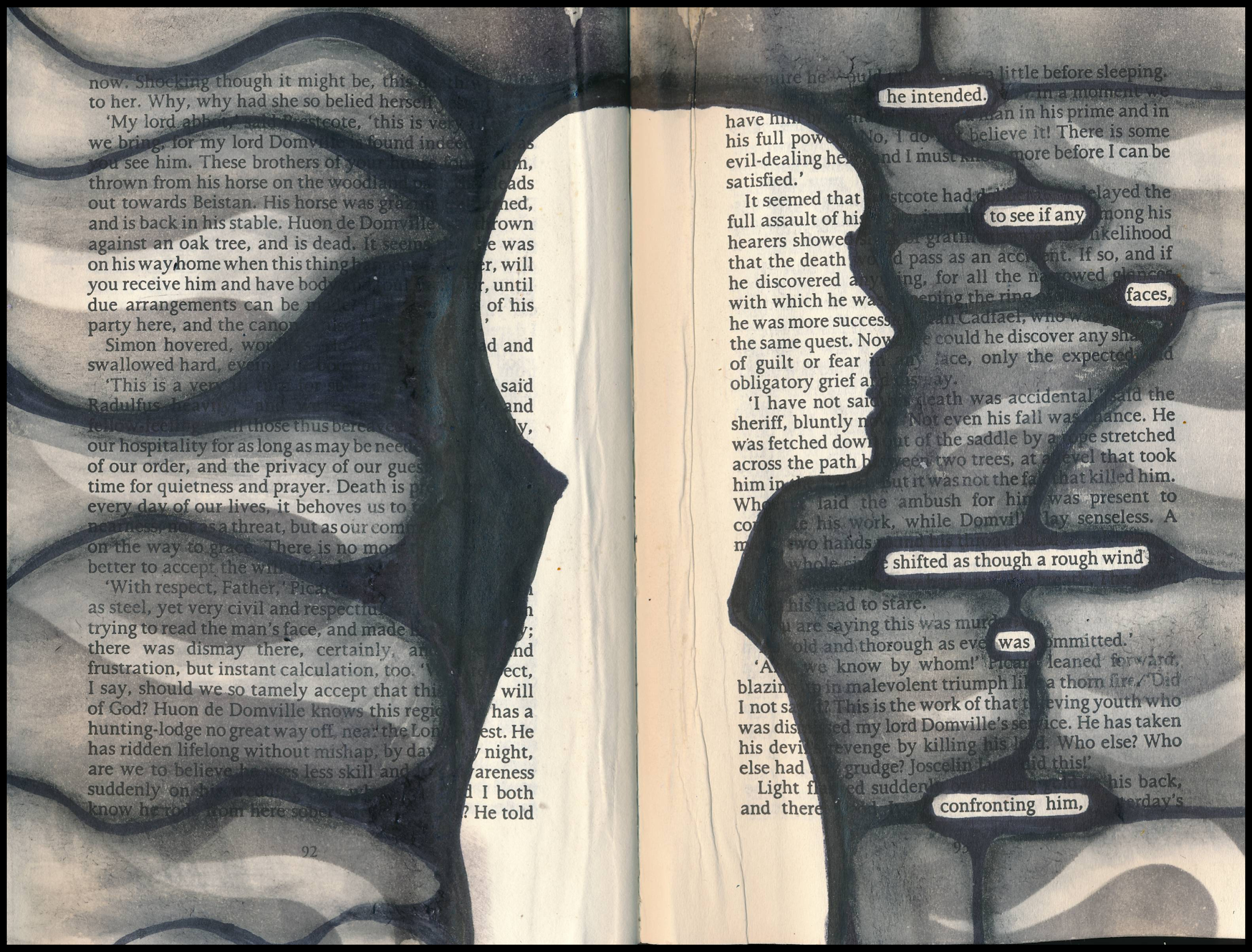
This evening I took a quick glance at the stream, and I was struck by an image of "blackout poetry" by Debra Eck. That got me looking for more. Here are a few random examples that I found. I really enjoy altered books, and in this case, altered book pages. 

Debra Eck (on this page
she has a video about how to
do what she calls
blackout meditations)

WordsbyHK

Colette Love H.

Jordan Wilmot

artist unknown to me

Janni Kretlow

Nadya F (a 7th- or 8th-grader)

Eloeloise

HC Mart

artist unknown to me

artist unknown to me


Saturday, February 27, 2021

Book Report: Tomato Red

12. Daniel Woodrell, Tomato Red (1998) (2/27/21)

Not long ago on FB, a writer friend of mine (of gangster stories) declared . . . I don't remember the exact words, but something to the effect that Daniel Woodrell was a god and could do no wrong. So of course I had to seek him out.

I had read Winter's Bone and greatly admired it. When I read my review of that book now, it seems that book wasn't so very different in its components from this one: a holler in the Ozarks; young people with unrealizable dreams of getting out. And yet while that one moved me, I didn't much care for this one. I don't know quite why, and I keep trying to puzzle it out.

The language, again, was virtuosic—maybe to a fault: there were moments when I wanted someone to just say a plain sentence.

The basic plot concerns a young man, Sammy, who has drifted into Venus Holler, Missouri, "the most low-life part of town," and into the lives of nineteen-year-old Jamalee (Tomato Red, so called for her red-dyed short hair), her younger and drop-dead gorgeous brother Jason (he is also, probably, gay—not necessarily a good thing in podunk Missouri), and their hooker mother Bev. Breaking and entering into the homes of wealthy neighbors introduces them all. 

Jason ends up dead—no one knows how, and the law seems not to care; Jamalee ends up absconding with some money and a gun—hopefully to find a better life, but prospects seem slim; and Sammy, at the very end, whacks someone with a crowbar, so it's pretty clear where he's headed. 

I wanted to like these people, and couldn't. But I suppose I did develop some empathy (or do I mean sympathy?) for them. Or not specifically for them, but for actual red-blooded Americans who live in the poorest pockets of this country and want something better in life—but have no ability to achieve it. 

Sammy's whack of the crowbar at the end is driven by desperate frustration, and I believe (bleeding heart that I am) that that same frustration is what drives so many in this country into sorry fates: of prison, or addiction, or murder, or early death. We, as a society (and I definitely include the uberwealthy here), could do so much more to educate and arm young people and give them the wherewithal to escape circumstances beyond their choosing."Pull yourself up by the bootstraps" be damned.

For a sample of the writing, randomly chosen, here's this:

When you look as if you are a person who should in any circumstances be considered a suspect, you get put through the drill plenty. Big boss man comes sidling up on the driver's side, hand on his pistol butt, stayin' just over my shoulder for a clear shot in case I might snap and want to blast my way free of a parking ticket. John Law has standard demands: license, registration, name of passenger. He runs the paperwork through the behemoth computer they've got that keeps track of us un-mainstreamed residents till the day the rules decide to stack us all in a pile and squash us like little irritants. The computer keeps us easy to find. On me the computer prints out that I'm temporarily clean, with no outstanding warrants and no more tail on my parole, either. Yet damned if I don't smell guilty.
     He hands my papers back and says, "There you go, Mr. Barlach." He says my name wrong, then leans to my window. He smells of baby powder and Old Spice and has a mint clicking behind his teeth so he's got sweet breath and is prepared to start kissin' at any second. He says, "You and your vehicle match a description."
     "What's that, cool cat in car? Is that the description?"

This book gave me a lot to think about, in an uncomfortable way. Again, I can't say as I liked this book. But I'm glad I read it. (And seriously, the use of metaphor, simile, and the like? Not to mention dialogue? Masterful.)