Friday, September 14, 2018

Book Report: The Late Show

25. Michael Connelly, The Late Show (2017) (9/14/18)

On Tuesday I flew from Seattle to San Jose—via San Diego. The San Diego extension was a surprise, my original direct flight having been canceled, and added four hours to my journey. I decided to buy a book to make the trip more entertaining. Although the in-airport offerings were limited, a thorough scanning of the shelves did net me one book I knew I'd enjoy: anything by Michael Connelly is a sure win.

This particular book features a new LAPD detective in Connelly's stable, Renée Ballard. The "late show" refers to her shift, midnight to 8 a.m., which she was relegated to as punishment for filing a sexual harassment complaint against a supervisor. But over the years, she's grown to enjoy the relative peace and autonomy of the assignment.

This book ties together several crimes that occur one night—a burglary, a beating, and a nightclub murder of five individuals. There's a dirty cop, a patient dog, a porno movie maker, a stashed witness, a car salesman, and we learn how to wax a surfboard.

It was all perfectly adequate storytelling, with nothing remarkable about the writing—so no quotes here.

Connelly has written twenty Harry Bosch novels, and a new one is due out next month, pairing Bosch and Ballard. I keep toying with the idea of reading all the Bosch books, some of them again, the more recent ones for the first time. Maybe that can be my next reading project.


Tuesday, September 11, 2018

Book Report: A Fatal Grace

24. Louise Penny, A Fatal Grace (2017) (9/11/18) 

The second book in Penny’s series of mysteries set in the bucolic village of Three Pines, Québec (my report on the first can be seen here), A Fatal Grace features two murders (and one accidental death for good measure) occurring over the Christmas holiday. Snow, ice, and dangerously frigid temperatures figure in. The story is complex, the murders, one of a reviled newcomer to the village, one of a down-and-out homeless woman in Montréal, at first appearing unrelated—and the murderers too. Though all is not as it seems in this otherwise peaceful hamlet. Naturellement. Chief Inspector Armand Gamache, smart, caring, trusting but not innocent, urbane, supremely moral yet warmly human, comes to town with his right-hand man, Inspector Beauvoir, and several deputies. Ultimately, though, it  is Gamache and Gamache alone who manages to assemble all the disparate clues and stories into a sensible whole to arrive at the truth. The sport of curling, Eleanor of Aquitaine, niacin, transcendent music, and jumper cables figure into the mystery. And through it all, we come to know just a little bit better the various residents of Three Pines: artists Clara and Peter; bistro owners Olivier and Gabri; the “three Graces,” aged Émilie, Kaye, and Bea; rude, crude poet Ruth Zardo; bookstore owner Myrna; and others.

Late in the book, Gamache and Émilie have a resonant conversation, which begins with Gamache describing becoming lost while driving in a blizzard and, ultimately, resorting to prayer when he finds himself stuck, deep in snow at a dead end. He then tells a story of a murder investigation, to explain where the prayer arose from.
“Did you find your murderer?”
 “I did.”
 But his inflection told her there was more. She waited, but when nothing more came she decided to ask.
 “And what else did you find?”
 “God,” he said simply. “In a diner.”
 “What was he eating?”
 The question was so unexpected Gamache hesitated then laughed.
 “Lemon meringue pie.”
 “And how do you know He was God?”
 The interview wasn’t going as he’d imagined.
 “I don’t,” he admitted. “He might have been just a fisherman. He was certainly dressed like one. But he looked across the room at me with such tenderness, such love, I was staggered.” He was tempted to break eye contact, to stare at the warm wooden surface where his hands now rested. But Armand Gamache didn't look down. He looked directly at her.
 “What did God do?” Émilie asked, her voice hushed.
 “He finished his pie then turned to the wall. He seemed to be rubbing it for a while, then he turned back to me with the most radiant smile I'd ever seen. I was filled with joy.”
 “I imagine you're often filled with joy.”
 “I'm a happy man, madame. I'm very lucky and I know it.”
 “C'est ça.” She nodded. “It's the knowing of it. I only became really happy after my family was killed. Horrible to say.”
 “I believe I understand,” said Gamache.
 “Their deaths changed me. At some point I was standing in my living room unable to move forward or back. Frozen. That's why I asked about the snowstorm. That's what it had felt like, for months and months. As though I was lost in a whiteout. Everything was confused and howling. I couldn't go on. I was going to die. I didn't know how, but I knew I couldn't support the loss any longer. I'd staggered to a stop. Like you in that snowstorm. Lost, disoriented, at a dead end. Mine, of course, was figurative. My cul de sac was in my own living room. Lost in the most familiar, the most comforting of places.”
 “What happened?”
 “The doorbell rang. I remember trying to decide whether I should answer the door or kill myself. But it rang again and I don't know, maybe it was social training, but I roused myself enough to go. And there was God. He had some crumbs of lemon meringue pie on the corner of His mouth.”
 Gamache's deep brown eyes widened.
 “I'm kidding.” She reached out and held his wrist for a moment, smiling. Gamache laughed at himself. “He was a road worker,” she continued. “He wanted to use the phone. He carried a sign.”
 She stopped, unable for a moment to go any further. Gamache waited. He hoped the sign didn't say The End is Nigh. The room faded. The only two people in the world were tiny, frail Émilie Longpré and Armand Gamache.
 “It said Ice Ahead.”

Sunday, September 9, 2018

Getting Out of Town

It's so pleasant to take a break from the normal—no matter how pleasant the normal may be.

A few months ago several of us writer friends hatched a plan to meet in Idaho at a cabin on a lake owned by the family of one of us. Unfortunately, that plan fell through—a husband's broken femur and a mother's death the sad derailing factors—but I had my plane ticket to Seattle, where I was going to meet my sister-in-law Patty and then we would have driven together the five hours to Idaho. And back. Couldn't let that ticket go to waste. So I came up anyway, and the two of us have been writing and otherwise enjoying ourselves thoroughly (walks, movies, good food, a reading) right here in Seattle. Here are some photos I've taken, nice mementos of yet another fun visit with a couple of my favorite people on the planet. (As always, click on the photos to see them large on black.)

On the flight up, we flew over Crater Lake,
and that's Mt. Shasta in the distance
One day we checked out Geocaching HQ, in
the offbeat Fremont District—whose motto,
appropriately, is De Libertas Quirkas
(Freedom to be Peculiar).
One of Fremont's quirky landmarks
(see its story here)
And then there's the Fremont Troll,
lurking under the Aurora Bridge
A piece of the Berlin Wall, installed in 2001,
in honor of the 31 American servicemen who
died in the Berlin Airlift (including one Seattleite);
it's 4 feet wide by 12 feet tall
Waiting for the Interurban by Richard Beyer (1979)
One of the eight geocaches we found on our
little walking tour around Geocaching HQ: Chairy Tree,
in a beautiful purple leaf cherry tree (Prunus cerasifera):
yes, it's in plain sight, but hanging high overhead
Here it is in hand
Sunday morning is walk-the-dog-at-the-off-leash-dog-park day,
which brought us to some beautiful sites

Binoculars are always at the ready
The dog in question: Greta, such a good girl

More dogs (and a canoe put-in across the way)

Saturday, September 1, 2018

Book Report: Transit

23. Rachel Cusk, Transit (2016) (9/1/18)

This is the second book of a trilogy, begun with Outline, which I reviewed here. Like Outline, Transit is narrated by the writer and recent divorcée Faye, whose name (again as in Outline) is uttered but once, near the end; for the most part, she remains rather shadowy, more of a conduit for other people's stories, though in this book we do watch as she settles into a decrepit flat in London with her two boys. The narratives she tells are mesmerizing, hyperintelligent, philosophical, and keenly observed down to the most minute detail.

In this book, Faye, newly returned to London after fifteen years living in the countryside, works with an estate agent to find a flat, bumps into an old boyfriend, gets her hair done, talks with her writing students (Gerard Manley Hopkins and salukis emerge as muses), participates in an event at a literary festival, deals with her contractor and his Albanian and Polish workers, interacts with her troll-like downstairs neighbors, goes on a date, and visits a recently remarried cousin at a small dinner party. We hear the various characters' innermost thoughts, worries, obsessions, and fears. One synopsis says the book is about "childhood and fate, the value of suffering, the moral problems of personal responsibility, and the mystery of change," and I suppose that's accurate enough.

I found this book rather unpleasant: many of the characters and situations struck me as simmering in a sort of desperate, fractured violence (the last chapter does, and so that's the feeling the book leaves one with). My memory of Outline is more positive, though I may simply have forgotten the unpleasantness. That said, Cusk's writing is masterful, and I was pulled along by her ability to see well beneath the surface of things. Perhaps life is more desperate, more disorienting, than the usual artistic representations convey, or than we allow ourselves to acknowledge as we seek stability and connection amid the vagaries, losses, confusions, and failures of life. To a certain degree, these stories are as much about the power of fate or circumstance as about any control we may have over our lives.

Here are a few tastes of the inner revelations that Cusk brings to the surface:

When she meets her former boyfriend, Gerald, he tells about how he and his wife met, a story that involves her beloved poodle, whom he loses (apparently for good) in the streets of Toronto.
It was strange, he said, but standing there on the sidewalk with the great grey chasms of Toronto's streets extending away to every side of him and the leash dangling from his hand, he had felt for the first time that he was at home: the feeling of having unwittingly caused an irreversible change, of his failure being the force that broke new ground, was, he realised standing there, the deepest and most familiar thing he knew. By failing he created loss, and loss was the threshold to freedom: an awkward and uncomfortable threshold, but the only one he had ever been able to cross; usually, he said, because he was shoved across it as a consequence of the events that had brought him there. 
In another chapter, she presents us with Louis, a memoirist on a speaking tour. He describes watching one day out his back French door as his cat, Mino, catches a bird—and then, momentarily distracted by a noise in the road, allows it to escape. Louis is surprised by the bird's resourcefulness, but also recognizes that he could have saved the bird himself by shooing the cat away. But as the story unfolds, he had been deep in thought, considering his unexpected success.
He had . . . bought several new items of furniture with his money, including the Mies van der Rohe chair in which he had at that moment been sitting. He could feel the soft leather beneath his thighs; his nostrils were full of its rich, luxurious smell. These sensations were still quite alien to him, yet he was aware that they were causing a new part of him, a new self, to grow. He had no association with them but those associations were being created right now, while he sat there: he was actively and by small degrees becoming distanced from the person he had been, while becoming by the same small degrees someone new.
 He had wanted to finish these thoughts, to think them to their completion and discover what he truly felt about his change of circumstances: was it self-satisfaction or shame? Was it the vitriolic feeling of having defeated the people who had once belittled and humiliated him, or was it guilt at having escaped them and turned their experiences at their hands to profit while their own lives remained miserably untransformed? These meditations were interrupted by the arrival of Mino in his line of vision and by the story that started playing itself out before his eyes. As he became absorbed in the story—brief though it was—of Mino and the bird, Louis was aware of the feelings of responsibility it was immediately beginning to invoke in him. He watched the bird feebly flap its wings while Mino held it pinned to the earth. Nobody, he realised, was controlling that story: either he needed to act and intervene, or he would be hurt by the sight of Mino killing the bird, because it was of course with the bird that he identified, despite the fact that he knew Mino and that Mino was his cat. . . . Part of him must hate Mino, yet Mino was part of himself. Watching the bird get away, he was reminded of the randomness and cruelty of reality, for which the belief in narrative could only ever provide the most absurd and artificial screen; but greater still was his sense of the bird as symbolising something about truth. Despite his new circumstances, he recalled very well the way he used to be in the world, particularly the way he had played cat, as it were, to his own bird.
It's a long passage, and a bit convoluted, but that epitomizes how Cusk tells her stories—her narratives, weaving together stimuli and responses, being and becoming, negotiations of meaning, control and lack thereof. There's a lot to think about in these pages.

The third book will be out in paperback next April. I believe I'll wait to pick that one up.


Tuesday, August 28, 2018

Book Report: The Little Prince

22. Antoine de Saint-Exupéry, The Little Prince: Deluxe Pop-Up Book, translated by Richard Howard (2009) (8/27/18)

Believe it or not, I never read The Little Prince until I was recently loaned a pop-up version. This even though I actually own copies in English, French, German, and Japanese. I know the first illustration of the hat—I mean, the boa that's swallowed an elephant—intimately, because the first chapter is about as far as I ever got. Several times over the years. I don't know why I never progressed further. It's a lovely book, with lovely illustrations—all by Saint-Exupéry himself.

You, of course, know the book: I'm probably the last person on the planet not to have read it, or to have had it read to me. The crashed aviator in the middle of the Sahara; the delicate little prince who visited six planets—inhabited, respectively, by a king, a very vain man, a drunkard, a businessman, a lamplighter, and a geographer (after my own heart!)—on his way to Earth, where he hoped to learn how to take care of a perfidious, proud flower on his tiny home planet, which also boasts three knee-high volcanoes, one of them extinct. On Earth, he first meets a snake, "more powerful than a king's finger," and a fox, who teaches him about belonging.

I love the fox the best. "Please . . . tame me!" he says. The prince says he'd like to, but he doesn't have much time: he's got friends to find, so much to learn.
"The only things you learn are the things you tame," said the fox. "People haven't time to learn anything. They buy things ready-made in stores. But since there are no stores where you can buy friends, people no longer have friends. If you want a friend, tame me!"
 "What do I have to do?" asked the little prince.
 "You have to be very patient," the fox answered. "First you'll sit down a little ways away from me, over there, in the grass. I'll watch you out of the corner of my eye, and you won't say anything. Language is the source of misunderstandings. But day by day, you'll be able to sit a little closer . . ."
 The next day the little prince returned.
 "It would have been better to return at the same time," the fox said. "For instance, if you come at four in the afternoon, I'll begin to be happy by three. The closer it gets to four, the happier I'll feel. By four I'll be all excited and worried; I'll discover what it costs to be happy! But if you come at any old time, I'll never know when I should prepare my heart . . . There must be rites."
 "What's a rite?" asked the little prince.
 "That's another thing that's too often neglected," said the fox. "It's the fact that one day is different from the other days, one hour from the other hours. My hunters, for example, have a rite. They dance with the village girls on Thursdays. So Thursday's a wonderful day: I can stroll all the way to the vineyards. If the hungers danced whenever they chose, the days would all be just alike, and I'd have no holiday at all."
The prince eventually takes leave of the fox, who has promised him a secret: "It's quite simple," he says. "One sees clearly only with the heart. Anything essential is invisible to the eyes. . . . People have forgotten this truth. But you mustn't forget it. You become responsible forever for what you've tamed."

It's a bittersweet little book, because it's about connecting and losing, but it teaches us to look into the heavens, knowing that the little prince—who could stand in for everyone we've ever known and loved and lost—is up there on his little planet taking care of his little rose (unless the sheep ate it—but let's not go there, because that's a whole other subplot . . . that actually sweetly ends the book, so perhaps you'll just have to reread it if you've forgotten how).

Here's a teaser from the publisher about the pop-up book itself:


Saturday, August 25, 2018

Book Report: Less

21. Andrew Sean Greer, Less (2017) (8/25/18)

Ann Patchett, on the cover of the paperback, recommends Less with her whole heart—and I do too. Though a quick glance at Goodreads suggests that not everyone is as enamored as I was of this bumbling, clumsy, rather clueless, but ultimately (I'd say) lovable protagonist. I'm glad I was. I really enjoyed this book.

The story is something of an international road trip as Arthur Less, seeking to flee the country as the wedding of his younger lover of nine years—to another man—approaches. He is also about to turn fifty, which is giving him conniptions. So he accepts various invitations: he will conduct an interview with a well-known writer in New York; participate in a conference in Mexico City centered on his former lover, a well-known poet of the bohemian "Russian River School"; attend an awards ceremony in Turin (an older book of his, recently translated into Italian, is among those nominated); teach a writing class in Berlin for three weeks; indulge in a trek across Morocco, invited by a friend to fill an empty spot on a trip organized by another birthday celebrant whom he does not know (it is there he will turn fifty); engage in a writing retreat in Kerala, India; and finally, spend two days in Kyoto, where he will review kaiseki cuisine for an in-flight magazine (this last an opportunity won in a poker game).

Of course, none of these experiences goes as planned. Misfortunes, embarrassments, and disappointments galore arise. But along the way Less learns some things—about letting go, about enjoying what he has, about humor and wisdom, survival and grace.

I found the writing wonderful. Sometimes laugh-out-loud funny, always with fresh turns of phrase, and with wonderful observation, both external and internal. Here are a few samples:
What had Freddy meant, "the bravest person I know"? For Less, it is a mystery. Name a day, name an hour, in which Arthur Less was not afraid. Of ordering a cocktail, taking a taxi, teaching a class, writing a book. Afraid of these and almost everything else in the world. Strange, though; because he is afraid of everything, nothing is harder than anything else. Taking a trip around the world is no more terrifying than buying a stick of gum. The daily dose of courage.
And at the Italian awards ceremony:
The only speaker is a handsome Italian . . . whose appearance on the podium is announced by a crack of thunder; the sounds goes out on his microphone; the lights go out. The audience goes "Aaaah!" Less hears the young writer, seated beside him in the darkness, lean over and speak to him at last: "This is when someone is murdered. But who?" Less whispers "Fosters Lancett" before realizing the famous Brit is seated just behind them.
 The lights awake the room again, and no one has been murdered. A movie screen begins to unroll noisily from the ceiling like a mad relative wandering downstairs and has to be sent back into hiding. The ceremony begins again, and as the mayor begins his speech in Italian, those mellifluous, seesawing, meaningless harpsichord words, Less feels his mind drifting away like a spaceman from an airlock, off into the asteroid belt of his own concerns. For he does not belong here. It seemed absurd when he got the invitation, but he saw it so abstractly, and at such a remote distance in time and space, that he accepted it as part of his getaway plan. But here, in his suit, sweat already beginning to dot the front of his white shirt and bead on his thinning hairline, he knows it is utterly wrong. . . . For he has come to understand this is not a strange funny Italian prize, a joke to tell his friends; it is very real. The elderly judges in their jewelry; the teens in their jury box; the finalists all quivering and angry with expectation; even Fosters Lancett, who has come all this way, and written a long speech, and charged his electronic cigarette and his dwindling battery of small talk—it is very real, very important to them. It cannot be dismissed as a lark. Instead: it is a vast mistake.
 Less begins to imagine (as the mayor doodles on in Italian) that he has been mistranslated, or—what is the word—super-translated, his novel given to an unacknowledged genius of a poet (Giuliana Monti is her name) who worked his mediocre English into breathtaking Italian. His book was ignored in America, barely reviewed, without a single interview request by a journalist (his publicist said, "Autumn is a bad time"), but here in Italy he understands he is taken seriously. In autumn, no less. . . . How has it come to this? What god has enough free time to arrange this very special humiliation, to fly a minor novelist across the world so that he can feel, in some seventh sense, the minusculitude of his own worth? Decided by high school students, in fact. Is there a bucket of blood hanging high in the auditorium rafters, waiting to be dropped on his bright-blue suit? Will this become a dungeon at last? It is a mistake, or a setup, or both. But there is no escaping it now
Spoiler: Less wins the prize. But more than that, he makes some first steps in confronting his own talent and ambition, even as he continues to obsess on love—which is another theme of this book, along with time. In Morocco, with the woman who's celebrating her fiftieth a day before him (which he ends up celebrating alone, for various reasons), there's this:
Zohra's voice comes loudly from her camel: "Shut the fuck up! Enjoy the fucking sunset on your fucking camels! Jesus!"
 It is, after all, almost a miracle they are here. Not because they've survived the booze, the hashish, the migraines. Not that at all. It's that they've survived everything in life, humiliations and disappointments and heartaches and missed opportunities, bad dads and bad jobs and bad sex and bad drugs, all the trips and mistakes and face-plants of life, to have made it to fifty and to have made it here: to this frosted-cake landscape, these mountains of gold, the little table they can now see sitting on the dune, set with olives and pita and glasses and wine chilling on ice, with the sun waiting more patiently than any camel for their arrival. So, yes. As with almost every sunset, but with this one in particular: shut the fuck up. 
I flagged a lot of passages and could go on. But what I most enjoyed about this book was the heart: the humor and the heart. Late in the book, his lover's father (who has never liked Less), while explaining that he's always thought that people's lives are split in two, either tragedy followed by comedy, or the reverse—and he'd always considered Less in the reverse category—tells him:
"Arthur, I['ve] changed my mind. You have the luck of a comedian. Bad luck in things that don't matter. Good luck in things that do. I think—you probably won't agree with this—but I think your whole life is a comedy. Not just the first part. The whole thing. You are the most absurd person I've ever met. You've bumbled through every moment and been a fool; you've misunderstood and misspoken and tripped over absolutely everything and everyone in your path, and you've won. And you don't even realize it."
 "Carlos." He doesn't feel victorious; he feels defeated. "My life, my life over the past year—"
 "Arthur Less," Carlos interrupts, shaking his head. "You have the best life of anyone I know."
 This is nonsense to Less.
I came away from this book feeling uplifted and even a little full of resolve myself, to pay better attention, to appreciate my own life more, to look harder for the humor and absurdity in things. I found it celebratory.

Sunday, August 12, 2018

Midcentury Modern: Alvin Lustig

The book I'm working on is about UPA
(United Productions of America),
an animation studio active from the
1940s through the 1970s (think
Mr. Magoo). Alvin Lustig designed
their logo, shown here—with
cartoon characters added.
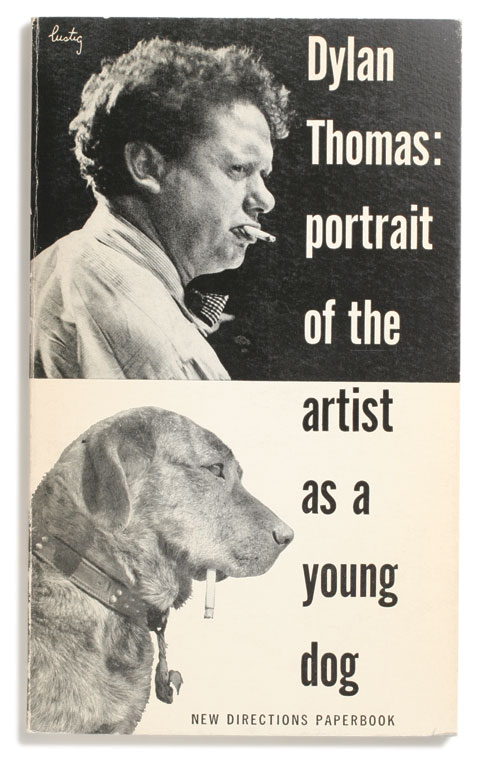
I have been working lately, so not reading—so no book reports. But this blog was whispering to me, "Isn't there something you want to say or share?" And then, in the work, I stumbled on a reference to one Alvin Lustig, well known in the mid–twentieth century for a series of book covers he created for New Directions' "New Classics" series (1941–52). They epitomize midcentury modernism. I thought I'd share a few here.

But first: what is midcentury modernism? To quote Creative Bloq, it is "a practical, clean-lined design movement spanning architecture, interior design, furniture, product and graphic design created during the middle of the 20th century. The exact dates are open to debate: some place mid-century modernism between 1933 and 1965, while others claim the time period was smaller—from 1947 to 1957." The design aesthetic is marked by "clean, sculptural lines, simple, organic shapes and neat proportions, as well as vibrant colour palettes—an evolution of earlier Modernist styles such as Bauhaus." See this page for 15 iconic examples of the style. You'll recognize them.

And here is "A Mid-Century Modern Primer for Graphic Designers," focusing on the qualities of color, shapes, typography, and use of space that practitioners of the style manipulated to arrive at their signature designs.

And now, here's Mr. Lustig (who curiously is not listed in the above "Primer" as a designer to study to learn more about the style). As the author of the book I'm working on puts it, "Lustig’s trademark, particularly on display in his book covers, was his ability to assess a large body of information and to distill it into a representation that was stark, simple, and arresting." See for yourself.