Friday, October 27, 2017

"Berryman" by W. S. Merwin


John Berryman (1914–1972)
I will tell you what he told me
in the years just after the war
as we then called
the second world war

don't lose your arrogance yet he said
you can do that when you're older
lose it too soon and you may
merely replace it with vanity

just one time he suggested
changing the usual order
of the same words in a line of verse
why point out a thing twice

he suggested I pray to the Muse
get down on my knees and pray
right there in the corner and he
said he meant it literally

it was in the days before the beard
and the drink but he was deep
in tides of his own through which he sailed
chin sideways and head tilted like a tacking sloop

he was far older than the dates allowed for
much older than I was he was in his thirties
he snapped down his nose with an accent
I think he had affected in England

as for publishing he advised me
to paper my wall with rejection slips
his lips and the bones of his long fingers trembled
with the vehemence of his views about poetry

he said the great presence
that permitted everything and transmuted it
in poetry was passion
passion was genius and he praised movement and invention

I had hardly begun to read
I asked how can you ever be sure
that what you write is really
any good at all and he said you can't

you can't you can never be sure
you die without knowing
whether anything you wrote was any good
if you have to be sure don't write

Hodgepodge 363/365 - Manzanar Gardens

In 1942, 110,000 Japanese and Japanese Americans were ordered to leave their homes on the West Coast and take up residence in ten internment camps scattered from California to Oklahoma, Arizona to Wyoming. Manzanar, east of the Sierra Nevada, ironically near the town of Independence, California, was home to over 10,000 people, mostly from Los Angeles, Stockton, and Bainbridge Island, Washington, between April 1942 and November 1945.

Ansel Adams
Life in the camp was hard, but the inmates did their best to make things more livable. They did this in part through sports—baseball (not just teams, but leagues, the sport was so popular), football, basketball, volleyball, martial arts, and there was even a nine-hole "golf course" built of oiled sand—as well as activities such as sewing, paper flower-making, calligraphy, puppetry, and painting and sketching.

A major focus of energy went to building and maintaining traditional Japanese gardens. It’s estimated that there were, at one point, more than one hundred gardens at this 814-acre site, constructed between the rows of barracks, outside the mess halls, along the firebreaks, and underneath the guard towers. These provided communal spaces—places for children to play and families to gather and relax.

Dorothea Lange: "William Katsuki, former professional
landscape gardener for large estates in
Southern California, demonstrates his skill and
ingenuity in creating from materials close at hand,
a desert garden alongside his home in the
barracks at this War Relocation Authority center"
According to the National Trust for Historic Preservation, "The most common gardens were small plots outside of the barracks apartments, typically near the entrances. The first such garden began on April 19, 1942, less than a month after the camp opened. It was the design of Southern California landscaper William Katsuki, who created the garden outside his barracks in Block 24. By October 1942, there were so many gardens throughout Manzanar that the Manzanar Free Press held a garden contest, which is believed to have spurred even more gardens."

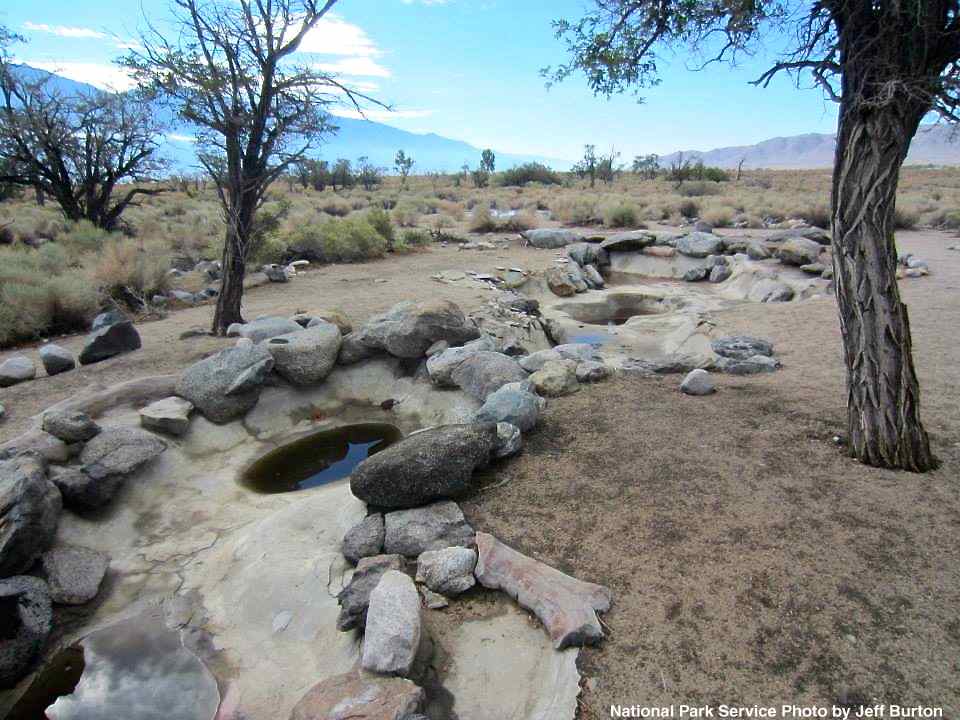
After Manzanar closed in 1945, most of the site was bulldozed. Debris, sand, and silt covered the ponds, and vegetation grew over everything. When the National Park Service conducted an archeological survey in 1993, only a few of the biggest gardens were still visible.

"Since then, Jeff Burton, an archaeologist at Manzanar National Historic Site, and his team have worked to uncover the gardens. Using newspaper accounts, oral histories, photographs, consultations with Japanese garden experts, and archaeological excavations, Burton and his crew—many of whom are volunteers—are finding and, in some cases, restoring or recreating the gardens. So far, 20 have been excavated, mapped, and stabilized."


Here are a few more before and after pictures. For more about the camp gardens, go here and here. For more about the restoration project, go here. (As always, click on the images to view large on black.)


Merritt Park, named for the camp director, Ralph Merritt
Ansel Adams: Merritt Park (1943)
Kitaro Uetsuzi: Merritt Park (1943)


Thursday, October 26, 2017

Hodgepodge 362/365 - Casework

I have been in Napa County the past four days, ostensibly to do Red Cross casework for the wildfires that raced through here two weeks ago: meeting with "clients" and taking down information in exchange for various reference materials and a small sum of money per person in the case, to help with their recovery.

The first day involved a brief training at Region 2 HQ in Fairfield, and then I drove the short distance to Napa, where I checked into the staff shelter at a church. When I saw the room that was lined with narrow green cots, about fifteen of them, I began to question my sanity. It's one thing to do casework at home—which I did a couple of years ago for the Soberanes Fire in my own county: but there, I got to go home at night. It's completely another to have to go to a communal shelter at the end of a day of work.

But I banished my doubts and headed into town to look around (i.e., do a little geocaching), and took myself out to dinner at the Black Bear Diner—a place I would not ordinarily patronize, but it was handy. The next day, we'd get down to work.

As it turned out, there were only four of us in the shelter that first night, all of us from Monterey/Santa Cruz Counties. I was somewhat relieved, though as it also turned out, I'd parked myself in the brightest spot in the room: right under a vigorously glowing green EXIT sign. I had grabbed one of the two sleeping pads that were piled in a corner with clean bedding, so the cot wasn't exactly uncomfortable, but I have trouble sleeping with other people because (shhhh) I'm always afraid I'll snore. So yeah, it wasn't the greatest night's sleep.

The next day I learned that we'd be joined by twelve more ERV (emergency response vehicle) drivers. Okay. Now I was not just questioning my sanity, but desperately seeking a way out.

Fortunately, my colleague Laurence has a friend (her sister-in-law's sister) who has a house in Napa, which she lets out, and it happened to be empty this week. Whew! Three of us very happily moved in there! Not only is it spacious, so each of us gets our own room, but it is also within walking distance of the service center. Did I say, whew!?

Our "service center"
That problem solved, it turned out there's very little work for us. Political problems between Napa County and the Red Cross, partly, had kept us from getting set up in a timely fashion, whereas the general LAC (local assistance center, with information on everything from FEMA grants, to replacing drivers licenses, passports, and birth certificates, to finding a reputable contractor, and much more) has already been in full swing for a week-plus. So we mostly waited on Tuesday, getting a total of three cases, thanks to a radio spot signaling our presence in the community. And yesterday: again, just three cases—though my new friend Joanne and I headed up to the LAC to table there, which at least made for a change of environment, though it wasn't very busy there either. I expect the big rush has come and gone.

Today, finally, we had some work—mainly going into launched casework to double-check that all i's are dotted and t's crossed, but at least it's something. I did get one new case today, a lovely older woman who came in with her grown daughter (who also got her own case). Everything lost, but they weren't daunted. I continue to be blown away by people's resilience.

We'll be here two more days. I imagine it'll be more of the same now—but as I said, at least we have something to do. There's nothing I like less than sitting around twiddling my thumbs. But I suppose we're managing to help people, even if it's at a few degrees of separation.

This experience is helping me revise my ambitions for working with the Red Cross—which I do want to continue to do: it's an important organization, doing important work. But that staff shelter? I can't imagine being happy staying in a place like that. I got lucky this time. So instead, I think I'll be sticking close to home as a Red Cross volunteer, responding to DAT (disaster action team) calls, doing local and virtual casework and follow-up. There's plenty to do, for anybody.

Romantically, I'd love to go to some hard-hit area—like, right now, Puerto Rico and the US Virgin Islands are mobilizing for evacuations. I wouldn't even mind a difficult work situation.  But sleep? I've got to get a good night's sleep . . .


Wednesday, October 25, 2017

Hodgepodge 361/365 - Poetry (Frank O'Hara)

Why I Am Not a Painter

Frank O'Hara (1926–1966)

I am not a painter, I am a poet.
Why? I think I would rather be
a painter, but I am not. Well,

for instance, Mike Goldberg
is starting a painting. I drop in.
“Sit down and have a drink” he
says. I drink; we drink. I look
up. “You have SARDINES in it.”
“Yes, it needed something there.”
“Oh.” I go and the days go by
and I drop in again. The painting
is going on, and I go, and the days
go by. I drop in. The painting is
finished. “Where’s SARDINES?”
All that’s left is just
letters, “It was too much,
Mike says.

But me? One day I am thinking of
a color: orange. I write a line
about orange. Pretty soon it is a
whole page of words, not lines.
Then another page. There should be
so much more, not of orange, of
words, of how terrible orange is
and life. Days go by. It is even in
prose, I am a real poet. My poem
is finished and I haven’t mentioned
orange yet. It’s twelve poems, I call
it ORANGES. And one day in a gallery
I see Mike’s painting, called SARDINES.


Today

Oh! kangaroos, sequins, chocolate sodas!
You really are beautiful! Pearls,
harmonicas, jujubes, aspirins! all
the stuff they’ve always talked about
still makes a poem a surprise!
These things are with us every day
even on beachheads and biers. They
do have meaning. They’re strong as rocks.

Tuesday, October 24, 2017

Hodgepodge 360/365 - 52 Places to Go

A friend sent me a link to a "job opportunity" with the New York Times: they're seeking a journalist to travel the world and hit every place on their annual 52 Places to Go list. Ha, I'd love to do that. I'm going to apply, though I don't expect I have a chance. Sure, I travel a lot. Sure, I actually have a year free. Sure, I write—every damn day. And doesn't it count that I love finishing to-do lists just like that? But I expect they'll be wanting someone younger, or more adventurous than me, or wackier . . . or something. But I'll give it my best shot. And then not hold my breath. That's the best way to be in life anyway.

Here's the first ten of this year's list, annotated:

1. Canada: I have been to BC (Vancouver and the area up by Whistler, for rock climbing; also the southern part of the province where they filmed The Grey Fox) and Alberta (Jasper-Banff), but I'd love to visit the Maritimes, and Quebec City and Montreal, and the flat plains of Saskatchewan. If I were to take this assignment and something as general as "Canada" were on the list, I might try to go up and see the polar bears in Churchill, or maybe go river rafting in the Yukon Territory. Or just living it up in Montreal! (I assume I'd get an expense account. Gourmet dining? Or . . . what about taking the train across Canada? That would cover at least one stretch of the whole place. Hmmm . . .

2. Atacama Desert, Chile: Chile—every part of it—is very high on my list of places to go, chiefly because it (at least the coastal area) is one of the five Mediterranean climate regions, and that and South Africa are the two I still need to hit to finish that very modest list of places to visit. But the Atacama: I love deserts, and that landscape looks unbelievably beautiful. I'd be especially interested in learning from a local naturalist about the life there. And sleeping under the stars.

3. Agra, India: I've been to India once—in the far north—and that visit piqued my interest to see more. The Taj Mahal is a no-brainer, but to explore the brand-new Mughal Museum, and simply wander the streets? That would be fun.

4. Zermatt, Switzerland: I've been there once, with a man who became my climbing partner for a good ten years. In Zermatt, we spent a lot of time looking at the Matterhorn (he had climbed it a couple of times) and talking about Edward Whymper's ascent. The visit to the little climbers' graveyard was fascinating.

5. Botswana: The NYT article mentions the Okavango Delta, which I have visited and loved, but I have to say that I was equally captivated (in a different way) by the Kalahari Desert, where we camped very near to where the Adamses of Born Free fame had their research camp. Oh, the birds! And driving all those dirt roads in our open jeep searching for . . . whatever happened to pop up!

6. Dubrovnik, Croatia: When I was a teenager, the Los Angeles Times Sunday magazine had a cover story on Dubrovnik. I cut out the cover picture and taped it to my wall—everywhere I lived for the next few college years. It was always my dream to go there—and yet I still never have. Since then, the town has been destroyed by civil war, and rebuilt exactly as it had been. But . . . is it exactly the same? That's what I'd be interested in investigating.

7. Grand Teton National Park, Wyoming: I've been there a couple of times. The last visit, we intended to climb the Grand, but weather worked against us. We did manage to climb Teewinot—not a very technical climb, but still: it was a good challenge, and oh the views!

8. Tijuana, Mexico: When I was a kid, I went to Tijuana—or really, more specifically, Rosarito Beach, nearby (which back then was a very sleepy little town)—with some frequency, on family long-weekends. If I were to go there now, I'd probably eat my way through town. I love Mexican food. And I would visit the border wall. I would definitely visit the border wall.

9. Detroit, Michigan: I've lived in Wisconsin and Illinois, but I've not actually been to Michigan. Now that Detroit has been named a UNESCO City of Design, it's pretty easy to say what I'd do if I were to visit: I'd find out what that means. Architecture? Arts? Anything else? It would be fun to find out. I'd also like to visit the River Rouge, the industrial landscape of which Michael Kenna did such a wonderful job documenting in black and white.

10. Hamburg, Germany: I've lived in Bavaria, visited the Rhine region, but I've never made it to Hamburg. Another haven for architecture and design: Zaha Hadid's promenade, the Elbphilharmonie. It's so stimulating to see cities remaking themselves. (I also still need to get to Berlin.)

This is fun!

Here's the rest of the list (items marked with a * are super high on my list of places to make sure I visit before . . . I can't; ones marked with a † I have visited):

11. Marrakesh, Morocco
12. Greenville, South Carolina
13. Pedregal, Ecuador
14. Penzance, England
†15. Osaka, Japan
†16. Stockholm, Sweden
17. Sikkim, India
18. Ile de Porquerolles, France
*19. Madagascar
20. Sanya, China
21. Cyprus
*22. Great Barrier Reef, Australia
†23. Minneapolis, Minnesota
†24. Kingston, Jamaica
*25. Comporta, Portugal
26. Kazakhstan
27. Gabon
*28. Athens, Greece
†29. Northwest Puerto Rico
30. Chiang Mai, Thailand
†31. Napa Valley, California (I happen to be there as I type)
32. Puerto Escondido, Mexico
†33. Sedona, Arizona
*34. Madrid
35. Ketchum, Idaho
*36. Maldives
37. Calabria, Italy
38. Antequera, Spain
†39. Lofoten Islands, Norway
40. Iberá Wetlands, Argentina
*41. Istria, Croatia
42. Placencia, Belize
43. Langtang Region, Nepal
44. Bozcaada, Turkey
45. Birmingham, Alabama
46. Sacred Valley, Peru
47. Laikipia, Kenya
48. Busan, South Korea
†49. Portland, Oregon
†50. Budapest, Hungary
51. South Bronx, New York
52. Ryukyu Islands, Japan


Monday, October 23, 2017

Hodgepodge 359/365 - Cartoon Physics (poetry)


Two poems by Nick Flynn:

Cartoon Physics, part 1

Children under, say, ten, shouldn't know
that the universe is ever-expanding,
inexorably pushing into the vacuum, galaxies

swallowed by galaxies, whole

solar systems collapsing, all of it
acted out in silence. At ten we are still learning

the rules of cartoon animation,

that if a man draws a door on a rock
only he can pass through it.
Anyone else who tries

will crash into the rock. Ten-year-olds
should stick with burning houses, car wrecks,
ships going down—earthbound, tangible

disasters, arenas

where they can be heroes. You can run
back into a burning house, sinking ships

have lifeboats, the trucks will come
with their ladders, if you jump

you will be saved. A child

places her hand on the roof of a schoolbus,
& drives across a city of sand. She knows

the exact spot it will skid, at which point
the bridge will give, who will swim to safety
& who will be pulled under by sharks. She will learn

that if a man runs off the edge of a cliff
he will not fall

until he notices his mistake.

Cartoon Physics, part 2

Years ago, alone in her room, my mother cut
    a hole in the air

& vanished into it. The report hung &
    deafened, followed closely by an over-

whelming silence, a ringing
    in the ears. Today I take a piece of chalk

& sketch a door in a wall. By the rules
    of cartoon physics only I

can open this door. I want her
    to come with me, like in a dream of being dead,

the mansion filled with cots,
    one for everyone I’ve ever known. This desire

can be a cage, a dream that spills
    into waking, until I wander this city

as a rose-strewn funeral. Once
    upon a time, let’s say, my mother stepped

inside herself & no one
    could follow. More than once

I traded on this, until it transmuted into a story,
    the transubstantiation of desire,

I’d recite it as if I’d never told anyone,
    & it felt that way,

because I’d try not to cry yet always
    would, & the listener

would always hold me. Upstairs the water
    channels off you, back

into the earth, or to the river, through pipes
    hidden deep in these walls. I told you the story

of first learning to write my own name, chalk
    scrawl across our garage door,

so that when my mother pulled it down I’d
    appear, like a movie.

Sunday, October 22, 2017

Hodgepodge 358/365 - Persimmons

I try not to repeat subjects in this blog (though on a couple of occasions I simply forgot that I'd already covered the subject!), but persimmons don't count. So here's something a little different from what I wrote almost a year ago, on day 3 of this incarnation of my 365-day blog, when I went to a friend's house to help her pick persimmons (hachiya) and prepare them for drying, on their way to becoming hoshigaki
(干し柿). Today I went back and did it again, only this time I missed out on the picking part, and there were four of us at work, so we made a quick business of peeling and hanging about 100 persimmons.


Here are a few photos I took:


Kim on the left, Daniella, and the persimmon
queen herself, Peggy: red bucket is for the skin
peelings, which will go to feed the local deer;
white bucket is for the calyx trimmings,
which go in the trash

And here are some showing the process in Japan, where they dry the fruits outdoors, and the final product:


I love persimmon time of year, since that is one of the very few truly seasonal fruits and vegetables there are any more, what with agriculturalists all over the globe filling in our seasonal gaps. Asparagus in November? No problem! 

I'll be looking for persimmons in the market the next few weeks, and probably getting back to baking. (This is the one time of the year I do that, for the same reason: I love persimmony baked goods, their chewy texture.)

Here's a recipe I'll try (with ice cream):

Persimmon Pudding

Prep, 20 min.; cook, 55 min. 

1/2 tsp baking soda
2 cups persimmon pulp
1 1/2 cups white sugar*
2 eggs, beaten
2 cups all-purpose flour
2 tsp baking powder
1/2 tsp ground cinnamon
1/4 tsp vanilla extract
1 pinch salt
2 1/2 cups milk
4 Tb melted butter

1. Preheat oven to 325 degrees F. Grease a 9x13-inch baking dish.
2. In a mising bowl, combine persimmon pulp, baking soda, sugar, and eggs. Mix well.
3. Add flour, baking powder, cinnamon, vanilla, salt, milk, and melted butter. Stir to combine.
4. Pour into baking pan and bake in preheated oven for 55 minutes.** The pudding will rise but will fall when removed from oven.

* Recipe calls for 2 1/2 cups sugar, but commenters say that's too much. I prefer less sweet, so I will try 1 1/2 cups—or maybe even only 1. One can also add more cinnamon and vanilla

** If you stir the pudding every 15 minutes while baking, you won't get a crusty top and it will be less cakelike, more like a true pudding.