Sunday, August 11, 2024

38 of 100: A day in the life

Instead of researching or quoting today, I'll just mention that we had a lovely afternoon, meeting our good friend Nina for coffee; making a quick run to Pet Food Express for, yes, pet food (those animals eat better than we do: venison and duck, I tell you—though we did bypass the grubs); and then heading up to Nina's to build a bookcase. That is, David built the bookcase, while Nina, Milo, and I went for a walk "up the mountain" (a gentle rise to a water tank). We finished the afternoon off with wine and appetizers—fried calamari and artichoke hearts—at the family-owned Fish Harvest restaurant, out in the sunshine, Milo snoozing under the table. 

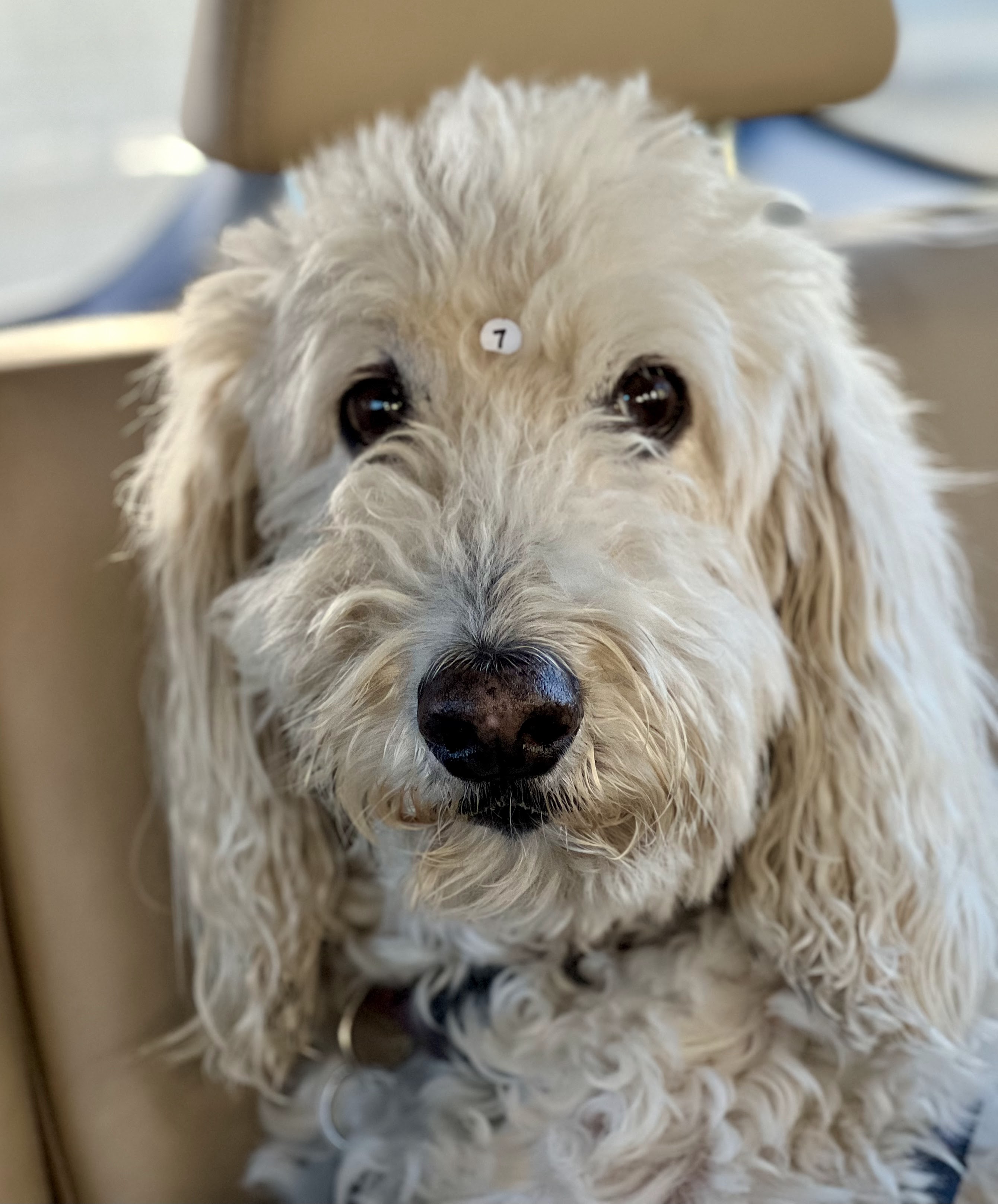
The shelving components were numbered 1–7, each part with an identifying sticker. I peeled one off and applied it to Milo's forehead, which he proudly wore (I called it his bindi dot). Well, okay, he didn't know he was wearing any kind of dot. But it attracted attention and smiles: all the people who saw him enjoyed his bindi dot. Here he is, my happy fellow: he makes everyone smile.


Saturday, August 10, 2024

37 of 100: Fibonacci

In the current "Flashback: Your Weekly History Quiz" in the New York Times, I had most of the events—Descartes; invention of the first automobile, and of Pilates; creation of X-Men; launch of the Hubble Space Telescope—situated correctly in time. But I missed placing the Italian mathematician Fibonacci (aka Leonardo of Pisa), by a long shot. I had no idea he lived ca. 1200! (1170–ca. 1240/50, to be rather inexact.) I've always thought of him as... somewhat modern? Well, at least Renaissance.

Maybe that's because he's a living presence in our household. My husband, David, is a mathematician, and a musician, and a geocacher. And Fibonacci inhabits all these personas. David's geocaching handle is FifiBonacci. He uses Fibonacci rhythms in his composing. Math: well, that's obvious. If we ever get another pet—an iguana, perhaps—we might just name it Fibonacci. Why not?

I did not know, until just now, that Fibonacci introduced the Hindu-Arabic number system, with ten digits including a zero and positional notation, to Western Europe in his Liber Abaci of 1202. This replaced Roman numerals, Egyptian multiplication, and an abacus, and no doubt assisted the growth of banking and accounting in Europe (and the spread of filthy capitalism, but don't get me started).

He also, in that same book, posited a problem involving the growth of a population of rabbits—which led to the Fibonacci sequence, in which each number is the sum of the previous two: 0, 1, 1, 2, 3, 5, 8, 13, 21, 34, 55... In his own calculations, Fibonacci only got to step 14: the value 233. But it, of course, goes on and on, infinitely.

And that in turn leads to the Golden Ratio, which... well, it's math. But it has real-world manifestation—in pine cones, sunflowers, spiral aloes, nautilus shells, and on and on. 

The Fibonacci Quarterly was established in 1963 to investigate this beautiful phenomenon more closely.

And then there are Fibonacci primes—because who doesn't love to get all wonky with prime numbers? As of September 2023, the largest known certain Fibonacci prime was F201107, with 42,029 digits. Those wacky mathematicians. How many pages would that number even fill?

Meanwhile, and perhaps more usefully, Fibonacci has a pizzeria in Columbus, Ohio, and another in Buenos Aires. Both of which I will definitely need to visit, next time I'm in the neighborhood.


Friday, August 9, 2024

36 of 100: A couple of poems about maps

I was delighted earlier this week, when Kamala Harris named her VP running mate, Minnesota governor Tim Walz, to learn that this former social studies teacher is a map nerd. Because maps are definitely in the top tier of things that interest me. And so, for a quick offering for today, here is a poem about maps—because poems are also in that top tier. I discovered it in an article in the Guardian from 2011, with excellent commentary. It's by Emily Hasler.

Cartography for Beginners

First of all, you will need to choose the correct blue
to indicate water. This should not be too watery.
You must remember: people do not like wet feet.
If there is no water to indicate, no matter,
you must still elect a blue. Let me recommend
eggshell, at a push, azure. Choose a symbol
for church/temple/mosque/synagogue. Choose
a symbol for pub. Dedicate your life
to the twin and warring gods of Precision
and Wild Abandon. People do not like
to be lost. Buy Mandelbrot's 1967 paper
on the coastline paradox, put it on the highest shelf—
but get a stepladder. Take a little licence with rivers,
especially their curves and estuaries. Add
an oxbow lake if at all possible. If the area you
are mapping has no seas/lakes/rivers/streams,
I have to question why you are bothering. You
won't get to use that lovely blue you spent so long
deciding upon. Do the Norfolk fens instead. Better
yet, East Anglia in its future state, quite utterly
submerged like a sodden Constable. Come on,
get your coat, I'll show you. You won't need your shoes.

And another one, heart-rending, by Yesenia Montilla:

Maps

    for Marcelo

Some maps have blue borders
like the blue of your name
or the tributary lacing of
veins running through your
father’s hands. & how the last
time I saw you, you held
me for so long I saw whole
lifetimes flooding by me
small tentacles reaching
for both our faces. I wish
maps would be without
borders & that we belonged
to no one & to everyone
at once, what a world that
would be. Or not a world
maybe we would call it
something more intrinsic
like forgiving or something
simplistic like river or dirt.
& if I were to see you
tomorrow & everyone you
came from had disappeared
I would weep with you & drown
out any black lines that this
earth allowed us to give it—
because what is a map but
a useless prison? We are all
so lost & no naming of blank
spaces can save us. & what
is a map but the delusion of
safety? The line drawn is always
in the sand & folds on itself
before we’re done making it.
& that line, there, south of
el rio, how it dares to cover
up the bodies, as though we
would forget who died there
& for what? As if we could
forget that if you spin a globe
& stop it with your finger
you’ll land it on top of someone
living, someone who was not
expecting to be crushed by thirst—

Finally, here's the Pantone Color of the Year 2020: I suppose that could be considered an excellent blue. But... is it right for seas/lakes/rivers/streams? 

Thursday, August 8, 2024

35 of 100: Women botanical artists

As I mentioned a while back, I am working on a book that unites botany and art. The chapter I'm currently tackling, titled "Colonial Roots and Symbolic Blooms," takes on the patriarchy (to some extent), in part by mentioning an array of female artists who elevated the inferior art genres of landscapes, and plant and animal studies, to respectability (conceptual depth, moral integrity, and ethical elevation having been hitherto ascribed only to art portraying grandiose human narratives).

In one paragraph, a good dozen of these women are singled out by name, and I thought I'd feature them, each with a painting or print that strikes my fancy. So here goes, listed in the random order they're cited in the book. Starting with an artist who is mentioned frequently, and whom I may well feature separately at some later time:

Maria Sibylle Merian (1647–1717), German entomologist, though she also focused on plants (as hosts): 

Spiders, ants, and hummingbird on a branch
of guava (the bird is at the lower left: lunch)

Maria Moninckx (1673–1657), Dutch:

Gasteria brachyphylla

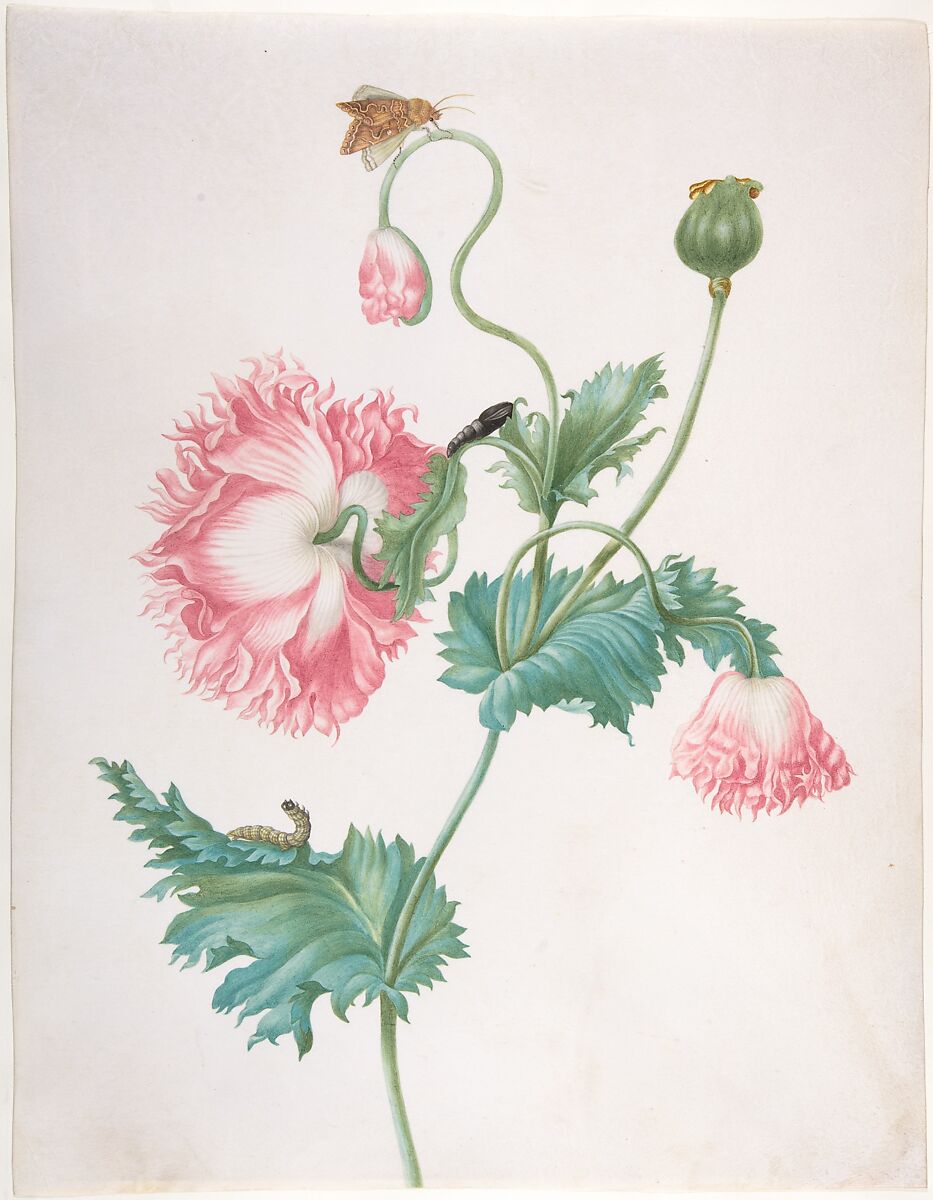
Johanna Helena Herolt (1668–1723), German (and a daughter of Maria Sybille Merian):

A poppy in three stages of flowering,
with a caterpillar, pupa, and butterfly

Helena Scott Forde (1832–1910), Australian (no, this is not a plant—but for something a little different...):

Black snake (Pseudechis porphyriacus)

Berthe Hoola van Nooten (1817–1892), Dutch (died in Java):

Custard-apple (Annona reticulata)

Barbara Regina Dietzsch (1706–1783), Bavarian:

Dandelion with butterflies and caterpillar

Lise Cloquet (1788–1860), French:

Wild cherry, sweet cherry, 1820

Rachel Ruysch (1664–1750), Dutch:

Roses, convolvulus, poppies, and other flowers
in an urn on a stone ledge, 1680s

Maria van Oosterwijck (1630–1693), Dutch:

Bouquet of flowers in a Rhine stoneware vase
on an entablature with an arrangement of shells

Frances Elizabeth Tripp (1832–1890), British bryologist:

British mosses

Augusta Innes Withers (1792–1877), British:

Oncidium incurvum orchid

Lydia Byam (1772–1854), British (who specialized in plants of the West Indies):

Rocou, aka annatto

And now, I'd better get back to proofreading . . .


Wednesday, August 7, 2024

34 of 100: August 7s past

My default cop-out when I've got nothing much to say: a trip down Flickr-memory lane. For today, just three photos, with original captions:

2011: I had my whole afternoon mapped out: a little work; moving
some boxes into the new storage space; picking up some supplies
from the Roost for my book arts class that starts tomorrow;
find a recipe for dinner and shop for ingredients; take Milo to
the dog park; cook. And then my phone yelped: a SAR call-out.
I've been trying hard to respond. And all those things I had
planned—well, the world wouldn't crash to a halt if they got
delayed. So... off I went, to search for a missing camper at a
state park down the coast. Bob and I got transported out to
the beach to start searching there. But of course, the main thing
I needed for today was a 2. And there were no 2s on the beach.
Except. Of course! I could just draw a 2! I didn't need to FIND
it in the landscape. I could make it! And so, I did. Here it is.

2009: Last night driving home a deer leapt into my path. I hit it
in the hindquarters, then pulled over and called 911. I have no
idea what happened to it. I do know it wasn't anywhere to be found
this morning. I had thought it didn't do any damage, but today I
noticed this new dent. Fortunately, it's not serious—just a reminder,
I guess, that things can happen in an instant. And that we were
lucky it didn't broadside me.

2007: Giving a sea lion what-for (that's him on the right,
just barely). He probably weighed 750 pounds—to her
4 or so—but he wisely decided not to mess with the
fierce momma and went around.

The caption for that number 2 ended with "Only one day left. And I know exactly what my 1 will be. Nothing—not even a call-out—will deter me." And so here it is:

Nuff said.

Maybe tomorrow I'll feel like doing some investigative/substantive blogging again. We'll see! But at least now I'm caught up.


Tuesday, August 6, 2024

33 of 100: Dragonflies

Dragonflies—and their relatives the damselflies—are beautiful. And amazing. Just look at these few:


Male red-veined darter (Sympetrum fonscolombii)

A mating pair of Chlorogomphus magnificus


Kirby's dropwing (Trithemis kirbyi)

And those are only a few species of some 3,000, in 348 genera, in 11 families—not to mention almost 3,000 more species (in 309 genera) of those relatives, the damselflies. (Though Nat Geo claims there are 7,000 species of dragonflies, so who really knows.) Order Odonata (from the Greek for tooth, maybe because their mouthparts are "toothed"); suborder Epiprocta (meaning unknown to me); infraorder Anisoptera (meaning unequal wings, their hindwings being broader than their forewings).

Their compound eyes contain some 24,000 ommatidia, or photo receptor cells:


these are damselfly eyes, but you get the picture

Dragonflies are predators, as adults catching their prey of other insects—mosquitos, midges, butterflies, small dragon- and damselflies—in mid-air using their long legs.

A dragonfly begins life in an aquatic nymphal stage, which lasts up to five years:

The adult, meanwhile—the creature we see flying around so enchantingly—lives for only up to ten weeks, more often five, and in some cases only a few days. Here is the anatomy of an adult dragonfly:

I have a (very small) collection of Japanese tea implements with dragonfly motifs, including this teapot:

There's much more to say about dragonflies—how their wings work, what they eat, their elaborate sex life, where they live (everywhere but Antarctica, of course)—but for today I think I'll just let the images do the work.

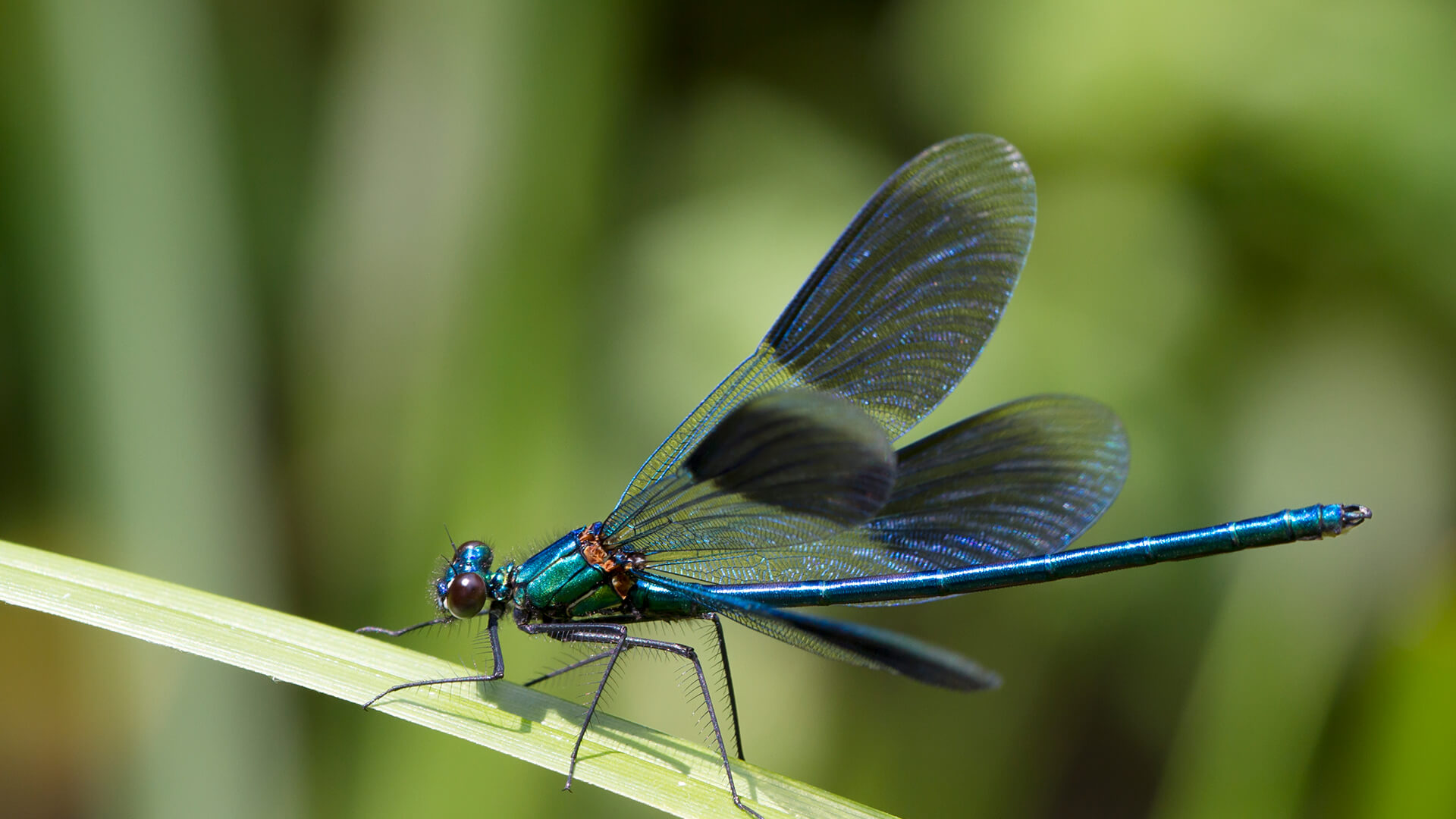
And here's a final one: a damselfly, male, the beautiful demoiselle (Calopteryx virgo):


Monday, August 5, 2024

32 of 100: Domoda (Gambian peanut stew, vegan)

A recipe today, because it was really good and I want to keep it around—and definitely make again. What else is this blog for? (I have adapted this recipe, and stolen the photo, from the website Rainbow Plant Life.)

Domoda

1 1/2 Tb coconut oil
1 large yellow onion, diced
6 garlic cloves, chopped
2 Tb freshly grated ginger
1–2 jalapeƱo peppers, diced (include the seeds for more heat)
2 Tb tomato paste
1 tsp ground cumin
1 tsp ground coriander
1/4 tsp cinnamon
1/4 tsp cloves
1 1/2 tsp kosher salt
Black pepper to taste
4 cups low sodium vegetable broth (or water)
1 small handful fresh thyme sprigs (or 1 tsp dried thyme; mix in with spice blend)
1 pound sweet potatoes, peeled and finely diced
1/2 cup creamy peanut butter (or chunky, if that's what you have)
1 15-oz can cannellini beans (or other white beans)
1 28-oz can crushed tomatoes
5 cups chopped kale
1 Tb freshly squeezed lemon (or lime) juice
1/2 cup cilantro leaves and tender stems, chopped

1. Heat oil in a Dutch oven over medium-high heat. Add onions with a pinch of salt and cook until onions are just starting to brown, about 5 minutes. Add the garlic, ginger, and jalapeƱos and cook for 2 minutes, stirring frequently.

2. Add the tomato paste and the spices: cumin, coriander, cinnamon, cloves, salt, and a generous amount of freshly ground black pepper (also the thyme, if using dried thyme). Stir for 2 minutes, to blend everything well. Can add a splash or two of water to prevent spices from drying out or burning.

3. Pour in the vegetable broth (or water) and stir, scraping up browned bits on pan bottom. Add the thyme sprigs (if using fresh), sweet potatoes, peanut butter, white beans, and crushed tomatoes and stir well to combine. Bring to a boil, then reduce heat to low/medium-low, maintaining a rapid simmer for 20 to 25 minutes, or until sweet potato is soft and tender, stirring occasionally. 

4. Add the chopped kale and simmer for 3 to 5 minutes, until wilted. 

5. Stir in the lemon or lime juice and the cilantro. Serve plain, or on your favorite grain (white or brown rice, millet, quinoa, or fonia).  

Note: For a thicker, creamier stew, after step 4 you can blend half the stew (an immersion blender works well), or just use a fork and smash the sweet potatoes in the pot. I kept my stew chunky (including chunky peanut butter), and it was delicious.