Saturday, May 9, 2020

Covid-19: World Central Kitchen

In 2010, in response to the Haiti earthquake, Spanish American celebrity chef and restaurateur José Andrés—he's got 19 enterprises, ranging from Michelin two-star signature restaurants to food trucks—launched World Central Kitchen, an NGO consortium bringing food to people touched (or should that be slammed) by disasters. Since then he has organized food distribution in the Dominican Republic, Nicaragua, Zambia, Peru, Cuba, Uganda, and Cambodia, as well as in the United States and Puerto Rico after Hurricanes Maria and Dorian.

That's when I first heard about him, with Puerto Rico. And today my friend Lynn mentioned all that he's doing now, during the Covid-19 crisis. So I went to the World Central Kitchen website, and found recent stories, giving updates on a new enterprise, #ChefsforAmerica:

(Yes, you can donate.)

Here is a short video featuring Danny Barber, who has been helping WCK distribute meals in the Bronx for over six weeks now. These are our local heroes!


"In California," the website states as of week 6, "we’re working with the United Farm Workers Foundation to provide meals to farmworkers in California’s Central Valley. Partnering with local restaurants in Delano, the site of a famous farmworkers’ strike, we set up a drive-through site for the community to pick up meals after a long day of work."

It is beautiful, and encouraging among all the other news, to read about the efforts being made to make sure that people in need find nourishment, now in more than 30 U.S. states and Spain, partnering with local restaurants. The caring and selflessness.

As of yesterday, 6,503,213 meals had been served during the past two months.


Here is José Andrés speaking with Guy Raz of "How I Built This," on April 23, about feeding people in a crisis (it kicks off at about 8 minutes, and just gets more passionate; he's a joy to listen to:


I am so happy to know that there are people like José Andrés, who care about people. It gives me hope.

~~~~~~~~~~~~~~~~~~~

Monterey County is up to 277 confirmed cases, which is 27 more than when I last posted, 10 more than yesterday; holding steady at 6 deaths. Only 3,952 people have been tested: 0.9 percent of the total population of the county (just over 434,000).

Be safe. Eat well. Exercise! Stay healthy.


Thursday, May 7, 2020

Book Report: Never Let Me Go

9. Kazuo Ishiguro, Never Let Me Go (2005) (5/7/2020)

The other day on Facebook, a writer acquaintance, Lidia Yuknavitch, commented: "oomph—just reread Never Let Me Go / Kazuo Ishiguro again (it's a slim volume/short read) . . . had a mega micro cry. Art draws my admittedly whack-fucked emotions out of me in the best and most gentle ways . . . gives me a place to PUT some of this disorder inside me. thank you, art. thank you, artists." I was drawn by the "oomph," by the idea of a "short read" (it wasn't, not for me anyway—but I am a slow reader), and by the idea of what "Art" can and does do. Plus, I knew exactly where on my shelves this book was.

And now I have finished. Perhaps I am writing this report too soon, because I expect it's a story that will keep sinking in. I found it a bit of a slog—very slow (which made it seem long), and in a way too conversational, if that's the right word: told in the first person, and all about memories. The story is set in "England, late 1990s," and the narrator, Kathy H., is a thirty-one-year-old "carer"—that is, for the past almost twelve years she has taken care of "donors." That much is stated on the first page. But what these categories—and a few others, like "possibles" and "completeds"—mean is revealed only gradually.

She spends the first part of the book, or over 100 pages, reminiscing about a school, Hailsham, that she attended—well, didn't just attend, but lived full time at, no parents ever in sight, just "guardians," or teachers. The second part, another 100 pages, concerns "the Cottages," where she and others seem basically to be waiting, biding time. We see no work in particular being done; their main task is to write an "essay," but even that seems meaningless. Plus, in this section there is a crucial visit to a coastal town in Norfolk (foreshadowed in part one as England's "Lost Corner"). And then there's part three, 80 pages, where everything comes together. Through all this, Kathy has two best friends, Ruth and Tommy, and most of the story concerns her ins and outs with them. This is where the conversational, meandering style comes in, as she loops back and forth, now having a particular story to tell, but first needing to fill us in on a prior, meaningful incident, then segueing into another bit of atmosphere, before getting to the point. There's a lot of hindsight in play as well, second-guessing what she or others might actually have felt or thought in the moment "back then."

Yes, it's clear from the start that things are off, and many of the incidents she relates—especially those concerning a certain "Miss Lucy"—add up to a feeling of gothic foreboding. There is a "Gallery" curated by a mysterious "Madame," who shows up at intervals to collect drawings or poems or other creative works that seemingly capture the "insides"—the souls—of these children. There are rivalries and alliances, misunderstandings and real love. I guess it's an emotional book, but there's also a certain distance to it, a lack of questioning of things as they are, an acceptance of mystery, or is it darkness.

In that sense, it feels like an object lesson, a warning not to stand back and simply observe what's going on (right now, right here) without questioning why and whether it must be that way. As another teacher, Miss Emily, says near the end,  speaking of Hailsham, which in the intervening dozen or so years has gone to ruin:
"I can see that it might look as though you were simply pawns in a game. It can certainly be looked at like that. But think of it. You were lucky pawns. There was a certain climate and now it's gone. You have to accept that sometimes that's how things happen in this world. People's opinions, their feelings, they go one way, then the other. It just so happens you grew up at a certain point in this process."
 "It might be just some trend that came and went," I said. "But for us, it's our life."
 "Yes, that's true. But think of it. You were better off than many who came before you. And who knows what those who come after you will have to face."
In a way, Ishiguro (who, by the way, won the Nobel Prize) really seems to be writing about a lot in life—fate, the inescapable. But surely there's something more than that? Or were the Greeks right?

The book also, it turns out, imagines a world in which science and medicine had a radically different turn following WWII, and (perhaps) invites us to consider the ethical implications.

As I said, I may need to digest this book further. But yes, I'm glad I finally read it. Now for something a little less speculative.

~~~~~~~~~~~~~~~~~~

Today's count for the virus in Monterey County, 250, up 3; deaths holding steady at 6. I hadn't been looking at the geographic breakdowns, but today noticed that 13 percent of total cases (so, 30 cases altogether) are on the Monterey Peninsula and down through Big Sur;  the Salinas area accounts for 65 percent of cases (163). Latinos account for 70 percent of cases. And the age group most affected, with 30 percent of cases, is 24–34; 24–54 accounts for 66 percent of cases.

Stay inside. Read a good book. Stay well.


Wednesday, May 6, 2020

Covid-19: Banksy

Graffiti artist Banksy was in the news today, with his second creation (at least, publicly presented) during this pandemic. So let's start with the first one, which he posted on Instagram on April 21. He captioned it, "My wife hates it when I work from home." I bet she does!


Today's is more uplifting. It is called Game Changer and celebrates superhero health workers. The meter-square piece is on display at Southampton General Hospital. Banksy included a note: "Thanks for all you’re doing. I hope this brightens the place up a bit, even if it’s only black and white." Come September, it will be auctioned off to benefit the NHS (National Health Service.)


According to the Guardian, Paula Head, the chief executive of University Hospital Southampton NHS foundation trust, said: "Our hospital family has been directly impacted with the tragic loss of much-loved and respected members of staff and friends. The fact that Banksy has chosen us to recognise the outstanding contribution everyone in and with the NHS is making, in unprecedented times, is a huge honour. It will be really valued by everyone in the hospital as people get a moment in their busy lives to pause, reflect and appreciate this piece of art. It will no doubt also be a massive boost to morale for everyone who works and is cared for at our hospital."

 Good people doing good things: it lifts the heart and boosts the soul.

~~~~~~~~~~~~~~~~~~~~~~

Today, Monterey County added 6 to the count of infections, bringing it to 247; deaths remain at 6.

Stay healthy. Consider who the true superheroes are. Celebrate them.


Tuesday, May 5, 2020

Covid-19: The Irish and Native Americans

First, a poem, by Irish poet and Stanford University professor Eavan Boland, who died of a stroke while in quarantine in Ireland on April 27. It is about the Irish potato famine of 1847.

Quarantine

In the worst hour of the worst season
 of the worst year of a whole people
a man set out from the workhouse with his wife.
He was walking—they were both walking—north.

She was sick with famine fever and could not keep up.
 He lifted her and put her on his back.
He walked like that west and west and north.
Until at nightfall under freezing stars they arrived.

In the morning they were both found dead.
 Of cold. Of hunger. Of the toxins of a whole history.
But her feet were held against his breastbone.
The last heat of his flesh was his last gift to her.

Let no love poem ever come to this threshold.
 There is no place here for the inexact
praise of the easy graces and sensuality of the body.
There is only time for this merciless inventory:

Their death together in the winter of 1847.
 Also what they suffered. How they lived.
And what there is between a man and woman.
And in which darkness it can best be proved.

Kindred Spirits (Choctaw Monument)
in Midleton, Ireland
The reason I am bringing up the Irish famine is this: In 1847, not so very long after their 1831–33 uprooting on the Trail of Tears, the Choctaw Nation sent $170 to Ireland (that would be almost $5,500 today) to help starving families during the potato famine. Since then, the two nations have continued to build ties. And recently, that relationship has been tapped into again (in an extended fashion) via a GoFundMe drive called "Navajo & Hopi Families COVID-19 Relief Fund," where as of today $2,319,730 has been raised, with Irish people responsible for hundreds of thousands of dollars in donations—in solidarity and in thanks for that help long ago. The money is being used to supply clean water, food, and health supplies to Native people in need.

Native Americans are being particularly hard hit by the coronavirus. "Navajo Nation,"AlJazeera reports, "had at least 2,530 confirmed coronavirus cases and 73 known deaths as of Tuesday [today], according to the Navajo Epidemiology Center. The Navajo Nation has the third-highest infection rate per capita of any region of the US."

This virus goes after the most vulnerable, that we know. It made my heart glad to see this story of longtime connection, trust, and support. Reading the notes on the GoFundMe website by all the Irish donors—like this, posted by Liam Ó Riain: "From the Choctaw Nation to the Irish Nation paid forward to the Navajo Nation. Kindred spirits across the sea. Tiocfaidh bhur lá [Your day will come]"—brings tears to my eyes. I am so glad to know that some people do care.

I know: a lot of people care. Probably most do. It's too easy to be sidetracked by the selfish fools.

~~~~~~~~~~~~~~~~~~

Monterey's numbers are up 4, to 241; deaths still at 6. (And were you paying attention to the numbers up there? Confirmed cases in Navajo Nation, 2,530; deaths, 73—in a population of some 350,000. Monterey County's population is 430,000. Think about it.)

Stay inside. Find some people who could use your help, and then help them. Stay healthy.

P.S. As I was about to toddle off to bed, I decided to follow my own advice and give to the Navajo & Hopi Families COVID-19 Relief Fund. It now stands at $2,409,720. Almost $90,000 in just a few hours. Yay generosity! (It no doubt helps that this story was also generously covered in the media. Which: good. It should be. It's a lovely story.)


Monday, May 4, 2020

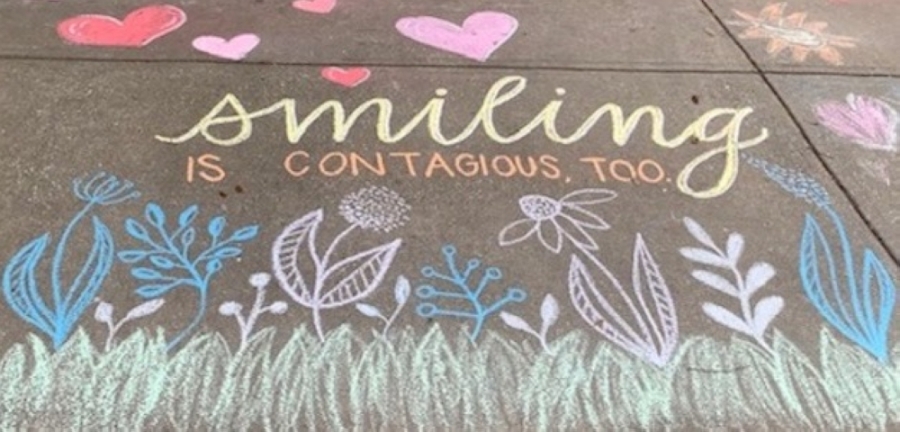
Covid-19: Chalk art

The other day, a friend posted a picture and appreciation on NextDoor of some street art that appeared in the wee hours of the morning, in celebration of her daughter's fifteenth birthday:


Today, our little city's administrators posted another such tribute that they discovered when they needed to access City Hall:


Someone sure is having fun with chalk during this time of Covid-19. And good for them! It brightens spirits and the world.

I thought I'd google the subject #Covid-19#chalkart, and oh my! There are so many people having similar fun. Here are a few examples:

By Orlando artist Casey Drake


Also by Casey Drake


By 18-year-old Zoe Stradesky of Regina, Saskatchewan

Today's count for Monterey County: up only 2 to 237; deaths remain steady at 6.

Be safe. Have fun--maybe take up art! Stay healthy.


Sunday, May 3, 2020

Covid-19: A walk in the park


Our regular easy short walk with the dog is to a nearby wetland preserve called the Frog Pond. Yes, there are frogs—Pacific tree frogs—and right about now is when they're really making a racket, but mainly at night. The route there involves a walk down a park service road—or, the nicer parallel trail underneath redwoods. They are literally twenty feet apart, but one is just a gravel road, baseball field and dog park off to the left, while the other truly does feel like a walk in the woods.

The other day David said, "Let’s just stick to the road on the way there, and take the trail back—for a change. There's a surprise I want to show you." On the Frog Pond loop, I quizzed him: 30 Questions—is it a mushroom? no; is it something natural? no; is it manmade? yes; is it colorful? yes; does it involve words? yes; is it a sign? He swung around and pointed with one hand at his nose, the other at me. There may have been one or two other questions in there—like, will I like it? I think so—but now I was excited. A new sign! Maybe put up by the city? I just hoped it wasn't another officious rule. 

When we got to the trail, I didn't see anything immediately. After a short ways, David said, "Psssst. Look around you." I did, and there, nestled in the greenery, was a framed photo surmounted by words: NEIGHBOR IT IS SO GOOD TO SEE YOU. What? How wonderful! Not an officious rule at all—indeed, just the opposite. "Are there more?" I asked. "Affirmative."

The rest of the walk became a treasure hunt as I searched for the secret messages. As a friend put it, "Each sign conveyed a level of intimacy, but in an appropriate way." Here is a collage I made of the walk (click to see it larger on black):


And because it's not easy to see what the signs say, here—but in reverse order from the above, because it makes (perhaps) better sense:

Sweet friend I have missed you
We are alone in this together
Soon we will embrace again
It will be a glorious reunion
The sky will be clearer
The plants will be bigger
Just look at this place
Neighbor it is so good to see you

Seriously, it made my heart sing. Neighbors, strangers, friends, going out of their way—and a lot of effort went into this—to reach out and connect, even while sheltering in place.

~~~~~~~~~~~~~~~~~~~

Monterey County cases are up to 235 today; deaths remain at 6.

Stay connected. We are alone in this together. And therein lies our continued health and strength.


Saturday, May 2, 2020

Covid-19: Outdoor activities

I'm back! Okay, I'm still planning on migrating to Wordpress, but it intimidates me. So I'll take my chances here again with this one.... It's just a simple musing on today, and this whole thing.

On our afternoon walk, up behind the industrial park—first, the meander on pine duff through the forest, then the straight, hard sandstone path up to the ridge—we ran into a fellow practicing his archery. We saw him up ahead, standing there, and called Milo back. He yelled that he was just packing up. I thought I saw a longbow in his hands—which I suppose could have given me pause, but it didn’t. There was also a rectangle of cardboard propped up in the trail, which my mind quickly translated to “target.” As we approached he explained that with the archery ranges all closed, he’s been having a hard time finding a place to exercise his sport—but he soon realized that that particular spot probably wasn’t the best: narrow trail, poor sightlines in case anyone was coming. He said the other day he’d driven an hour and a half out Carmel Valley to find a place, and still hadn’t come up with anything good. We suggested the now-closed Frisbee golf course, which is right across the fenceline from where he was, and he said he’d thought of that, but someone was weed-whacking there today. I pointed out that that’ll be all the weed-whacking it’ll see for weeks now, so the place could be all his. He seemed to like that idea.

The interaction made me think about how we are used to using space, and how, with this shutdown, the rules (such as they are) have changed. Of course, not having access to archery ranges is a big deal, if you’re an archer. Where else can you go and shoot pointy projectiles at great velocity? But more than that, there is a feeling of watchfulness—and of being watched—now. Of doing things “correctly.” The question of masks. (None of us moved to put a mask on as we stood and chatted, but I can imagine that in another situation we all would have—following leads.) Not petting other people’s animals. Keeping one’s distance.

I’ve always felt invisible, which gives me a certain amount of freedom in the world (or so I think). Who would care what I’m doing in my space, if I’m not bothering anybody? Who’s going to notice? Well, now everybody notices. You see people pulling their masks out of their pockets when you’re hundreds of feet apart. I do too. I may be invisible, but I’m playing by the rules. Mostly.

California Governor Newsom’s office published a list the other day of all the activities that it’s okay to do now, during shelter-in-place. “We want you to see sunsets,” he said. “We want you to enjoy activities outdoors. What we don’t want is people congregating outside in large groups.” The list is extensive—those interns must have had a rollicking good brainstorming session:

-- Athletics

-- Badminton (singles)

-- Throwing a baseball or softball

-- BMX biking

-- Canoeing (singles)

-- Crabbing

-- Cycling

-- Exploring rock pools

-- Gardening (not in groups)

-- Golf (singles, walking – no cart)

-- Hiking (on trails and paths allowing distancing)

-- Horseback riding (singles)

-- Jogging and running

-- Kite boarding and kitesurfing

-- Meditation

-- Outdoor photography

-- Picnics (with your stay-home household members only)

-- Quad Biking

-- Rock Climbing

-- Roller Skating and Roller Blading

-- Rowing (singles)

-- Scootering (not in groups)

-- Skateboarding (not in groups)

-- Soft martial arts – Tai Chi, Chi Kung (not in groups)

-- Table tennis (singles)

-- Throw and catch an American mini football, Frisbee, or Frisbee golf (not in groups)

-- Trail running

-- Trampolining

-- Tree climbing

-- Volleyball (singles)

-- Walk the dog

-- Wash the car

-- Watch the sunrise or sunset

-- Yoga

But hey! Where’s archery on this list? (And how did “Wash the car” get in there?) No, but seriously, the reason I mention this is—partly—as a record of “these times of Covid-19,” but also to comment on a comment that a friend made on FB, to wit: “I appreciate the state trying to be thorough and specific, but . . . saying the government ‘allows’ meditation, photography, and watching sunsets has an unpleasant totalitarian tinge to it.” To which I responded, “Oh, I don’t see it that way. It’s just a list for people who don’t know what-all they CAN do. I do agree that those particular activities are a little surprising. . . . Then again, a professional photographer I know has been conducting a hearty discussion on whether it’s okay for him to drive places to do his photography—so perhaps this list will give him some relief on that count.”

Morning Light, Yosemite, by Don Smith
This photographer’s discussion (his name is Don Smith) had people splitting pretty much down the middle: NO, you shouldn’t drive places to photograph because what if everyone decided to follow your lead; and YES, go ahead: you’re by yourself, no danger of infecting anyone, and you’re feeding your soul. Everybody’s got an opinion. And is there one right answer? I don’t think so. But then, I am a relativist in so many things: it depends. Like with Don’s question: I’m definitely in the YES camp, especially for him—he’s a landscape photographer. Maybe I would be in a “cautiously yes” camp if he were an urban photojournalist, assuming he deployed proper physical distancing. Then again, why does my opinion matter? Why does the opinion of anyone matter right now except the people who are calling the shots—the experts and the policymakers? And those of us making our own decisions about how to be in the world. Our opinions matter too—for us. With gentle "call-outs," perhaps, from those around us who aren't in agreement. Their opinions matter too. But strangers' opinions? There, again, is a good reason to quit social media. If only I could.

Garland Ranch Regional Park,
one of my favorite places for a hike
Back to the here and now, though: I’ve been interested to see how many people are out at the few parks that are still open—mostly behaving respectfully, now carrying a mask to slip on when another person is in sight, maintaining six feet of distance. Of course, so many people, used to going to a job, out to dinner or for a drink, are probably climbing the walls at home, and need an outlet. It has changed the formerly fairly solitary nature of my regular walks in regional parklands. Not that I object—why would I? how could I? It’s just interesting.

I don’t have any single point in all this. Just that, Covid-19 is still here, and it’s still got us locked down. People’s responses are all over the map, from polite, patient resignation (that would be me) to adamant insistence that people follow the rules to open resistance on statehouse steps. Maybe that’s not so different from usual, except that we’ve all got a single focus now: the virus, and when things will go back to “normal.”

~~~~~~~~~~~~~~~~~~~~~~~~~

Monterey County confirmed cases: 226; and there's been a sixth death.

Stay inside. Go outside too, but use proper physical distancing. Stay well.